ART WARS
for St. Peter's Day
Compare and contrast:
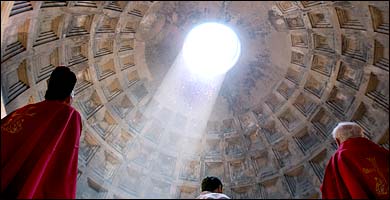
Pigi Cipelli for The New York Times
 |
|
When?
Going to dark bed there was a square round Sinbad the Sailor roc's Where?
-- Ulysses, conclusion of Ch. 17 |
A Visual Meditation for
the Feast of St. Peter

For further details on this structure, see
Magic Squares, Finite Planes,
and Points of Inflection
on Elliptic Curves,
by Ezra Brown, and
Visualizing GL(2, p)
by Steven H. Cullinane.
For a more literary approach
to this structure, see
Balanchine's Birthday (Jan. 9, 2003),
Art Theory for Yom Kippur (Oct. 5, 2003),
A Form (May 22, 2004),
Ineluctable (May 27, 2004),
A Form, continued (June 5, 2004),
Parallelisms (June 6, 2004),
Deep Game (June 26, 2004), and
Gameplayers of Zen (June 27, 2004).

To appreciate fully this last entry
on Gameplayers,
one must understand
the concept of "suicide"
in the game of Go
and be reminded
by the fatuous phrase of the
Institute of Contemporary Art
quoted in Gameplayers --
"encompassed by 'nothing' " --
of John 1:5.

"The void, the ineffable, the sublime,
nonsense, nihilism, zero—
all are encompassed by
-- Institute of Contemporary Art,
Philadelphia
"The Zen disciple sits for long hours silent and motionless, with
his eyes closed. Presently he enters a state of impassivity, free
from all ideas and all thoughts. He departs from the self and
enters the realm of nothingness. This is not the nothingness or
the emptiness of the West. It is rather the reverse, a universe
of the spirit in which everything communicates freely with
everything, transcending bounds, limitless."
--
Yasunari Kawabata, Nobel lecture, 1968


Herman Goldstine (left), shown in 1952
at the Institute for Advanced Study
with J. Robert Oppenheimer (center)
and John von Neumann (right).
Click on the picture above
for an obituary in today's New York Times
of Goldstine, who died on June 16, 2004.
Click on the picture below
for an event appropriate to
the date of Goldstine's death. 
The entry Ado of June 25, 2004 contains a link to an earlier entry, A Form, continued, of June 5, 2004. This in turn contains a link to a site by Wolfgang Wildgen which contains the following:
"Historically, we may say that the consequence of Bruno's parallel work on cosmology and artificial memory is a new model of semantic fields which was so radical in its time that the first modern followers (although ignorant of this tradition) are the Von-Neumann automata and the neural net systems of the 1980s (cf. Wildgen 1998 : 39, 237f)."
Wildgen, W. 1998. Das kosmische Gedächtnis. Kosmologie, Semiotik und Gedächtniskunst im Werke von Giordano Bruno. Frankfurt/Bern: Lang.
Gedächtniskunst:

Figure A
Neighborhood in a
Cellular Automaton
by Adam Campbell
For more of the Gedächtnis
in this Kunst, see the following
Google search on shc759:

Figure B
Note that the reference to "forerunners" in fig. B occurs in a journal entry of June 12, 2002. See also the reference to a journal entry of the following day, June 13, 2002, in last Tuesday's Dirty Trick.
Those who have viewed Campbell's applet (see fig. A) may appreciate the following observation of poet and Dante translator Robert Pinsky:
-- Poetry, Computers, and Dante's Inferno
For some related remarks
on the muses and epic poetry,
see a paper on Walter Benjamin:
"Here the memory (Gedächtnis) means
'the epic faculty par excellence.' "
(Benjamin, Der Erzähler, 1936: in
Gesammelte Schriften, 1991, II.2, 453)

Click on above picture
for some background.

Related material:
A Form (May 22, 2004),
A Form, continued (June 5, 2004),
Balanchine's Birthday (Jan. 9, 2003),
Pictures of Nothing (Aug. 23, 2003)
Dirty Trick
Some quotations in memory of philosopher Stuart Hampshire, who died on June 13, 2004.
From the Hampshire obituary in The Guardian:
|
I He frequently told the "If But what the whole anecdote, and its incessant retelling, revealed was that II It is hard to know how |
From a log24 entry on the day before Hampshire's death:
|
I "Hemingway called it a dirty -- Jack Kerouac in Desolation Angels II The New Yorker of June 14 & 21, 2004: ...in 'The Devil's Eye,' Bergman's little-known comedy of 1960. 'First, I'll finish off that half-dug vegetable patch |
Whether Hampshire is now in Hell, the reader may surmise. Some evidence in Hampshire's favor:
His review of On
Beauty and Being Just, by Elaine Scarry, in The New York Review of
Books of November 18, 1999. Note particularly his remarks on Fred
Astaire, and the links to Astaire and the Four Last Things in an earlier entry of June 12, which was, as noted above, the day before Hampshire's death.
As for the day of death itself, consider the following
remark with which Hampshire concludes his review of
Scarry's book:
"But one must occasionally fly the flag, and the flag, incorrigibly, is beauty."
In this connection, see the entry of the Sunday Hampshire died, Spider Web, as well as entries on the harrowing of hell -- Holy Saturday,
Ishtar Wannabe
Reuters, Los Angeles,
June 17, 2004 09:09 PM ET--
Madonna Louise Veronica Ciccone has adopted the Hebrew name Esther.
I personally feel that a more deserving candidate for such a flattering name change would be Piper Laurie (nee Rosetta Jacobs).
See an entry of Dec. 30, 2002, on Miss Laurie:
|
From Robert A. Heinlein's Glory Road: Her face turned thoughtful. "Would you like to call me 'Ettarre'?" "Is that one of your names?" "It is " 'Aster,' " I repeated. "Star. Lucky Star!" |

Kierkegaard on death:
"I have thought too much about death not to know that he cannot
speak earnestly about death who does not know how to employ (for
awakening, please note) the subtlety and all the profound waggery which
lies in death. Death is not earnest in the same way the eternal
is. To the earnestness of death belongs precisely that capacity
for awakening, that resonance of a profound mockery which, detached
from the thought of the eternal, is an empty and often brash jest, but
together with the thought of the eternal is just what it should be,
utterly different from the insipid solemness which least of all
captures and holds a thought with tension like that of death."
-- Works of Love,
Harper Torchbooks, 1964, p. 324
For more on "the thought of the eternal," see the discussion of the number 373 in Directions Out and Outside the World, both of 4/26/04.
"... as an inscription over the graveyard gate one could place 'No compulsion here' or 'With us there is no compulsion.' "
-- Works of Love,
Harper Torchbooks, 1964, p. 324
"In the summer of 1943 I was eight, and my father and mother and
small brother and I were in Peterson Field in Colorado Springs. A
hot wind blew through that summer.... There was not much to do....
There was an Officers' Club, but no swimming pool; all the Officers'
Club had of interest was artificial blue rain behind the bar. The
rain interested me a good deal, but I could not spend the summer
watching it, and so we went, my brother and I, to the movies.
We
went three and four afternoons a week, sat on folding chairs in the
darkened Quonset hut which served as a theater, and it was there, that
summer of 1943 while the hot wind blew outside, that I first saw John
Wayne. Saw the walk, heard the voice. Heard him tell a girl in a
picture called War of the Wildcats
that he would build her a house, 'at the bend in the river where the
cottonwoods grow.' As it happened I did not grow up to be the
kind of woman who is the heroine in a Western, and although the men I
have known have had many virtues and have taken me to live in many
places I have come to love, they have never been John Wayne, and they
have never taken me to that bend in the river where the cottonwoods
grow. Deep in that part of my heart where the artificial rain
forever falls, that is still the line I wait to hear.
... When John Wayne spoke, there was no mistaking his intentions; he
had a sexual authority so strong that even a child could perceive
it. And in a world we understood early to be characterized by
venality and doubt and paralyzing ambiguities, he suggested another
world, one which may or may not have existed ever but in any case
existed no more: a place where a man could move free. could make his
own code and live by it; a world in which, if a man did what he had to
do, he could one day take the girl and go riding through the draw and
find himself home free, not in a hospital with something wrong inside,
not in a high bed with the flowers and the drugs and the forced
smiles, but there at the bend in the bright river, the
cottonwoods shimmering in the early morning sun."
-- Joan Didion,
"John Wayne: A Love Song," 1965
"He is home now. He is free."
-- Ron Reagan, Friday, June 11, 2004
"Beware, therefore, of the dead! Beware of his kindness;
beware of his definiteness, beware of his strength; beware of his
pride! But if you love him, then remember him lovingly, and learn
from him, precisely as one who is dead, learn the kindness in thought,
the definiteness in expression, the strength in unchangeableness, the
pride in life which you would not be able to learn as well from any
human being, even the most highly gifted."
-- Works of Love,
Harper Torchbooks, 1964, p. 328


Recent Comments