
Thanks to JadedFey
for pointing out this
Ray Charles connection.
Don Giovanni, Part II
(See entries of June 8, 2004,
and June 4, 2004.)
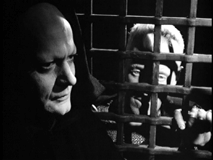
Ingmar Bergman long ago
"earned the nickname of
the 'demon director,'
such are the demands that
he makes on his performers."
-- Anthony Lane in
The New Yorker,
June 14 & 21, 2004

AFP/GETTY IMAGES
on the set in
the late 1940's
From the entry of
June 4 last year:
Commentary by Jack Kerouac,
from an entry of May 21, 2004:
"So what do we all do in this life which comes on so
much like an empty voidness yet warns us that we will die in pain,
decay, old age,
trick. It might even be an ancient Ordeal laid down on us by an evil
Inquisitor in Space, like the ordeal of the sieve and scissors, or even
the water ordeal where they dump you in the water with toes tied to
thumbs, O
"... listen to the
words of Pablo, the servant of Don Juan, who is summoned from the
underworld in 'The Devil's Eye,' Bergman's little-known comedy of 1960.
Pablo seduces the wife of a minister, and then, sorrowful and sated,
falling to his knees, he addresses her thus:
'First, I'll finish off that half-dug vegetable patch
I saw. Then I'll sit and let the rain fall on me. I shall feel
wonderfully cool. And I'll breakfast on one of those sour apples down
by the gate. After that, I shall go back to Hell.' "

"Who's got the last laugh now?"
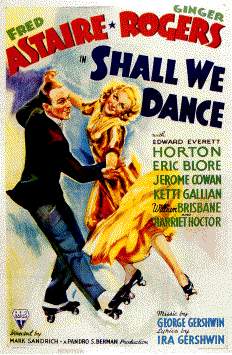
-- "They All Laughed,"
words by Ira Gershwin,
music by George Gershwin,
from the 1937 film Shall We Dance
(sung by Ginger Rogers,
then danced by
Fred Astaire and Ginger Rogers)
See also
the entry of June 4 last year,
The Four Last Things.

Critics in Mozart’s age
threw up their hands
at the dark Don Giovanni,
calling it perverse, amoral.
These days, such qualities
turn us on... more»

Paul Klee,
The Bavarian Don Giovanni,
1919, watercolor and ink
on paper
There's a little black spot
on the sun today....
(See Feel Lucky?, June 4)
Anomaly
|
Robert Quine, 61, By BEN SISARIO Robert He In the loud world of New York punk, "He was an extraordinary Mr. His uncle, the philosopher W. V. Quine, died in 2000. |
| "Anomalies must be expected along the conceptual frontier between the temporal and the eternal." -- The Death of Adam, by Marilynne Robinson, Houghton Mifflin, 1998, essay on Marguerite de Navarre
"D'exterieur en l'interieur entre |
"He was trained by the British MI6
intelligence agency for an operation
known as X2 - or 'double cross.' "
|
From Fritz Leiber's
"Damnation Morning," 1959:
Bordered version The sigil was an eight-limbed asterisk made of fine dark ... "Here is how it stacks up: You've bought your way "It's a very big organization," she went on, as if warning "I. G. Farben?" I asked grabbing nervously and clumsily at She didn't rebuke my flippancy, but said, "And it isn't the "Which is?" I asked. "The Spiders," she said. That word gave me the shudders, coming so suddenly. I She watched me. "You might call it the Double Cross," |
|
From
The Man in the High Castle by Philip K. Dick Juliana said, "Oracle, why did you write The Grasshopper Lies Heavy? What are we supposed to learn?" "You have a disconcertingly superstitious way of phrasing your She began throwing the coins; she felt calm and very much herself. "Sun at the top. Tui at the bottom. Empty in the center."
"Do you know what hexagram that is?" she said. "Without using the chart?" "Yes," Hawthorne said. "It's Chung Fu," Juliana said. "Inner Truth. I know without using the chart, too. And I know what it means." From 12:5 ... and the almond tree shall flourish, and the grasshopper shall be a
burden, and desire shall fail: because man goeth to his long home, and the mourners go about the streets |
From a review of On the Composition of Images, Signs
& Ideas, by Giordano Bruno:
|
Proteus in the House of Mnemosyne (which is the fifth chapter of the |
From an interview with Vladimir Nabokov published in Wisconsin Studies in Contemporary Literature, vol. VIII, no. 2, Spring 1967:
|
When I was your student, you never mentioned the Homeric parallels in discussing Joyce's Ulysses But Joyce |

From Lullus to Cognitive Semantics:
The Evolution of a Theory of Semantic Fields
by Wolfgang Wildgen and in
Another Page in the Foundation of Semiotics:
A Book Review of On the Composition of Images, Signs
& Ideas, by Giordano Bruno...
by Mihai Nadin
"We have had a gutful of
fast art and fast food. What we need more of is slow art: art that
holds time as a vase holds water: art that grows out of modes of
perception and whose skill and doggedness make you think and feel; art
that isn't merely sensational, that doesn't get its message across in
10 seconds, that isn't falsely iconic, that hooks onto something
deep-running in our natures. In a word, art that is the very opposite
of mass media. For no spiritually authentic art can beat mass media at
their own game."
-- Robert Hughes, speech of June 2, 2004
Whether the 3x3 square grid is fast art or slow art, truly or falsely iconic, perhaps depends upon the eye of the beholder.
For a meditation on the related 4x4 square grid as "art that holds time," see Time Fold.


Recent Comments