Month: August 2008

  • Happy Birthday, Dennis Lehane:

    Summer of '36

    Another Opening
    of Another Show

    "When I cast my mind back to that summer of 1936 different kinds of
    memories offer themselves to me. We got our first wireless set that
    summer-- well, a sort of a set; and it obsessed us. And because it
    arrived as August was about to begin, my Aunt Maggie-- she was the
    joker of the family-- she suggested we give it a name. She wanted to
    call it Lugh after the old Celtic God of the Harvest. Because in the
    old days August the First was La Lughnasa, the feast day of the pagan god, Lugh; and the days and weeks of harvesting that followed were called the Festival of Lughnasa."

    -- Michael in the play
     "Dancing at Lughnasa"

    From the film "Contact"--

    Jodie Foster in 'Contact' viewing the opening of the 1936 Olympics

    Jodie Foster and the
    opening of the 1936 Olympics

    "Heraclitus.... says: 'The ruler
     whose prophecy occurs at Delphi
     oute legei oute kryptei,
     neither gathers nor hides,
     alla semainei, but gives hints.'"
     -- An Introduction to Metaphysics,
     by Martin Heidegger, Yale University
     Press paperback, 1959, p. 170

  • Annals of Lughnasa:

    This Hard Prize

    Triangle (percussion instrument)


    "Credences
    of Summer," VII,

    by Wallace Stevens, from
    Transport to Summer (1947)

    "Three times the concentred
         self takes hold, three times
    The thrice concentred self,
         having possessed
    The object, grips it
         in savage scrutiny,
    Once to make captive,
         once to subjugate
    Or yield to subjugation,
         once to proclaim
    The meaning of the capture,
         this hard prize,
    Fully made, fully apparent,
         fully found."

    Lughnasa -- An Irish harvest festival.

    "It was usually
    celebrated on the nearest Sunday to August 1st." --Chalice Centre

    Related material:

    1. Dancing at Lughnasa, a play by Brian Friel
    2. Natasha's Dance, an entry in this journal
    3. Dancing at Lughnasa, an entry in this journal from August 3, 2003
    "Going up."
    -- Nanci Griffith   

  • Every Good Boy Deserves...

    Note for a Triangle

    Triangle (percussion instrument)
    The triangle,
    a percussion instrument
    featured prominently in
    the Tom Stoppard play
    "Every Good Boy
    Deserves Favour
    "

    From a BBC News webpage
    last updated at 22:31 GMT
    (6:31 PM EDT)
    Sunday, 3 August 2008 --

    Alexander Solzhenitsyn
    dies at 89

    http://www.log24.com/log/pix08A/080803-Solzhenitsyn.jpg"Russian writer Alexander Solzhenitsyn, who exposed Stalin's prison
    system in his novels and spent 20 years in exile, has died near Moscow
    at the age of 89.

    The author of The Gulag Archipelago and One Day In The Life Of Ivan
    Denisovich
    , who returned to Russia in 1994, died of either a stroke or
    heart failure.

    The Nobel laureate had suffered from high blood pressure in recent years.

    After returning to Russia, Solzhenitsyn wrote several polemics on Russian history and identity.

    His son Stepan was quoted by one Russian news agency as saying
    his father died of heart failure, while another agency quoted literary
    sources as saying he had suffered a stroke.

    He died in his home in the Moscow area, where he had lived with
    his wife Natalya, at 2345 local time (1945 GMT) [3:45 PM EDT], Stepan told Itar-Tass.

    Russian President Dmitry Medvedev sent his condolences to the writer's family, a Kremlin spokesperson said...."

    Related material:

    Today's 3 PM (EDT) entry.

  • Mathematics and Narrative, continued:

    Kindergarten
    Geometry

    Preview of a Tom Stoppard play presented at Town Hall in Manhattan on March 14, 2008 (Pi Day and Einstein's birthday):

    The play's title, "Every Good Boy Deserves Favour," is a mnemonic for the notes of the treble clef EGBDF.

    The place, Town Hall, West 43rd Street. The time, 8 p.m., Friday, March 14. One single performance only, to the tinkle-- or the clang?-- of a triangle. Echoing perhaps the clang-clack of Warsaw Pact tanks muscling into Prague in August 1968.

    The “u” in favour is the British way, the Stoppard way, "EGBDF" being "a Play for Actors and Orchestra" by Tom Stoppard (words) and André Previn (music).

    And what a play!-- as luminescent as always where Stoppard is concerned. The music component of the one-nighter at Town Hall-- a showcase for the Boston University College of Fine Arts-- is by a 47-piece live orchestra, the significant instrument being, well, a triangle.

    When, in 1974, André Previn, then principal conductor of the London Symphony, invited Stoppard "to write something which had the need of a live full-time orchestra onstage," the 36-year-old playwright jumped at the chance.

    One hitch: Stoppard at the time knew "very little about 'serious' music… My qualifications for writing about an orchestra," he says in his introduction to the 1978 Grove Press edition of "EGBDF," "amounted to a spell as a triangle player in a kindergarten percussion band."

    -- Jerry Tallmer in The Villager, March 12-18, 2008

    Review of the same play as presented at Chautauqua Institution on July 24, 2008:

    "Stoppard's modus operandi-- to teasingly introduce numerous clever tidbits designed to challenge the audience."

    -- Jane Vranish, Pittsburgh Post-Gazette, Saturday, August 2, 2008

    "The leader of the band is tired
    And his eyes are growing old
    But his blood runs through
    My instrument
    And his song is in my soul."

    -- Dan Fogelberg

    "He's watching us all the time."

    -- Lucia Joyce


    Finnegans Wake,
    Book II, Episode 2, pp. 296-297:

    I'll make you to see figuratleavely the whome of your eternal geomater. And if you flung her headdress on her from under her highlows you'd wheeze whyse Salmonson set his seel on a hexengown.1 Hissss!, Arrah, go on! Fin for fun!

    1 The chape of Doña Speranza of the Nacion.

    Reciprocity

    From my entry of Sept. 1, 2003:

    "...the principle of taking and giving, of learning and teaching, of listening and storytelling, in a word: of reciprocity....

    ... E. M. Forster famously advised his readers, 'Only connect.' 'Reciprocity' would be Michael Kruger's succinct philosophy, with all that the word implies."

    -- William Boyd, review of Himmelfarb, a novel by Michael Kruger, in The New York Times Book Review, October 30, 1994

    Last year's entry on this date: 

    Today's birthday:
    James Joseph Sylvester

    "Mathematics is the music of reason."
    -- J. J. Sylvester

    Sylvester, a nineteenth-century mathematician, coined the phrase "synthematic totals" to describe some structures based on 6-element sets that R. T. Curtis has called "rather unwieldy objects." See Curtis's abstract, Symmetric Generation of Finite Groups, John Baez's essay, Some Thoughts on the Number 6, and my website, Diamond Theory.

    The picture above is of the complete graph K6 ...  Six points with an edge connecting every pair of points... Fifteen edges in all.

    Diamond theory describes how the 15 two-element subsets of a six-element set (represented by edges in the picture above) may be arranged as 15 of the 16 parts of a 4x4 array, and how such an array relates to group-theoretic concepts, including Sylvester's synthematic totals as they relate to constructions of the Mathieu group M24.

    If diamond theory illustrates any general philosophical principle, it is probably the interplay of opposites....  "Reciprocity" in the sense of Lao Tzu.  See

    Reciprocity and Reversal in Lao Tzu.

    For a sense of "reciprocity" more closely related to Michael Kruger's alleged philosophy, see the Confucian concept of Shu (Analects 15:23 or 24) described in

    Shu: Reciprocity.

    Kruger's novel is in part about a Jew: the quintessential Jewish symbol, the star of David, embedded in the K6 graph above, expresses the reciprocity of male and female, as my May 2003 archives illustrate.  The star of David also appears as part of a graphic design for cubes that illustrate the concepts of diamond theory:

    Click on the design for details.

    Those who prefer a Jewish approach to physics can find the star of David, in the form of K6, applied to the sixteen 4x4 Dirac matrices, in

    A Graphical Representation
    of the Dirac Algebra
    .

    The star of David also appears, if only as a heuristic arrangement, in a note that shows generating partitions of the affine group on 64 points arranged in two opposing triplets.

    Having thus, as the New York Times advises, paid tribute to a Jewish symbol, we may note, in closing, a much more sophisticated and subtle concept of reciprocity due to Euler, Legendre, and Gauss.  See

    The Jewel of Arithmetic and


    FinnegansWiki:


    Salmonson set his seel:

    "Finn MacCool ate the Salmon of Knowledge."

    Wikipedia:

    "George Salmon spent his boyhood in Cork City, Ireland. His father was a linen merchant. He graduated from Trinity College Dublin at the age of 19 with exceptionally high honours in mathematics. In 1841 at age 21 he was appointed to a position in the mathematics department at Trinity College Dublin. In 1845 he was appointed concurrently to a position in the theology department at Trinity College Dublin, having been confirmed in that year as an Anglican priest."

    Related material:

    Kindergarten Theology,

    Kindergarten Relativity,

    Arrangements for
    56 Triangles
    .

    For more on the
    arrangement of
    triangles discussed
    in Finnegans Wake,
    see Log24 on Pi Day,
    March 14, 2008.

    Happy birthday,
    Martin Sheen.

  • You Say Adieu, I Say...

    Ready When
    You Are, C. B.

    (continued from
    June
    23, 2007)

    Front page top center,
    online New York Times,
    3:12 PM Saturday, August 2, 2008:

    http://www.log24.com/log/pix08/080802-OlympicsLogo.gif

    http://www.log24.com/log/pix08/080802-NastiaLiukin.jpg

    Finlay MacKay for The New York Times

    For gold-medal hopefuls like Nastia Liukin,
    there’s just one big chance to make it as a marketing darling.

    Possible titles
    for the above photo:

    The Eye of Apollo
    or
    The Hidden Sign.

    See also the conclusion
    of the Wallace Stevens
    poem linked to in
    the previous entry.

  • ART WARS continued:

    Geometry and Death

    (continued from
    June 15, 2007)

    Today is the anniversary
    of the 1955 death of poet
    Wallace Stevens.

    Related material:

    A poem by Stevens,

    an essay on  the
    relationships between
    poets and philosophers --
    "Bad Blood," by
    Leonard Michaels
    --

    and

    The ninefold square, a symbol of Apollo

    the Log24 entries
    of June 14-15, 2007
    .

  • Mathematics and...

    Prattle

    There is an article in today's Telegraph on mathematician Simon Phillips Norton-- co-author, with John Horton Conway, of the rather famous paper "Monstrous Moonshine" (Bull. London Math. Soc. 11, 308–339, 1979).
    "Simon studies one of the most complicated groups of
    all: the Monster. He is, still, the world expert on it ....

    Simon tells me he has a quasi-religious faith in the Monster. One day,
    he says, ... the Monster will
    expose the structure of the universe.

    ... although Simon says he is keen for
    me to write a book about him and his work on the Monster and his
    obsession with buses, he doesn't like talking, has no sense of
    anecdotes or extended conversation, and can't remember (or never paid
    any attention to) 90 per cent of the things I want him to tell me about
    in his past. It is not modesty. Simon is not modest or immodest: he
    just has no self-curiosity. To Simon, Simon is a collection of
    disparate facts and no interpretative glue. He is a man without
    adjectives. His speech is made up almost entirely of short bursts of
    grunts and nouns.

    This is the main reason why we
    spent three weeks together .... I needed to find a way to make him prattle."

    Those in search of prattle and interpretive glue should consult Anthony Judge's essay ""Potential Psychosocial Significance of Monstrous Moonshine: An Exceptional Form of Symmetry as a Rosetta Stone for Cognitive Frameworks."  This was cited here in Thursday's entry "Symmetry in Review."  (That entry is just a list of items related in part by synchronicity, in part by mathematical content. The list, while meaningful to me and perhaps a few others, is also lacking in prattle and interpretive glue.)

    Those in search of knowledge, rather than glue and prattle, should consult Symmetry and the Monster, by Mark Ronan.  If they have a good undergraduate education in mathematics, Terry Gannon's survey paper "Monstrous Moonshine: The First Twenty-Five Years" (pdf) and book-- Moonshine Beyond the Monster-- may also be of interest.

  • Annals of Burlesque:

    A Two-Part Invention

    for Sarah Silverman

    Part I:

    (Thanks to
    The Unapologetic Mathematician)


    The puzzle
    --

    http://www.log24.com/log/pix08A/080801-Puzzlement.png

    http://xkcd.com/457/

    Part II:


    The moves
    --

    Australia Firefox /31592918/item.html?
    8/1/2008 11:32 AM
    Australia Firefox /607455961/annals-of-pr... 8/1/2008 11:31 AM
    Australia Firefox /50840880/item.html?
    8/1/2008 11:30 AM
    Australia Firefox /13339976/item.html?
    8/1/2008 11:29 AM
    Australia Firefox /444176348/item.html?
    8/1/2008 11:26 AM
    Australia Firefox /537539006/gee-saint-pe... 8/1/2008 11:23 AM
    Australia Firefox /504856559/item.html? 8/1/2008 11:21 AM
    Australia Firefox /523541127/item.html? 8/1/2008 11:19 AM
    (From this weblog's footprints today)

  • One for my baby...

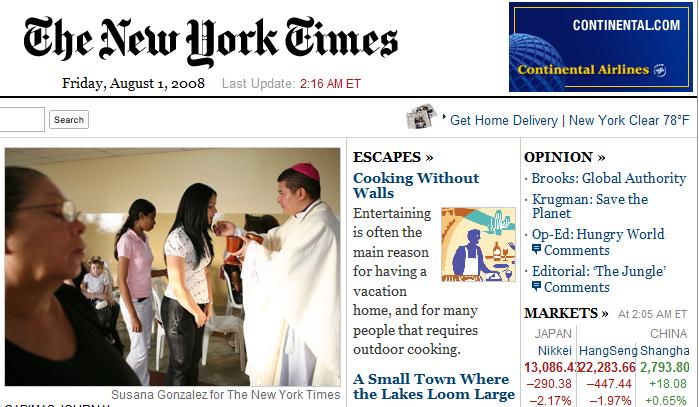
    Front page, online New York Times,  Friday, August 1, 2008, 2:16 AM

    Click on image for context.

    Time of entry: 2:56:04 AM.