Month: August 2008

  • Movie-Teller, Part Deux:

    Ready when
    you are, C. B.

    "Hurricane Gustav
    is bearing down on the Gulf Coast, a reminder of Hurricane Katrina in
    2005 and the Bush administration's poor response. The storm was clearly
    on McCain's mind Saturday.

    'You know, it just wouldn't be
    appropriate to have a festive occasion while a near tragedy or a
    terrible challenge is presented in the form of a natural disaster....'
    McCain said in an interview taped for 'Fox News Sunday.'" --AP Aug. 30

    Photos from John McCain's
    birthday three years ago:

    The Gulf Coast,
    Aug. 29, 2005:

    The image “http://www.log24.com/log/pix06A/060829-Katrina.gif” cannot be displayed, because it contains errors.

    The same day:

    The image “http://www.log24.com/log/pix06A/060829-McCain.jpg” cannot be displayed, because it contains errors.

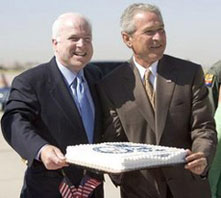
    President George W. Bush
    joins John
    McCain
    in a celebration of
     McCain's 69th birthday

    "... liberal filmmaker Michael Moore... said Friday that
    the timing of Hurricane Gustav is 'proof that there is a God in
    heaven,' since the storm approaching the Gulf Coast could disrupt next
    week’s Republican National Convention." --Fox News
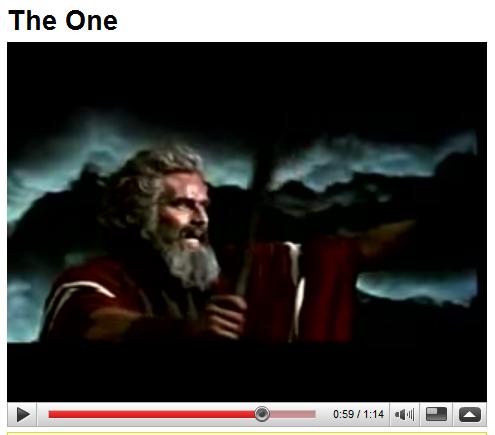
    From JohnMcCain.com
    on August 1, 2008:

    http://www.log24.com/log/pix08A/080830-TheOne.jpg

    "Behold his mighty hand!"

  • On Style, continued:

    Poetry and Politics* --

    Movie-Teller

    "... maybe it was McCain's role as 'movie-teller' that
    he cherishes most-- the man who used to narrate the plots of films to
    his fellow PoWs in the compound. 'I must have told a hundred movies,'
    says McCain. 'Of course I don't know a hundred movies-- I made them
    up.'"

    -- The Guardian, quoted here on McCain's birthday, August 29, 2006. (McCain's birthday nine years earlier was the date of Judgment Day in "Terminator 2.")

    A story from McCain's
    birthday this year:

    "Hail Sarah!"
    -- Newsweek

    Sarah Connor, mother of the savior in 'Terminator 2'

    "At the still point,
    there the dance is."

    -- Four Quartets

    "... the Four Quartets themselves appear, in all their
    complexity, as the poetry of simple civic virtue-- the poetry of a poet
    trying to read the writing of the law that has become all but
    illegible. This, you may say, has nothing to do with poetry. On the
    contrary, it is one of the few truly hopeful signs that this civic
    virtue could once more be realized poetically."

    -- Erich Heller, quoted here
    on August 25, 2008
    (Feast of St. Louis)


    Related material:

    St. Sarah's Day,
     
    The Dance:
    5/24

    See also the remarks of St. Augustine and others on time (August 28 entry) and, from May 24,  a song hook thanks to Cyndi Lauper:

    * Also known as smoke and mirrors.

  • On Style:

    Associations
    for the writer
    known as UD

    "Have liberty not as
         the air within a grave
    Or down a well. Breathe freedom,
         oh, my native,
    In the space of horizons
         that neither love nor hate."

    -- Wallace Stevens,
       "Things of August"

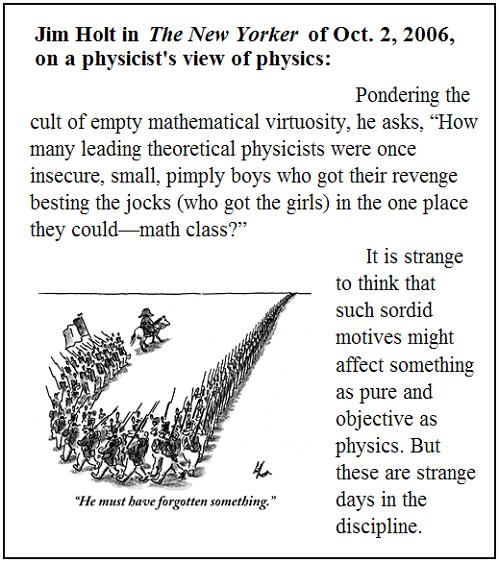
    Remarks on physics, with apparently unrelated cartoon, New Yorker, Oct. 2, 2006

    A related visual  
    association of ideas --


    ("The association is the idea"
    -- Ian Lee, The Third Word War)

    From UD Jewelry:

    For  fishing enthusiasts: hook pendant from UD Jewelry

    by John Braheny

    "Hook" is the term you'll hear most often in the business
    and craft of commercial songwriting. (Well, maybe not as much
    as "Sorry, we can't use your song," but it's possible that
    the more you hear about hooks now, the less you'll hear "we
    can't use it" later.)

    The hook has been described as "the part(s) you remember
    after the song is over," "the part that reaches out and grabs
    you," "the part you can't stop singing (even when you hate
    it)" and "the catchy repeated chorus...."

    See also UD's recent
    A Must-Read and In My Day*
    as well as the five
    Log24 entries ending
    Sept. 20, 2002.

    More seriously:

    The date of The New Yorker issue quoted above is also the anniversary of the birth of Wallace Stevens and the date of death of mathematician Paul R. Halmos.

    Stevens's "space of horizons" may, if one likes, be interpreted as a reference to projective geometry. Despite the bleak physicist's view of mathematics quoted above, this discipline is-- thanks to Blaise Pascal-- not totally lacking in literary and spiritual associations.

    * Hey Hey

  • Songlines:

    "One Shot"
    -- Keynote Address,
    Democratic
     National Convention

    Of the People,
    by the People,
    for the People

    From the autobiography of Reba McEntire:

    "...my major field of study was elementary education and my minor was
    music. I received my bachelor's degree, but never taught school as my
    Mama and Grandma had done before me...."  --My Story, Bantam, 1994

    From a notable production of  "Annie Get Your Gun" starring Reba McEntire:

    "Doin' what comes naturally...."

    -- Irving Berlin

    From Zenna Henderson's first story of the People:

    "Suddenly I felt her, so plainly that I knew with a feeling of
    fear and pride that I was of my grandmother, that soon I would be
    bearing the burden and blessing of her Gift -- the Gift that develops
    into free access to any mind, one of the People or an Outsider, willing
    or not. And besides the access, the ability to counsel and help, to
    straighten tangled minds and snarled emotions.... It was the first time
    I had ever sorted anybody."

    -- "Ararat," in The Magazine of Fantasy & Science Fiction, October 1952 (reprinted in Ingathering, NESFA Press, 1995)

    "You know, I spent 20 years in business. If you ran a company whose
    only strategy was to tear down the competition, it wouldn't last long.
    So why is this wisdom so hard to find in Washington?

    I know we're at the Democratic convention, but if an idea works, it
    really doesn't matter if it has an 'R' or 'D' next to it. Because this
    election isn't about liberal versus conservative. It's not about left
    versus right. It's about the future versus the past.

    In this election, at this moment in our history, we know what the
    problems are. We know that at this critical juncture, we have only one
    shot to get it right....

    Let me tell you about a place called Lebanon-- Lebanon, Virginia."

    -- Last night's keynote address at the Democratic National Convention

    Related material
     
    Triangulation:

    Map of Lebanon VA in relation to Bluefield WV, Pikeville KY, and Asheville NC

    "The lunatic,
      the lover,
      and the poet
      are of imagination
      all compact."
      -- Shakespeare

    For further details,
    see the sons and
    daughters of
    Bluefield, Pikeville,
    and Asheville.

  • Annals of Poetry:

    For the Feast of
    St. Louis

    The concluding paragraph of Erich Heller's 1953 essay, "The Hazard of Modern Poetry"--

    "'The poetry does not matter.' These words from Mr. T.S. Eliot's Four Quartets acquire an all but revolutionary significance if we understand them not only in their particular context but also in the context of a period of poetry in which nothing mattered except poetry. Against this background the Four Quartets themselves appear, in all their complexity, as the poetry of simple civic virtue-- the poetry of a poet trying to read the writing of the law that has become all but illegible. This, you may say, has nothing to do with poetry. On the contrary, it is one of the few truly hopeful signs that this civic virtue could once more be realized poetically. For in speaking to the hazard of modern poetry I did not wish to suggest that the end had come for singers and skylarks. There will always be skylarks; perhaps even a few nightingales. But poetry is not only the human equivalent of the song of singing birds. It is also Virgil, Dante, and Hölderlin. It is also, in its own terms, the definition of the state of man."

  • Context-Sensitive Theology continued:

    Cross-Purposes

    Yesterday's entry, Absurdities, quoted Erich Heller:

    "All relevant objective truths are born and die as absurdities. They
    come into being as the monstrous claim of an inspired rebel and pass
    away with the eccentricity of a superstitious crank."

    The context for this remarkable saying is Heller's essay "The Hazard of Modern Poetry." (See p. 270 in the links below.)

    Discussing "the century of Pascal and Hobbes," he says (see the link to p. 269 below) that

    "... as for spiritual cunning, it was in the conceits of metaphysical poetry, in the self-conscious ambiguities of poetical language (there are, we are told, as many types of it as deadly sins), and in the paradoxes of Pascal's religious thought. For ambiguity and paradox are the manner of speaking when reality and symbol, man's mind and his soul, are at cross-purposes."

    Heller's description of "relevant objective truths" as "absurdities" seems to be an instance of such ambiguity and paradox. For further details, see

    The Disinherited Mind: Essays in Modern German Literature and Thought (Harvest paperback, 1975)--

    "The Hazard of Modern Poetry" (pp. 263-300), Section 1, pages

    263, 264, 265, 266, 267, 268, 269, 270, 271, 272.

    For material related to Pascal, see the five Log24 entries ending on D-Day, 2008.

    For material related to Hobbes, see the five Log24 entries ending on St. Patrick's Day, 2007.

  • The Lottery Theater presents:

    Absurdities

    "The balance-beam of Fate was bent;  
    The bounds of good and ill were rent;  
    Strong Hades could not keep his own,  
    But all slid to confusion."

    -- "Uriel," by  
    Ralph Waldo Emerson:

    Oxford Book of
    English Verse
    , 1919,
    number
     670

    "All relevant objective truths are born and die as absurdities. They
    come into being as the monstrous claim of an inspired rebel and pass
    away with the eccentricity of a superstitious crank."

    -- Erich Heller, The Disinherited Mind

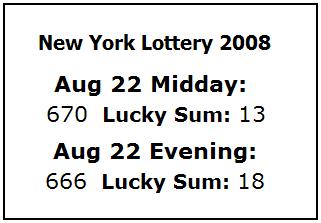
    NY lottery Aug. 22, 2008: mid-day 670, evening 666

    Related material:

    Yesterday's entry
    and
    Angels in Arabia

  • ART WARS continued --

    Tentative movie title:
    Blockheads

    Kohs Block Design Test

    The Kohs Block Design
    Intelligence Test

    Samuel Calmin Kohs, the designer (but not the originator) of the above intelligence test, would likely disapprove of the "Aryan Youth types" mentioned in passing by a film reviewer in today's New York Times. (See below.) The Aryan Youth would also likely disapprove of Dr. Kohs.

    Related material from
    Notes on Finite Geometry:

    Kohs Block Design figure illustrating the four-color decomposition theorem

    Other related material:

    1.  Wechsler Cubes (intelligence testing cubes derived from the Kohs cubes shown above). See...

    Harvard psychiatry and...
    The Montessori Method;
    The Crimson Passion;
    The Lottery Covenant.

    2.  Wechsler Cubes of a different sort (Log24, May 25, 2008)

    3.  Manohla Dargis in today's New York Times:

    "... 'Momma’s Man' is a touchingly true film, part weepie, part comedy, about the agonies
    of navigating that slippery slope called adulthood. It was written and
    directed by Azazel Jacobs, a native New Yorker who has set his modestly
    scaled movie with a heart the size of the Ritz in the same downtown
    warren where he was raised. Being a child of the avant-garde as well as
    an A student, he cast his parents, the filmmaker Ken Jacobs and the
    artist Flo Jacobs, as the puzzled progenitors of his centerpiece, a
    wayward son of bohemia....

    In American movies, growing up tends to be a job for either Aryan Youth types or the oddballs and outsiders...."

    4.  The bohemian who named his son Azazel:
    "... I think that the deeper opportunity,
    the greater opportunity film can offer us is as an exercise of the
    mind. But an exercise, I hate to use the word, I won't say 'soul,' I
    won't say 'soul' and I won't say 'spirit,' but that it can really put
    our deepest psychological existence through stuff. It can be a powerful
    exercise. It can make us think, but I don't mean think about this and
    think about that. The very, very process of powerful thinking, in a way
    that it can afford, is I think very, very valuable. I basically think
    that the mind is not complete yet, that we are working on creating the
    mind. Okay. And that the higher function of art for me is its
    contribution to the making of mind."

    -- Interview with Ken Jacobs, UC Berkeley, October 1999

    5.  For Dargis's "Aryan Youth types"--

    From a Manohla Dargis
    New York Times film review
    of April 4, 2007
       (Spy Wednesday) --

    Scene from Paul Verhoeven's film 'Black Book'

    See also, from August 1, 2008
    (anniversary of Hitler's
    opening the 1936 Olympics) --

    For Sarah Silverman
    --

    and the 9/9/03 entry 

    Olympic Style.

    Doonesbury,
    August 21-22, 2008:

    http://www.log24.com/log/pix08A/080821-22-db16color.gif

  • Flashback:

    For Madeleine L'Engle,
    wherever she may be

    The entries of yesterday (updated today) and the day before suggest a flashback to the five "Dungeons & Dragons" entries ending on March 6, 2008.  For more about dungeons, see Jan. 7, 2007. For more about dragons, see Crystal and Dragon: The Cosmic Dance of Symmetry and Chaos in Nature, Art and Consciousness, by David Wade.