Month: July 2008

  • Annals of Mathematics:

    Bertram Kostant, Professor Emeritus of Mathematics at MIT, on an object discussed in this week's New Yorker:

    "A word about E(8). In my opinion, and shared by others, E(8) is the most magnificent 'object' in all of mathematics. It is like a diamond with thousands of facets. Each facet offering a different view of its unbelievable intricate internal structure."

    Hermann Weyl on the hard core of objectivity:

    "Perhaps the philosophically most
    relevant feature of modern science is the emergence of abstract
    symbolic structures as the hard core of objectivity behind-- as
    Eddington puts it-- the colorful tale of the subjective storyteller
    mind." (Philosophy of Mathematics and Natural Science, Princeton, 1949, p. 237)


    Steven H. Cullinane on the symmetries of a 4x4 array of points:

    A Structure-Endowed Entity

    "A guiding principle in modern mathematics is this lesson: Whenever you
    have to do with a structure-endowed entity S, try to determine its group of
    automorphisms
    ,
    the group of those element-wise transformations which leave all
    structural relations undisturbed.  You can expect to gain a deep
    insight into the constitution of S in this way."

    -- Hermann Weyl in Symmetry

    Let us apply Weyl's lesson to the following "structure-endowed entity."

    4x4 array of dots

    What is the order of the resulting group of automorphisms?

    The above group of
    automorphisms plays
    a role in what Weyl,
    following Eddington,
      called a "colorful tale"--

    The Diamond 16 Puzzle

    The Diamond 16 Puzzle

    This puzzle shows
    that the 4x4 array can
    also be viewed in
    thousands of ways.

    "You can make 322,560
    pairs of patterns. Each
     pair pictures a
    different
    symmetry of the underlying
    16-point space."

    -- Steven H. Cullinane,
    July 17, 2008

    For other parts of the tale,
    see Ashay Dharwadker,
    the Four-Color Theorem,
    and Usenet Postings
    .

  • Mathematics and Narrative, continued:

    Hard Core

    David Corfield quotes Weyl in a weblog entry, "Hierarchy and Emergence," at the n-Category Cafe this morning:

    "Perhaps the philosophically most relevant feature of modern science is the emergence of abstract symbolic structures as the hard core of objectivity behind-- as Eddington puts it-- the colorful tale of the subjective storyteller mind." (Philosophy of Mathematics and Natural Science [Princeton, 1949], p. 237)

    For the same quotation in a combinatorial context, see the foreword by A. W. Tucker, "Combinatorial Problems," to a special issue of the IBM Journal of Research and Development, November 1960 (1-page pdf).

    See also yesterday's Log24 entry.

  • Annals of Philosophy:

    CHANGE
     FEW CAN BELIEVE IN

    Continued from June 18.

    Jungian Symbols
    of the Self --

    User icons (identicons) from Secret Blogging Seminar
    Compare and contrast:

    Jung's four-diamond figure from
    Aion
    -- a symbol of the self --

    Jung's four-diamond figure showing transformations of the self as Imago Dei

    Jung's Map of
    the Soul
    ,
    by Murray Stein:

    "... Jung thinks of the self as
    undergoing continual transformation during the course of a lifetime.... At the
    end of his late work Aion, Jung presents a diagram to illustrate the
    dynamic movements of the self...."

    For related dynamic movements,
    see the Diamond 16 Puzzle
    and the diamond theorem.

  • Elliptic comment:

    My comment on a discussion of elliptic curves and modular forms at Secret Blogging Seminar, about 10 PM tonight:

    How does this affect popularized discussions of the Taniyama-Shimura
    conjecture-- for instance, Ivars Peterson's, in "Curving Beyond Fermat,"
    November 1999-- which claim, for instance, that "Elliptic curves and
    modular forms are mathematically so different that mathematicians
    initially [in the 1950's, the early days of the conjecture] couldn't
    believe that the two are related."?

    Update of about 10:45 PM tonight:

    A reply by the author of the discussion, Scott Carnahan:

    I don’t think anyone doubted that there is a connection between
    elliptic curves and modular forms on the level I described above.
    However, the Taniyama-Shimura conjecture refers to a more advanced idea
    about a deeper connection.

    Carnahan then gives a one-paragraph summary, definitely not popularized, of the deeper connection.

  • Star Quality:

    Christ's High Table

    C. P. Snow in A Mathematician's Apology:

    FOREWORD

    "It was a perfectly ordinary night at Christ's high table, except that Hardy was dining as a guest. He had just returned to Cambridge as Sadleirian professor, and I had heard something of him from young Cambridge mathematicians. They were delighted to have him back: he was a real mathematician, they said, not like those Diracs and Bohrs the physicists were always talking about: he was the purest of the pure. He was also unorthodox, eccentric, radical, ready to talk about anything. This was 1931, and the phrase was not yet in English use, but in later days they would have said that in some indefinable way he had star quality."

    Perhaps now also at Christ's high table-- Scarlett O'Hara's Younger Sister, Evelyn Keyes, who died on July 4, 2008:

    "... the memory of Evelyn Keyes looking at herself on the screen, exclaiming: 'There's star quality! Look at those tits!'"

    http://www.log24.com/log/pix08/Evelyn_Keyes_in_99_River_Street.jpg

    Evelyn Keyes in 99 River Street

  • Annals of Philosophy:

    Footprint

    Sweden
    608410039/philosophy-w...
    7/13/2008 11:55 AM
    O blinding hour, O holy, terrible day,
    When first the shaft into his vision shone
    Of light anatomized! Euclid alone
    Has looked on Beauty bare. Fortunate they
    Who, though once only and then but far away,
    Have heard her massive sandal set on stone.

    -- Edna St. Vincent Millay
  • In the Details:

    Advertisement

    "God is like Me,
    only more so."

    -- Norman Mailer,
    Advertisements for Myself

    NY Times online front page July 12, 2008-- detail from review of 'Hellboy 2'-- 'jokey, sometimes touching and a lot of fun'

    Context:

    NY Times online front page July 12. 2008, 10:02 AM-- Tony Snow, former White House press secretary, dies

    See also
    Context-Sensitive Theology.

  • The Lottery Theater presents:

    Ready When
    You Are, C. B.

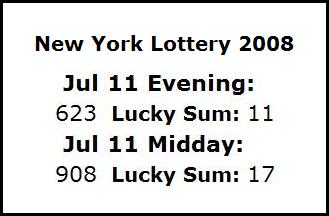
    New  York Lottery July 11, 2008: Mid-day 908, Evening 623

    For related material, see
    "Goodbye and Hello"
    from 9/08, 2003 and
    "Requiem for a Storyteller"
    from 9/08, 2007,
    as well as
    "Raiders of the Lost Stone"
    from 6/23, 2007 and
    "George Carlin Dies"
    from 6/23, 2008.

    See also
    today's previous entries.

  • The 7/11 Alignment:

    De Haut en Bas
    continued from July 3

    "I say high, you say low,
    you say why,
    and I say I don't know.
    Oh, no.
    You say goodbye
    and I say hello."

    -- Hello Goodbye *

    Thanks to NBC Nightly News tonight for a story on the following:

    Manhattanhenge
    is an evening when "the Sun sets in exact alignment with the Manhattan grid, fully
    illuminating every single cross-street...."

    Full Sun on grid:
    Friday, July 11--
    8:24 PM EDT

    Related material from the late
    Tom Disch on St. Sarah's Day:

    Saturday, May 24th, 2008

    9:15 pm

    What I Can See from Here

    I face east toward the western wall
    Of a tall many-windowed building
    Some distance off. I don't see the sunset
    Directly, only as it is reflected
    From the facade of that building.
    Those familiar with Manhattan know
    How the evening sun appears to slide
    Into the slot of any east/west street,
    And so its beams are channeled
    Along those canyon streets to strike
    Large objects like that wall
    And scrawl their anti-shadows there,
    A Tau of twilight luminescence
    At close of day. I've seen this
    For some forty years and only tonight
    Did I realize what I had been looking at:
    The way god tries to say good-bye.

    -- Tom Disch

    * Stanley Cavell, in The Claim of Reason: Wittgenstein, Skepticism, Morality, and Tragedy, has a note on the song "Hello Goodbye"--

    "189. The extra-long coda... was referred to as the 'Maori finale' from the start...."