Month: May 2008

  • Mathematics and Narrative, continued:

    A short story
    for the conclusion of
    Mental Health Month, 2008:

    752, 753, 286.

    (Numbers courtesy of the
    Pennsylvania Lottery,
    evening of May 30-
    evening of May 31)

    Commentary on the
    meaning of this
    short story:

    Countdown

  • Indiana Jones and…

    The Diadem
    of Death

    Washington
    Post Death Notices
    :

    Dead on
    St. Sarah’s Day,
    May 24 –

    Sophie
    B. Altman

    Star of David in Washington Post death notice of Sophie B. Altman

    Sophie B. Altman at Christmas 2006 dinner at DeCarlo's

    Mother-in-law of
    Wonder Woman
    Lynda Carter
    and founder and
    producer of TV’s
    It’s Academic

    In Memoriam:

    LOS TRES REYES MAGOS
    Rubén Darío

    —Yo soy Gaspar. Aquí traigo el incienso.
    Vengo a decir: La vida es pura y bella.
    Existe Dios. El amor es inmenso.
    ¡Todo lo sé por la divina Estrella!

    —Yo soy Melchor. Mi mirra aroma todo.
    Existe Dios. El es la luz del día.
    ¡La blanca flor tiene sus pies en lodo
    y en el placer hay la melancolía!

    —Soy Baltasar. Traigo el oro. Aseguro
    que existe Dios. El es el grande y fuerte.
    Todo lo sé por el lucero puro
    que brilla en la diadema de la Muerte.

    —Gaspar, Melchor y Baltasar, callaos.
    Triunfa el amor, ya su fiesta os convida.
    ¡Cristo resurge, hace la luz del caos
    y tiene la corona de la Vida!

    THE THREE KINGS

    I am Caspar. I bring with me the myrrh,
    And have this to say: Life is pure and beautiful.
    There is a God. His love is immense.
    I can see all by the divine Star!

    I am Melchior. My frankincense perfumes the air.
    There is a God. He is the light of day.
    The whitest flower has its stem in the mire
    And in joy is also found sorrow!

    I am Balthasar. I bring the gold. And I
    Assure you: There is a God, great and mighty.
    And I know this from the pure light
    That radiates from the Diadem of Death.

    Caspar, Melchior, Balthasar — say no more.
    Love is triumphant, and beckons you to His feast:
    Christ is born! The Chaos He has turned to light,
    And he wears the crown of Life!

    Midrash:

    Wonder Woman and the Secret of the Magic Tiara

    Wonder Woman and the Secret of the Magic Tiara-- The End

  • Party Girl Turns 40:

    Tequila
    Mockingbird

    (November 5, 2002):


    CelebritySexNews.com
    on Kylie Minogue:

    “Turns out she’s a party girl
    who loves Tequila:
    ‘Time disappears with Tequila.
    It goes elastic, then vanishes.’”

    From a web page on
    Malcolm Lowry’s classic novel
    Under the Volcano

    The day begins with Yvonne’s arrival at the Bella Vista
    bar in Quauhnahuac. From outside she hears Geoffrey’s familiar voice
    shouting a drunken lecture this time on the topic of the rule of the
    Mexican railway that requires that  “A corpse will be transported by
    express!” (Lowry, Volcano, p. 43).

    Kylie Minogue
    Kylie

    Film 'Under the Volcano'
    Finney


    Well if you want to ride
    you gotta ride it like you find it.
    Get your ticket at the station
    of the Rock Island Line.

    – Lonnie Donegan (d. Nov. 3) 

    and others


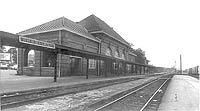
    Station of the Rock Island Line


    The Rock Island Line’s namesake depot 
    in Rock Island, Illinois


    Related material:

    Twenty-First Century Fox
    (10/6/02)

    Back to You, Kylie
    (11/5/02)

    Time, Eternity, and Grace
    (11/22/02)

    That Old Devil Moon
    (1/1/03) and
    The Shanghai Gesture
    (1/3/03)

    Whirligig
    (1/5/03)

    Harrowing
    (4/19/03)

    Temptation
    (4/22/03)

    Temptation
    (4/9/04)

    Tribute
    ,
    Train of Thought,
    Drunk Bird, and
    From Here to Eternity
    (8/17/04-8/18/04)

    Heaven and Earth
    (9/2/04)

    Habeas Corpus

    (11/24/04)

    X, continued
    (12/4/04)

    Birth and Death
    (5/28/05)

    Time Travel
    (5/28/06)

    Timeagain and
    Two-Bar Hook
    (8/9/06)

    Echoes
    (8/11/06)

    Phantasmagoria
    and Tequila!
    (9/23/06)

  • Husbands and Wives, continued:

    From the
    Cartoon Graveyard

    Page from 'The Paradise of Childhood,' 1906 edition

    The above is from
    The Paradise of Childhood
    ,
    a work first published in 1869.

    For the late Thelma Keane,
    wife of “Family Circus
    cartoonist Bil Keane of
    Paradise Valley, Arizona:

    I need a photo-opportunity,

    Thelma Keane, real-life 'Family Circus' mother
    I want a shot at redemption.*
    Don’t want to end up a cartoon
    In a cartoon graveyard.”
    — Paul Simon
    *                         
    St. Barnabas on the Desert, Paradise Valley, Arizona

    Mrs. Keane died May 23
    (St. Sarah’s Eve)
    according to
    The Washington Post.
    Related material:
    Log24 on May 23,
    Saints in Australia.

  • Husbands and Wives:

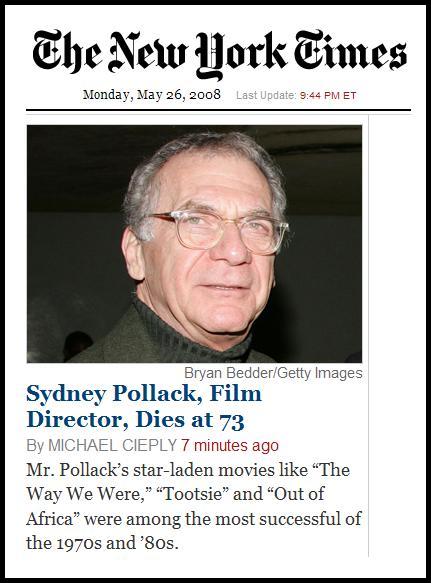
    For Sydney Pollack
    (See last night’s entry.)

    “Now, gentlemen,
    I give you

    our latest acquisition

    from the enemy.”

    Paths of Glory   

    Final scene from 'Paths of Glory'

    Note the number, 701,
    on the colonel’s collar.

    Adapted from Log24,
    February 19-22, 2008:


    “‘This is the last call for Jaunt-701,’

     the pleasant female voice
    echoed

     through the Blue Concourse
    of 
    New York’s
         Port Authority Terminal….

    Images of time and eternity in memory of Michelangelo
    See 2/22/08,
     4/19/08,
    and 5/22/08.

    ….’What happened?’
    one of the scientists shouted….


    ‘It’s eternity in there,’ he said,
    and dropped dead….”


    – Stephen King, “The Jaunt

    Die Liebe nahm kein Ende mehr.

  • Memorial Day Endgame:

    Sydney Pollack dies-- NY Times online front page

    From Bloomberg.com:

    Great Directors

    “After his return to acting in ‘Tootsie,’ Pollack took
    movie roles under directors Robert Altman in ‘The Player’
    (1992), Woody Allen in ‘Husbands and Wives’ (1992) and Stanley
    Kubrick
    in ‘Eyes Wide Shut’ (1999). He said he chose roles in
    part to study other great directors.”
     

  • ART WARS: The Craft–

    Crystal Vision

    Stevie Nicks
     is 60 today.

    Poster for the film 'The Craft'

    On the author discussed
    here yesterday,
    Siri Hustvedt:

    “… she explores
    the nature of identity
    in a structure* of
    crystalline
    complexity.”

    Janet Burroway,   
    quoted in  
    ART WARS  

    Olivier as Dr. Christian Szell

    The icosahedron (a source of duads and synthemes)


    “Is it safe?”

    Annals of Art Education:
     Geometry and Death

    * Related material:
    the life and work of
    Felix Christian Klein
    and
    Report to the Joint
    Mathematics Meetings

  • Time After Time:

    Today’s Sermon

    continued from 9 AM

    Pennsylvania Lottery today:
    Mid-day 105,
    Evening 304

    Related material:
    1/05, 2003,
    3/04, 2004

    Bill laid bare the arbitrary
    roots of meaning itself….”
    – Siri Hustvedt,
    quoted here
    this morning

    “A poem should not mean
    But be”

    Archibald MacLeish,
      quoted here May 23

  • ART WARS continued:

    Hall of Mirrors

    Epigraph to
    Deploying the Glass Bead Game, Part II,”
    by Robert de Marrais:

    “For a complete logical argument,”
    Arthur began
    with admirable solemnity,
    “we need two prim Misses –”
    “Of course!” she interrupted.
    “I remember that word now.
    And they produce — ?”
    “A Delusion,” said Arthur.

    – Lewis Carroll,
    Sylvie and Bruno

    Prim Miss 1:

    Erin O’Connor’s weblog
    “Critical Mass” on May 24:

    Roger Rosenblatt’s Beet [Ecco hardcover, Jan. 29, 2008] is the latest addition to the noble sub-genre of campus fiction….

    Curricular questions and the behavior of committees are at once dry as dust subjects and areas ripe for sarcastic send-up– not least because, as dull as they are, they are really both quite vital to the credibility and viability of higher education.

    Here’s an excerpt from the first meeting, in which committee members propose their personal plans for a new, improved curriculum:

    “… Once the students really got into playing with toy soldiers, they would understand history with hands-on excitement.”

    To demonstrate his idea, he’d brought along a shoe box full of toy doughboys and grenadiers, and was about to reenact the Battle of Verdun on the committee table when Heilbrun stayed his hand. “We get it,” he said.

    “That’s quite interesting, Molton,” said Booth [a chemist]. “But is it rigorous enough?”

    At the mention of the word, everyone, save Peace, sat up straight.

    “Rigor is so important,” said Kettlegorf.

    “We must have rigor,” said Booth.

    “You may be sure,” said the offended Kramer. “I never would propose anything lacking rigor.”

    Smythe inhaled and looked at the ceiling. “I think I may have something of interest,” he said, as if he were at a poker game and was about to disclose a royal flush. “My proposal is called ‘Icons of Taste.’ It would consist of a galaxy of courses affixed to several departments consisting of lectures on examples of music, art, architecture, literature, and other cultural areas a student needed to indicate that he or she was sophisticated.”

    “Why would a student want to do that?” asked Booth.

    “Perhaps sophistication is not a problem for chemists,” said Smythe. Lipman tittered.

    “What’s the subject matter?” asked Heilbrun. “Would it have rigor?”

    “Of course it would have rigor. Yet it would also attract those additional students Bollovate is talking about.” Smythe inhaled again. “The material would be carefully selected,” he said. “One would need to pick out cultural icons the students were likely to bring up in conversation for the rest of their lives, so that when they spoke, others would recognize their taste as being exquisite yet eclectic and unpredictable.”

    “You mean Rembrandt?” said Kramer.

    Smythe smiled with weary contempt. “No, I do not mean Rembrandt. I don’t mean Beethoven or Shakespeare, either, unless something iconic has emerged about them to justify their more general appeal.”

    “You mean, if they appeared on posters,” said Lipman.

    “That’s it, precisely.”

    Lipman blushed with pride.

    “The subject matter would be fairly easy to amass,” Smythe said. “We could all make up a list off the top of our heads. Einstein–who does have a poster.” He nodded to the ecstatic Lipman. “Auden, for the same reason. Students would need to be able to quote ‘September 1939[ or at least the last lines. And it would be good to teach ‘Musee des Beaux Arts’ as well, which is off the beaten path, but not garishly. Mahler certainly. But Cole Porter too. And Sondheim, I think. Goya. Warhol, it goes without saying, Stephen Hawking, Kurosawa, Bergman, Bette Davis. They’d have to come up with some lines from Dark Victory, or better still, Jezebel. La Dolce Vita. Casablanca. King of Hearts. And Orson, naturally. Citizen Kane, I suppose, though personally I prefer F for Fake.”

    “Judy!” cried Heilbrun.

    “Yes, Judy too. But not ‘Over the Rainbow.’ It would be more impressive for them to do ‘The Trolley Song,’ don’t you think?” Kettlegorf hummed the intro.

    Guernica,” said Kramer. “Robert Capa.” Eight-limbed asterisk

    “Edward R. Murrow,” said Lipman.

    “No! Don’t be ridiculous!” said Smythe, ending Lipman’s brief foray into the world of respectable thought.

    “Marilyn Monroe!” said Kettlegorf.

    “Absolutely!” said Smythe, clapping to indicate his approval.

    “And the Brooklyn Bridge,” said Booth, catching on. “And the Chrysler Building.”

    “Maybe,” said Smythe. “But I wonder if the Chrysler Building isn’t becoming something of a cliche.”

    Peace had had enough. “And you want students to nail this stuff so they’ll do well at cocktail parties?”

    Smythe sniffed criticism, always a tetchy moment for him. “You make it sound so superficial,” he said.

    Prim Miss 2:

    Siri Hustvedt speaks at Adelaide Writers’ Week– a story dated March 24, 2008

    “I have come to think of my books as echo chambers or halls of mirrors in which themes, ideas, associations continually reflect and reverberate inside a text. There is always point and counterpoint, to use a musical illustration. There is always repetition with difference.”

    A Delusion:

    Exercise — Identify in the following article the sentence that one might (by unfairly taking it out of context) argue is a delusion.

    (Hint: See Reflection Groups in Finite Geometry.)

    A. V. Borovik, 'Maroids and Coxeter Groups'

    Why Borovik’s Figure 4
    is included above:

    Euclid, Peirce, L’Engle:
    No Royal Roads.

    For more on Prim Miss 2
    and deploying
    the Glass Bead Game,
    see the previous entry.

    The image “http://www.log24.com/log/images/asterisk8.gif” cannot be displayed, because it contains errors. And now, perhaps, his brother Cornell Capa, who died Friday.

     Related material: Log24 on March 24– Death and the Apple Tree– with an excerpt from
    George MacDonald, and an essay by David L. Neuhouser mentioning the influence of MacDonald on Lewis Carroll– Lewis Carroll: Author, Mathematician, and Christian (pdf).

  • Today’s Sermon:

    Wechsler Cubes

     ”Confusion is nothing new.”
    – Song lyric, Cyndi Lauper  

    Part I:
    Magister Ludi


    Hermann Hesse’s 1943 The Glass Bead Game (Picador paperback, Dec. 6, 2002, pp. 139-140)–

    “For the present, the Master showed him a bulky memorandum, a proposal he had received from an organist– one of the innumerable proposals which the directorate of the Game regularly had to examine. Usually these were suggestions for the admission of new material to the Archives. One man, for example, had made a meticulous study of the history of the madrigal and discovered in the development of the style a curved that he had expressed both musically and mathematically, so that it could be included in the vocabulary of the Game. Another had examined the rhythmic structure of Julius Caesar’s Latin and discovered the most striking congruences with the results of well-known studies of the intervals in Byzantine hymns. Or again some fanatic had once more unearthed some new cabala hidden in the musical notation of the fifteenth century. Then there were the tempestuous letters from abstruse experimenters who could arrive at the most astounding conclusions from, say, a comparison of the horoscopes of Goethe and Spinoza; such letters often included pretty and seemingly enlightening geometric drawings in several colors.”

    Part II:
    A Bulky Memorandum

    From Siri Hustvedt, author of Mysteries of the Rectangle: Essays on Painting (Princeton Architectural Press, 2005)– What I Loved: A Novel (Picador paperback, March 1, 2004, page 168)–

    A description of the work of Bill Wechsler, a fictional artist:

    “Bill worked long hours on a series of autonomous pieces about numbers. Like O’s Journey, the works took place inside glass cubes, but these were twice as large– about two feet square. He drew his inspiration from sources as varied as the Cabbala, physics, baseball box scores, and stock market reports. He painted, cut, sculpted, distorted, and broke the numerical signs in each work until they became unrecognizable. He included figures, objects, books, windows, and always the written word for the number. It was rambunctious art, thick with allusion– to voids, blanks, holes, to monotheism and the individual, the the dialectic and yin-yang, to the Trinity, the three fates, and three wishes, to the golden rectangle, to seven heavens, the seven lower orders of the sephiroth, the nine Muses, the nine circles of Hell, the nine worlds of Norse mythology, but also to popular references like A Better Marriage in Five Easy Lessons and Thinner Thighs in Seven Days. Twelve-step programs were referred to in both cube one and cube two. A miniature copy of a book called The Six Mistakes Parents Make Most Often lay at the bottom of cube six. Puns appeared, usually well disguised– one, won; two, too, and Tuesday; four, for, forth; ate, eight. Bill was partial to rhymes as well, both in images and words. In cube nine, the geometric figure for a line had been painted on one glass wall. In cube three, a tiny man wearing the black-and-white prison garb of cartoons and dragging a leg iron has

    – End of page 168 –

    opened the door to his cell. The hidden rhyme is “free.” Looking closely through the walls of the cube, one can see the parallel rhyme in another language: the German word drei is scratched into one glass wall. Lying at the bottom of the same box is a tiny black-and-white photograph cut from a book that shows the entrance to Auschwitz: ARBEIT MACHT FREI. With every number, the arbitrary dance of associations worked togethere to create a tiny mental landscape that ranged in tone from wish-fulfillment dream to nightmare. Although dense, the effect of the cubes wasn’t visually disorienting. Each object, painting, drawing, bit of text, or sculpted figure found its rightful place under the glass according to the necessary, if mad, logic of numerical, pictorial, and verbal connection– and the colors of each were startling. Every number had been given a thematic hue. Bill had been interested in Goethe’s color wheel and in Alfred Jensen’s use of it in his thick, hallucinatory paintings of numbers. He had assigned each number a color. Like Goethe, he included black and white, although he didn’t bother with the poet’s meanings. Zero and one were white. Two was blue. Three was red, four was yellow, and he mixed colors: pale blue for five, purples in six, oranges in seven, greens in eight, and blacks and grays in nine. Although other colors and omnipresent newsprint always intruded on the basic scheme, the myriad shades of a single color dominated each cube.

    The number pieces were the work of a man at the top of his form. An organic extension of everything Bill had done before, these knots of symbols had an explosive effect. The longer I looked at them, the more the miniature constructions seemed on the brink of bursting from internal pressure. They were tightly orchestrated semantic bombs through which Bill laid bare the arbitrary roots of meaning itself– that peculiar social contract generated by little squiggles, dashes, lines, and loops on a page.”

    Part III:
    Wechsler Cubes

    (named not for
    Bill Wechsler, the
    fictional artist above,
    but for the non-fictional
       David Wechsler) –

    From 2002:

    Above: Dr. Harrison Pope, Harvard professor of psychiatry, demonstrates the use of the Wechsler Adult Intelligence Scale “block design” subtest.

    Part IV:
    A Magic Gallery

    ZZ
    WW

    Figures from the
    Kaleidoscope Puzzle
    of Steven H. Cullinane:


    Poem by
    Eugen Jost:

    Zahlen und Zeichen,
    Wörter und Worte


    Mit Zeichen und Zahlen

    vermessen wir Himmel und Erde

    schwarz

    auf weiss

    schaffen wir neue Welten

    oder gar Universen


     Numbers and Names,
    Wording and Words

    With numbers and names
    we measure heaven and earth
    black
    on white
    we create new worlds
    and universes

    English translation
    by Catherine Schelbert


    A related poem:

    Alphabets
    by Hermann Hesse

    From time to time
    we take our pen in hand
    and scribble symbols
    on a blank white sheet
    Their meaning is
    at everyone’s command;
    it is a game whose rules
    are nice and neat.

    But if a savage
    or a moon-man came
    and found a page,
    a furrowed runic field,
    and curiously studied
    lines and frame:
    How strange would be
    the world that they revealed.
    a magic gallery of oddities.
    He would see A and B
    as man and beast,
    as moving tongues or
    arms or legs or eyes,
    now slow, now rushing,
    all constraint released,
    like prints of ravens’
    feet upon the snow.
    He’d hop about with them,
    fly to and fro,
    and see a thousand worlds
    of might-have-been
    hidden within the black
    and frozen symbols,
    beneath the ornate strokes,
    the thick and thin.
    He’d see the way love burns
    and anguish trembles,
    He’d wonder, laugh,
    shake with fear and weep
    because beyond this cipher’s
    cross-barred keep
    he’d see the world
    in all its aimless passion,
    diminished, dwarfed, and
    spellbound in the symbols,
    and rigorously marching
    prisoner-fashion.
    He’d think: each sign
    all others so resembles
    that love of life and death,
    or lust and anguish,
    are simply twins whom
    no one can distinguish…
    until at last the savage
    with a sound
    of mortal terror
    lights and stirs a fire,
    chants and beats his brow
    against the ground
    and consecrates the writing
    to his pyre.
    Perhaps before his
    consciousness is drowned
    in slumber there will come
    to him some sense
    of how this world
    of magic fraudulence,
    this horror utterly
    behind endurance,
    has vanished as if
    it had never been.
    He’ll sigh, and smile,
    and feel all right again.

    – Hermann Hesse (1943),
    Buchstaben,” from
    Das Glasperlenspiel,
    translated by
    Richard and Clara Winston