Mathematics and Narrative
Rebecca Goldstein, Mathematics and the Character of Tragedy:
"It was Plato who best expressed-- who veritably embodied-- the tension between the narrative arts and mathematics."
Mathematics and Narrative
Rebecca Goldstein, Mathematics and the Character of Tragedy:
"It was Plato who best expressed-- who veritably embodied-- the tension between the narrative arts and mathematics."
Inscape
My entry for New Year's Day links to a paper by Robert T. Curtis* from The Arabian Journal for Science and Engineering (King Fahd University, Dhahran, Saudi Arabia), Volume 27, Number 1A, January 2002.
From that paper:
"Combinatorially, an outer automorphism [of S6] can exist because the number of unordered pairs of 6 letters is
equal to the number of ways in which 6 letters can be partitioned into three pairs. Which is to say that the
two conjugacy classes of odd permutations of order 2 in S6
contain the same number of elements, namely 15. Sylvester... refers to
the unordered pairs as duads and the partitions as synthemes. Certain
collections of five synthemes... he refers to as synthematic totals or simply totals; each total is stabilized within S6 by a subgroup acting triply transitively on the 6 letters as PGL2(5)
acts on the projective line. If we draw a bipartite graph on (15+15)
vertices by joining each syntheme to the three duads it contains, we
obtain the famous 8-cage (a graph of valence 3 with minimal cycles of
length 8)...."
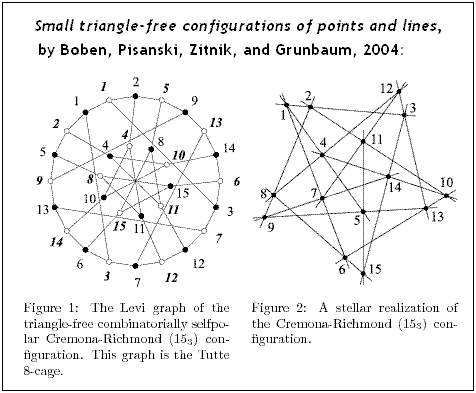
Here is a way of picturing the 8-cage and a related configuration of points and lines:
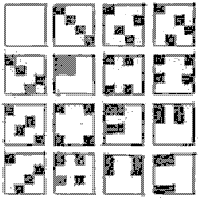
Diamond Theory shows that this structure
can also be modeled by an "inscape"
made up of subsets of a
4x4 square array:
The illustration below shows how the
points and lines of the inscape may
be identified with those of the
Cremona-Richmond configuration.

-- Brian Weatherson, Associate Professor of Philosophy, Cornell University, May 11, 2004
Here, on the other hand, is a way of framing the problem that is entirely idiosyncratic:
On this date:
Probability:
In 1970, William Feller died.
Modality:
In 1978, Kurt Gödel died.
Intersection:
In 1898, the Rev. Deacon Charles Lutwidge Dodgson died.
Beyond the Fire
"Who Needs a White Cube These Days?"
-- Headline in today's New York Times
"That Nature is a Heraclitean Fire..."
-- Poem title, Gerard Manley Hopkins
"... Sleep
realized
Was the whiteness that is the ultimate intellect,
A diamond jubilance beyond the fire,
That gives its power to the wild-ringed eye."
-- Wallace Stevens,
"The Owl in the Sarcophagus" III 13-16,
from The Auroras of Autumn, 1950
Related material:
The five entries ending on Christmas, 2005.
Time in the Rock
"a world of selves trying to remember the self
before the idea of self is lost--
Walk with me world, upon my right hand walk,
speak to me Babel, that I may strive to assemble
of all these syllables a single word
before the purpose of speech is gone."
-- Conrad Aiken, "Prelude" (1932),
later part of "Time in the Rock,
or Preludes to Definition, XIX" (1936),
in Selected Poems, Oxford U. Press
paperback, 2003, page 156
"The rock is the habitation of the whole,
Its strength and measure, that which is near, point A
In a perspective that begins again
At B: the origin of the mango's rind.
It is the rock where tranquil must adduce
Its tranquil self, the main of things, the mind,
The starting point of the human and the end,
That in which space itself is contained, the gate
To the enclosure, day, the things illumined
By day, night and that which night illumines,
Night and its midnight-minting fragrances,
Night's hymn of the rock, as in a vivid sleep."
-- Wallace Stevens in The Rock (1954)
"Poetry is an illumination of a surface,
the movement of a self in the rock."
-- Wallace Stevens, introduction to
The Necessary Angel, 1951
The following may help illuminate the previous entry:
"I want, as a man of the imagination, to write poetry with all the
power of a monster equal in strength to that of the monster about whom
I write. I want man's imagination to be completely adequate in
the face of reality."
-- Wallace Stevens, 1953 (Letters 790)
The "monster" of the previous entry is of course not Reese Witherspoon, but rather Vox Populi itself.

Reese Witherspoon
was the winner of
the leading lady award
at the People's Choice
ceremony in Los Angeles.
Related material:
Election,
All About Eve.

Question:
What does Chicken Little
have in common with
The Passion of the Christ?
An anonymous commenter's answer: "The title character announces the coming of the end, suffers mockery
and condemnation, and ends up saving the world through his actions."
(The "real" answer: "The music for each was composed by John Debney.")
Related hymn:
"Till Armageddon,
no Shalam, no Shalom.
Then the father hen will
call his chickens home."
-- Johnny Cash

"'Tikkun Olam,
the fixing of the world,'
she whispers. 'I've been
gathering up the broken vessels
to make things whole again.'"
From Nov. 14, 2005:
(Dean Goodman, Reuters) (Leonard Klady, Movie City News):
Today's vocabulary lesson:
Culture
Wars
'Chicken Little' Lays Golden Egg
The
mixed bag of limited release preems was highlighted by an excellent
response to the concert film Sarah Silverman: Jesus is Magic.
The film recorded a $19,000 plus per engagement average from seven
outings for a $130,000 gross. The family drama Bee Season
had a comparable gross but on three times as many screens that
translated into anxiety about the Richard Gere film's expansion
prospects.

A search on the related adjective "hendiadic"
leads to an insightful discussion of
religion and law
in contemporary Latin America
by Antônio Flávio Pierucci.
For other material on
Latin America and religion
from Robert Stone and
Nythamar Fernandes de Oliveira,
see the Jan. 25, 2005, entry
Diamonds Are Forever.
Related material:
Yesterday's link for Nixon's birthday
led to an obituary of a Marxist
writer that concluded as follows:
"In 2004, Mr. Magdoff wrote about his friendship with Che Guevara,
one of his revolutionary heroes. At what proved to be their final
meeting before Mr. Guevara's death in 1967, Mr. Magdoff asked what he
could do to help Cuba. 'Keep on educating me,' was the response."
-- Dean G. Hoffman, Auburn U.,
July 2001 Rutgers talk
Diagrams from Dieter Betten's 1983 proof
of the nonexistence of two orthogonal
6x6 Latin squares (i.e., a proof
of Tarry's 1900 theorem solving
Euler's 1782 problem of the 36 officers):
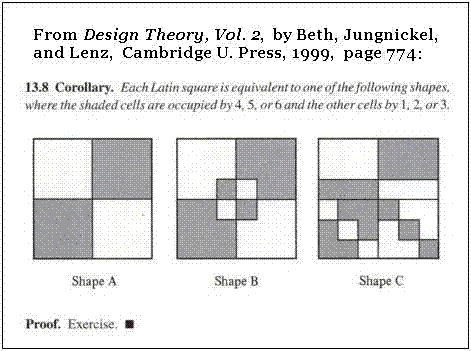
Compare with the partitions into
two 8-sets of the 4x4 Latin squares
discussed in my 1978 note (pdf).


Recent Comments