Natural Hustler (jpg, 283 KB)
Month: January 2006
-
PlayOn this date in 1938, Thornton Wilder's
"Our Town" premiered at the
McCarter Theatre, Princeton University.
St. Patrick's Day, 2005,
St. Patrick's Day, 2003,
and, for
Piper Laurie's birthday
(today) in 2003,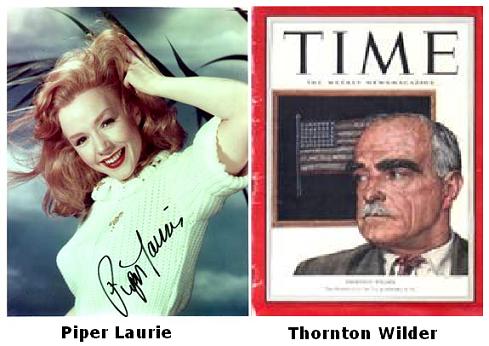
-
Fourstone Parable
(continued)
Alms for Oblivion:
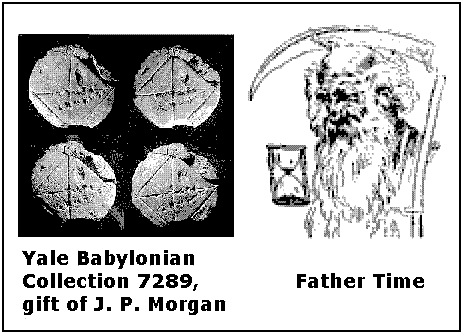
In memory of Akkadian scholar
Erica Reiner, who died at 81 on
December 31, 2005."Erica combined a tough-minded commitment to intellectual
excellence with a dry wit, charm, and a deep love of art, music,
and literature. Erica's passion for her work was legendary.
She was someone who expected the very highest standards of scholarly
rigor both in her own work, and in the efforts of others."-- Gil Stein, director of the Oriental Institute at the University of Chicago
A Mass for Dr. Reiner
was scheduled for
Friday the 13th
at the church of
"doubting Thomas"--
St. Thomas
the Apostle
in Chicago. -
Jews on Fiction
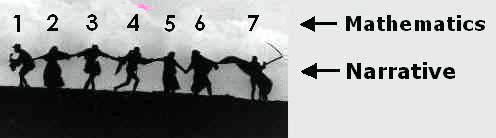
See Tony Kushner and E.L. Doctorow in today's New York Times, Rebecca Goldstein's talk from last summer's Mykonos conference on mathematics and narrative, and Martin Buber on the Bible.
-
Fourstone Parable
"Wherefore let it hardly... be...
thought that the prisoner... was at his best a onestone
parable... for... pathetically few... cared... to doubt... the
canonicity of his existence as a tesseract."-- Finnegans Wake, page 100, abridged
"... we have forgotten that we were angels and painted ourselves into a
corner of resource extraction and commodification of ourselves."-- A discussion, in a draft of
a paper (rtf) attributed
to Josh Schultz,
of the poem "Diamond"
by Attila JozsefCommodification of
the name Cullinane:See the logos at
cullinane.com,
a design firm with
the motto
To adapt a phrase from
Finnegans Wake, the
"fourstone parable" below
is an attempt to
decommodify my name.Fourstone Parable:
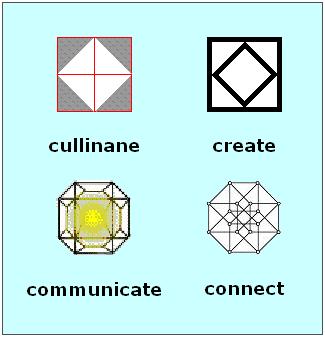
(See also yesterday's "Logos."
The "communicate" logo is taken from
an online library at Calvin College;the "connect" logo is a commonly
available picture of a tesseract
(Coxeter, Regular Polytopes, p. 123),
and the other two logos
are more or less original.)For a more elegant
four-diamond figure, see
Jung and the Imago Dei. -
The Man Who Was Thursday:
An Introduction"Wallace Stevens's remarkable oeuvre is a quasi-spiritual quest for the
supreme fiction, for a poetry that 'must take the place / Of empty
heaven and its hymns' and thus help modern man find meaning in a
godless world. The poet's role, for Stevens, is that of high priest of
the imagination: it is the poet who 'gives to life the supreme fictions
without which we are unable to conceive of it.' ....
... Stevens's hallmark 'imagination-reality' complex... is pursued
almost obsessively in his poetry and prose of the 1940s. Parts of a
World, published in 1942, and the poem-sequence of the same year,
'Notes toward a Supreme Fiction' ('Notes' was subsequently collected in
Transport to Summer in 1947), comprise a prolonged meditation in a time
of war on poetry and the poet's role, in the face of what Stevens, in
his essay 'The Noble Rider and the Sound of Words,' terms 'the pressure
of reality.' Parts of a World is riven by its competing vocabularies. A
discourse of desire, of process, of the poet's contemplation of the
mind in the act of finding what will suffice, is elaborated in 'the
never-resting mind' of 'The Poems of Our Climate' and in 'The Well
Dressed Man with a Beard,' in which 'It can never be satisfied, the
mind, never' [occurs]. A very different idiom, that of the 'hero' or 'major
man,' the figure of capable imagination, dominates and directs such
poems as 'Mrs Alfred Uruguay,' 'Asides on the Oboe' and 'Examination of
the Hero in a Time of War,' whereSummer, jangling
the savagest diamonds and
Dressed in its
azure-doubled crimsons,
May truly bear
its heroic fortunes
For the large,
the solitary figure."-- Lee M. Jenkins,
University College Cork,
"Wallace Stevens,"
The Literary Encyclopedia,
9 Dec., 2004.For some related serious, but less solemn, remarks, click on the above date.
-
Plato and Shakespeare
at Breakfast
"Plato has told you a truth; but Plato is dead.
Shakespeare has startled you with an image; but Shakespeare will not startle
you with any more. But imagine what it would be to live with such men still
living, to know that Plato might break out with an original lecture to-morrow,
or that at any moment Shakespeare might shatter everything with a single song.
The man who lives in contact with what he believes to be a living Church is a
man always expecting to meet Plato and Shakespeare to-morrow at breakfast. He
is always expecting to see some truth that he has never seen before."-- G. K. Chesterton, Orthodoxy
For Plato:
Inscapes.For Shakespeare:
Hopkins on Inscape.For both:

Click on the picture
for related remarks.
-

BBC News Jan. 17Related material:
Log24 Sept. 27 and
Sept. 28, 2005,
as well as
The Harvard Crimson,
Jan. 13, 2006:
"President was resolute--
'This is bullshit'"


Recent Comments