January 26, 2006
-
In honor of Paul Newman’s age today, 81:
On Beauty
Elaine Scarry, On Beauty (pdf), page 21:“Something beautiful fills the mind yet invites the
search for something beyond itself, something larger or something of
the same scale with which it needs to be brought into relation. Beauty,
according to its critics, causes us to gape and suspend all thought.
This complaint is manifestly true: Odysseus does stand marveling before
the palm; Odysseus is similarly incapacitated in front of Nausicaa; and
Odysseus will soon, in Book 7, stand ‘gazing,’ in much the same way, at
the season-immune orchards of King Alcinous, the pears, apples, and
figs that bud on one branch while ripening on another, so that never
during the cycling year do they cease to be in flower and in fruit. But
simultaneously what is beautiful prompts the mind to move
chronologically back in the search for precedents and parallels, to
move forward into new acts of creation, to move conceptually over, to
bring things into relation, and does all this with a kind of urgency as
though one’s life depended on it.”
The above symbol of Apollo
suggests, in accordance with
Scarry’s remarks, larger structures.
Two obvious structures are the affine 4-space over GF(3), with 81
points, and the affine plane over GF(32), also with 81 points.
Less obvious are some related projective structures. Joseph Malkevitch has discussed the standard method of constructing GF(32)
and the affine plane over that field, with 81 points, then
constructing the related Desarguesian projective plane of order 9, with92 + 9 + 1 = 91 points
and 91 lines. There are other, non-Desarguesian, projective
planes of order 9. See Visualizing GL(2,p), which
discusses a spreadset construction of the non-Desarguesian translation plane of order 9. This plane
may be viewed as illustrating
deeper properties of the
3×3 array shown above.
To view the plane
in a wider context, see
The Non-Desarguesian Translation Plane of Order 9
and a paper on
Affine and Projective Planes (pdf).
(Click to enlarge the excerpt beow).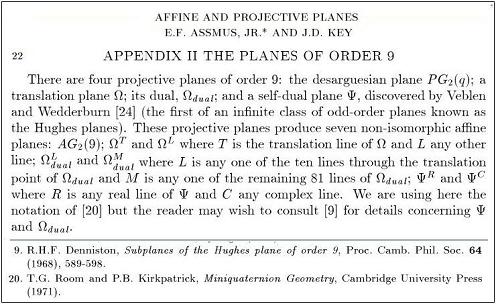 See also Miniquaternion Geometry: The Four Projective Planes of Order 9 (pdf), by Katie Gorder (Dec. 5, 2003), and a book she cites:
Miniquaternion geometry: An introduction to the study of projective planes,
by
T. G. Room and P. B. Kirkpatrick. Cambridge Tracts in Mathematics and
Mathematical Physics, No. 60. Cambridge University Press, London, 1971. viii+176 pp.For “miniquaternions” of a different sort, see my
entry on Visible Mathematics for Hamilton’s birthday last year:

