June 2, 2005
-
The Barest Vocabulary
at the Altar of Facts
From Log24,
April 28, 2005:
April 5, 2005.)
Compare this diagram with that of
Samuel Beckett in Quad (1981):
Related quotation:Barry Mazur on a seminal paper of algebraist Saunders Mac Lane:
The paper was rejected “because the editor thought that it was ‘more
devoid of content’ than any other he had read. ‘Saunders wrote
back and said, “That’s the point,”‘ Mazur said. ‘And in some ways
that’s the genius of it. It’s the barest, most Beckett-like vocabulary
that incorporates the theory and nothing else.’”Other related material:
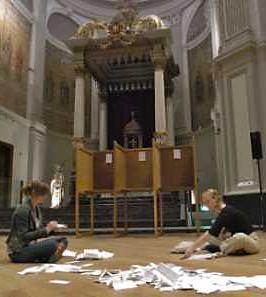 “Members
of the ballot commission manually count EU referendum votes in the
Duifkerk in Amsterdam June 1st, 2005. Dutch voters soundly rejected the
European Union constitution in a referendum on June 1….. Photo by… Ronald
Fleurbaaij”Background reading on the new
Prime Minister of France:“M. de Villepin
positively worships Napoleon, and models himself after his hero. In a
600-page biography, Villepin wrote admiringly about the difference
between great men like Napoleon and the ‘common run’ of men. It is
worth reading every word carefully.
‘Here we
touch on that particular essence of great men, on what distinguishes
Napoleon or Alexander, Caesar or de Gaulle, from the common run. It is
excess, exaltation, and a taste for risk that forms their genius. It is
why they are often better understood in their élan by writers and
poets, who are possessed of the same thirst for the absolute, than by
those who pray at the altar of facts.’
(New Republic)And in praise of French nationalism, de Villepin wrote,
‘The
Gaullist adventure renewed the élan of [Napoleon's] Consulate through
the restoration of a strong executive and the authority of the State,
the same scorn for political parties and for compromise, a common taste
for action, and an obsession with the general interest and the grandeur
of France.’Those words come
straight from 1800. Napoleon’s ‘genius,’ his ‘thirst for the absolute,’
‘excess, exaltation, and a taste for risk,’ ‘a strong executive and the
authority of the State,’ ‘his ‘scorn for political parties and for
compromise,’ and ‘an obsession with the grandeur of France’ — it is
all classic national hero worship. But today that kind of thinking is
used to promote a new vision of destiny, the European Union.”

