Month: November 2003

  • School Book Depository


    Pro-Truth


    Pro-Lies


    "Many people look at the Kennedy assassination as a turning point, when people started realizing and thinking and believing their government would lie to them and lie to them repeatedly," said Gary Mack, curator of the Sixth Floor Museum at Dealey Plaza in Dallas.


    -- AP, Dallas, Nov. 21, 2003


    Better late than never.

  • Chinese Theatre, Part II:


    Just Say NO


    For more on the above "spider" symbol, see


    ART WARS for Trotsky's Birthday
    (Oct. 26, 2003), Parts I and II


    and the site from which
    the above figure is taken,


    Yin & Yang and the I Ching.


    For some Chinese poetic justice, see


    The Song of Saint Ezra,


    Library of Paradise, and


    Endings and Beginnings.


    See, too, the Chinese character for "end"
    used to sell the work of Ian Fleming:


    Note, in Endings and Beginnings, the strong resemblance between this character and the name of the Chinese-American architect of the Robert Frost Library at Amherst College.  Then meditate on the following passage by Amherst graduate Stephen Mitchell:


    “We dance round in a ring and suppose,
    But the Secret sits in the middle
        and knows,”
    Robert Frost wrote,
    looking in from the outside.
    Looking out from the inside,
        Chuang-tzu wrote,
    “When we understand, we are at
        the center of the circle,
    and there we sit while Yes and No
        chase each other
    around the circumference.”


    A view of the Robert Frost Library
    from the inside is available in the entry


    Library of Paradise


    mentioned above.


    See, too, my entry


    Keats and the Web


    of July 28, 2002.

  • November Oscar


    From weebay.com:


    Nautical flag for N Nautical flag for O

    November


    This nautical
    flag signifies
    the letter N.


    Oscar


    This nautical
    flag signifies
    the letter O.


    Just say November Oscar.


    (See previous entry.)

  • Chinese Theatre


    Epic Records released a new Michael Jackson album, "Number Ones," on Tuesday, Nov. 18, 2003.


    From Those Were the Days:


    On this date in...


    "1984 - The largest crowd to see the unveiling of a Hollywood Walk-of-Fame star turned out as Michael Jackson got his piece of the sidewalk right in front of Mann’s Chinese Theatre in Los Angeles.


    1971 - Isaac Hayes of Memphis, TN, got his first #1 hit as the 'Theme from Shaft' began a two-week stay at the top of the charts."


    The above two Chinese characters
    mean "Shaft One," according to


    The Source:


    Unihan 3.1 data for U+4E95,


    Unihan 3.1 data for U+4E28.


    Hayes won an Oscar for best song.

  • Staying the Course


    "However flawed the case for invading Iraq may have been, the premature withdrawal of U.S. military forces would not only be a humiliating defeat for the United States but a betrayal of the hopes of the Iraqi people...."


    -- "Staying the Course," editorial in America, the Jesuit weekly, Nov. 24, 2003


    "...all means to prevent procreation are illicit. This includes temporary or permanent sterilization, chemicals (like birth control pills or foams), mechanical devices (like the condom or diaphragm) or premature withdrawal."


    -- "The Wisdom of Humanae Vitae," by Father Jay Scott Newman


    "This is a perfect example of what my father calls 'thinking with your dick.' "


    -- Susanna Moore, author of In the Cut


    Today's birthday: Meg Ryan, star of the film version of In the Cut.


    See also the previous entry.

  • Total Recall:


    in which Philip K. Dick
    meets Joan Didion yet again


    From Joan Didion's new work on California history, Where I Was From:


    "There was never just the golden dream of riches and bountiful nature, but always a scene of exploitation and false promises, indifference and ruthlessness, a kind of hollow core."


    Hollow no more.      

  • Inaugural Poem for California:

    Archaischer Torso Apollos


    by Rainer Maria Rilke


    Wir kannten nicht sein unerhörtes Haupt,
    darin die Augenäpfel reiften. Aber
    sein Torso glüht noch wie ein Kandelaber,
    in dem sein Schauen, nur zurückgeschraubt,

    sich hält und glänzt. Sonst könnte nicht der Bug
    der Brust dich blenden, und im leisen Drehen
    der Lenden könnte nicht ein Lächeln gehen
    zu jener Mitte, die die Zeugung trug.

    Sonst stünde dieser Stein entstellt und kurz
    unter der Schultern durchsichtigem Sturz
    und flimmerte nicht so wie Raubtierfelle;

    und bräche nicht aus allen seinen Rändern
    aus wie ein Stern: denn da ist keine Stelle,
    die dich nicht sieht. Du musst dein Leben ändern.


    Illustration:


    See also


    Philip K. Dick Meets Joan Didion,


    Aes Triplex,


    From the Empty Center,


    The Empty Center, and


    Translation of Rilke by Stephen Mitchell:


    Archaic Torso of Apollo


    We cannot know his legendary head
    with eyes like ripening fruit. And yet his torso
    is still suffused with brilliance from inside,
    like a lamp, in which his gaze, now turned to low,

    gleams in all its power. Otherwise
    the curved breast could not dazzle you so, nor could
    a smile run through the placid hips and thighs
    to that dark center where procreation flared.

    Otherwise this stone would seem defaced
    beneath the translucent cascade of the shoulders
    and would not glisten like a wild beast's fur:

    would not, from all the borders of itself,
    burst like a star: for here there is no place
    that does not see you. You must change your life.

  • Russell Crowe as Santa's Helper


    From The Age, Nov. 17, 2003:


    "Russell Crowe's period naval epic has been relegated to second place at the US box office by an elf raised by Santa's helpers at the North Pole."


    From A Midsummer Night's Dream:


    "The lunatic,¹ the lover,² and the poet³
      Are of imagination all compact."


    1


    2


    3


    In acceping a British Film Award for his work in A Beautiful Mind, Crowe said that


    "Richard Harris, one of the finest of this profession, recently brought to my attention the verse of Patrick Kavanagh:

    'To be a poet and not know the trade,
    To be a lover and repel all women,
    Twin ironies by which
        great saints are made,
    The agonising
        pincer jaws of heaven.' "


    A theological image both more pleasant and more in keeping with the mathematical background of A Beautiful Mind is the following:
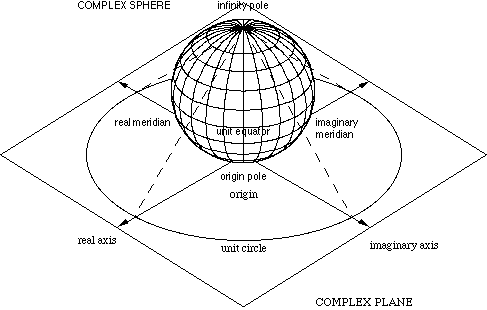


    This picture, from a site titled Strange and Complex, illustrates a one-to-one correspondence between the points of the complex plane and all the points of the sphere except for the North Pole.


    To complete the correspondence (to, in Shakespeare's words, make the sphere's image "all compact"), we may adjoin a "point at infinity" to the plane -- the image, under the revised correspondence, of the North Pole.


    For related poetry, see Stevens's "A Primitive Like an Orb."


    For more on the point at infinity, see the conclusion of Midsummer Eve's Dream.


    For Crowe's role as Santa's helper, consider how he has helped make known the poetry of Patrick Kavanagh, and see Kavanagh's "Advent":


    O after Christmas we'll have
        no need to go searching....


    ... Christ comes with a January flower.


    i.e. Christ Mass... as, for instance, performed by the six Jesuits who were murdered in El Salvador on this date in 1989.
      

  • The Empty Center

    From Stephen Mitchell, foreword to
    The Enlightened Heart:
    An Anthology of Sacred Poetry
    :


    “We dance round in a ring and suppose,
    But the Secret sits in the middle
        and knows,”
    Robert Frost wrote,
    looking in from the outside.
    Looking out from the inside,
        Chuang-tzu wrote,
    “When we understand, we are at
        the center of the circle,
    and there we sit while Yes and No
        chase each other
    around the circumference.”
    This anonymous center—
    which is called God
    in Jewish, Christian, and Moslem cultures,
    and Tao, Self, or Buddha
    in the great Eastern Traditions—
    is the realest of realities.


    From Wallace Stevens's
    A Primitive Like an Orb:


    The essential poem
        at the center of things....


    We do not prove
        the existence of the poem.
    It is something seen and known
        in lesser poems.


    From Namkaran Samskar:


    There is only one center in existence;
    the ancients used to call it
    Tao, Dharma, God.


    Those words have become old now;
    you can call it Truth.


    There is only one center of existence.

  • From the
    Empty Center:


    From Friday's 2:56 AM entry --


    Philip K. Dick,
    The Man in the High Castle:


    "Sun at the top.
    Tui at the bottom.
    Empty in the center."


    "Do you know
    what hexagram that is?"
    she said.
    "Without using the chart?"


    "Yes," Hawthorne said.


    "It's Chung Fu," Juliana said.
    "Inner Truth. I know
    without using the chart, too.
    And I know what it means."


    Margo Jefferson in
    today's NY Times
    :


    "When a classical text is modernized,
    what matters is imaginative logic.
    Is the transformation coherent?
    Does it enhance the power
    of the past and present?
    I say yes to both questions."


    Today's previous entry, "Aes Triplex," is actually from 1:48 PM EST yesterday.  (It was posted to my alternate site, log24.com, since log24.net was down for Xanga maintenance.)  "Aes Triplex" deals with image and reality.


    Its final link, to the heart of Rome, leads to Julius Caesar.


    A related review in today's New York Times:


    The opening paragraph:


    "We live in a media maelstrom, and the Moonwork theater company's 'Julius Caesar' comes hurtling toward us right from its center. This production, at the Connelly Theater in the East Village through Nov. 23, is set in the here and now.


    Shakespeare's


    'Julius Caesar' is about politics, rhetoric and power; about manipulation of a nation's image and its people; about conspiracy, murder and the war that leads to a new regime. What play is better suited for our times?"


    -- Margo Jefferson