Month: November 2003

  • The Proof and the Lie


    A mathematical lie has been circulating on the Internet.


    It concerns the background of Wiles’s recent work on mathematics related to Fermat’s last theorem, which involves the earlier work of a mathematician named Taniyama.


    This lie states that at the time of a conjecture by Taniyama in 1955, there was no known relationship between the two areas of mathematics known as “elliptic curves” and “modular forms.”


    The lie, due to Harvard mathematician Barry Mazur, was broadcast in a TV program, “The Proof,” in October 1997 and repeated in a book based on the program and in a Scientific American article, “Fermat’s Last Stand,” by Simon Singh and Kenneth Ribet, in November 1997.


    “… elliptic curves and modular forms… are from opposite ends of the mathematical spectrum, and had previously been studied in isolation.”


    Site on Simon Singh’s 1997 book Fermat’s Last Theorem


    “JOHN CONWAY: What the Taniyama-Shimura conjecture says, it says that every rational elliptic curve is modular, and that’s so hard to explain.


    BARRY MAZUR: So, let me explain.  Over here, you have the elliptic world, the elliptic curves, these doughnuts.  And over here, you have the modular world, modular forms with their many, many symmetries.  The Shimura-Taniyama conjecture makes a bridge between these two worlds.  These worlds live on different planets.  It’s a bridge.  It’s more than a bridge; it’s really a dictionary, a dictionary where questions, intuitions, insights, theorems in the one world get translated to questions, intuitions in the other world.


    KEN RIBET: I think that when Shimura and Taniyama first started talking about the relationship between elliptic curves and modular forms, people were very incredulous….”


    Transcript of NOVA program, “The Proof,” October 1997


    The lie spread to other popular accounts, such as the column of Ivars Peterson published by the Mathematical Association of America:


    “Elliptic curves and modular forms are mathematically so different that mathematicians initially couldn’t believe that the two are related.”


    Ivars Peterson, “Curving Beyond Fermat,” November 1999 


    The lie has now contaminated university mathematics courses, as well as popular accounts:


    “Elliptic curves and modular forms are completely separate topics in mathematics, and they had never before been studied together.”


    Site on Fermat’s last theorem by undergraduate K. V. Binns


    Authors like Singh who wrote about Wiles’s work despite their ignorance of higher mathematics should have consulted the excellent website of Charles Daney on Fermat’s last theorem.


    A 1996 page in Daney’s site shows that Mazur, Ribet, Singh, and Peterson were wrong about the history of the known relationships between elliptic curves and modular forms.  Singh and Peterson knew no better, but there is no excuse for Mazur and Ribet.


    Here is what Daney says:


    “Returning to the j-invariant, it is the 1:1 map betweem isomorphism classes of elliptic curves and C*. But by the above it can also be viewed as a 1:1 map j:H/r -> C.  j is therefore an example of what is called a modular function. We’ll see a lot more of modular functions and the modular group. These facts, which have been known for a long time, are the first hints of the deep relationship between elliptic curves and modular functions.”


    “Copyright © 1996 by Charles Daney,
    All Rights Reserved.
    Last updated: March 28, 1996″


    Update of Dec. 2, 2003


    For the relationship between modular functions and modular forms, see (for instance) Modular Form in Wikipedia.


    Some other relevant quotations:


    From J. S. Milne, Modular Functions and Modular Forms:


    “The definition of modular form may seem strange, but we have seen that such functions arise naturally in the [nineteenth-century] theory of elliptic functions.”


    The next quote, also in a nineteenth-century context, relates elliptic functions to elliptic curves.


    From Elliptic Functions, a course syllabus:


    “Elliptic functions parametrize elliptic curves.”


    Putting the quotes together, we have yet another description of the close relationship, well known in the nineteenth century (long before Taniyama’s 1955 conjecture), between elliptic curves and modular forms.


    Another quote from Milne, to summarize:


    “From this [a discussion of nineteenth-century mathematics], one sees that arithmetic facts about elliptic curves correspond to arithmetic facts about special values of modular functions and modular forms.”


    Serge Lang apparently agrees:


    Elliptic functions parametrize elliptic curves, and the intermingling of the analytic and algebraic-arithmetic theory has been at the center of mathematics since the early part of the nineteenth century.”


    Editorial description of Lang’s Elliptic Functions (second edition, 1987)


    Update of Dec. 3, 2003


    The theory of modular functions and modular forms, defined on the upper half-plane H and subject to appropriate tranformation laws with respect to the group Gamma = SL(2, Z) of fractional linear transformations, is closely related to the theory of elliptic curves, because the family of all isomorphism classes of elliptic curves over C can be parametrized by the quotient GammaH. This is an important, although formal, relation that assures that this and related quotients have a natural structure as algebraic curves X over Q. The relation between these curves and elliptic curves predicted by the Taniyama-Weil conjecture is, on the other hand, far from formal.”


    Robert P. Langlands, review of Elliptic Curves, by Anthony W. Knapp.  (The review  appeared in Bulletin of the American Mathematical Society, January 1994.)

  • Command at Mount Sinai


    Tuesday, Nov. 25, was the feast day of St. Catherine, patroness of a monastery at Mount Sinai. (See entries for that date.)


    “In a landmark essay,* the anthropologist Bernard S. Cohn showed how the command of language could become the language of command.


    – “Right formula for a nation in the making,”
         by Asad Latif


    * “The Command of Language
        and the Language of Command,”
        Subaltern Studies IV, pp. 276- 329


    † B.S.


    “I think writing about people in science and math is a way we can pay homage to genius and people we admire.  And it’s a way of saying, ‘You may be smarter, but I have the last word, I control you.’ “


    – Ira Hauptman, author of a play, “Partition,” about the mathematician Ramanujan and the culture of India


    No B.S.


    NY Times, Saturday,
    Nov. 29, 2003:


    B. S. Cohn,
    Expert on Culture
    of Modern India,
    Dies at 75


    CHICAGO, Nov. 28 — Bernard S. Cohn, who spent his life studying and writing about British influence on modern Indian culture and society, died here on Tuesday….


  • Understanding Media


    BBC News, March 2, 2002:


    “The Reverend Billy Graham has apologised for a taped conversation with former President Nixon in which he said the Jewish ‘stranglehold’ of the media was ruining the United States and must be broken.”


    “The ‘propaganda model’ of media operations laid out and applied by Edward Herman and Noam Chomsky in Manufacturing Consent: The Political Economy of the Mass Media postulates that elite media interlock with other institutional sectors in ownership, management and social circles, effectively circumscribing their ability to remain analytically detached from other dominant institutional sectors. The model argues that the net result of this is self-censorship without any significant coercion.” 


    A Critical Review and Assessment of
       Herman and Chomsky’s ‘Propaganda Model’
       by Jeffery Klaehn,
       European Journal of Communication,
       2002,
    Vol 17(2): 147–182. 


    “We are in a war of ideas.”


    – Defense Secretary Donald Rumsfeld,
       Oct. 24, 2003


    Toby Ziegler
    of West Wing


    THE WEST WING
    “NIGHT FIVE”


    WRITTEN BY: AARON SORKIN


    Transcription from http://communicationsoffice.tripod.com
    /3-13.txt


    Episode 3.13 — “Night Five”
    Original Airdate: February 6, 2002


    **************************


    PORTION OF THE TRANSCRIPT
    DEALING WITH A
    UN FOREIGN POLICY SPEECH


    **************************


    TOBY
    Our goal is to proclaim American values.


    ANDY
    This speech isn’t supposed to be about ideology. It’s supposed to be about reality.


    TOBY
    I think the President will decide what the speech is suppose to be about, but the reality is, the United States of America no longer sucks up to reactionaries, and our staunch allies will know what we mean.


    ANDY
    We don’t have any staunch allies in the Arab world; just reluctant ones.  We’ve a coalition held together with duct tape! A coalition without which we cannot fight!


    TOBY
    Nobody’s blowing off the coalition, and that coalition will be plenty strong….


    ANDY
    What’s Egypt going to think? Or Pakistan?


    TOBY
    That freedom and democracy are coming soon to a theatre near them, so get dressed.


    He sits on the edge of his desk.


    ANDY
    …. this one moment in time, you have to
    get off your horse and just… simply put – be nice to the Arab world.


    TOBY
    Be nice?


    ANDY
    Yes.


    TOBY
    Well… How about when we, instead of
    blowing Iraq back to the seventh century for harbouring terrorists and trying to develop nuclear weapons,
    we just imposed economic sanctions and were reviled by the Arab world….


    Supplemental reading:


    Who Rules America?


    Review of Abraham Foxman’s
    Never Again? The Threat of
    The New Anti-Semitism
    ,
    NY Times Book Review,
    November 30, 2003

  • Wheels for St. Catherine


    This java applet displays the wave functions of a particle in a three dimensional harmonic oscillator.”


    See also the Chapel of the Burning Bush at St. Catherine’s Monastery.

  • St. Catherine’s Day


    As the previous three entries indicate, I have little respect for the lies of the Bible.  Certain Christian traditions are, however, worthy of respect…. among them, the observance of Nov. 25 as St. Catherine’s Day.

  • Farewell to 40-Year Holiday


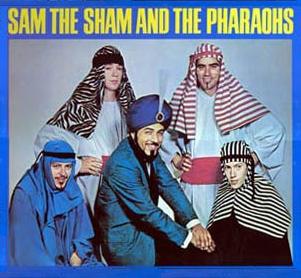
    Hope everyone had a happy “Sam the Sham Day,” a religious holiday with roots in the Book of Exodus:


    “We got the… name from the movie ‘The Ten Commandments.’ Old Ramses, the King of Egypt, looked pretty cool, so we decided to become The Pharaohs.”


    Sam the Sham


    (See also previous two entries.)

  • A Contribution to Trudeau’s
    Story Theory of Truth” –


    Epic of the Chosen People:


    After Forty Years
    in the Wilderness,


    The Winners Are…


    Dallas, 1963:


    Sam the Sham
    “started his music career
    in Dallas in the early sixties”
    – The Pharaohs Discography


    Leesville, La., 2003:


    Forty years later,
    Leesville to honor
    “Wooly Bully” singer


  • Epiphany


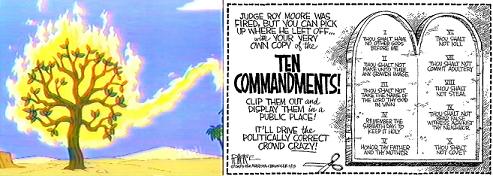
    Yesterday, to give thanks for the winning score in the Harvard-Yale game (Harvard won, 37 to 19), I browsed the Net to find the religious significance, if any, of the number “37.” I encountered the picture at left below, of a burning bush.  (It was frame 37 in a sequence of frames from an episode of The Simpsons.)  The finger of flame did not seem to lead to anything meaningful, so I ignored it.  (Frame 38 in the sequence seems to be a Simpsons version of Edward G. Robinson in “The Ten Commandments.”) Then today, lo and behold, the Commandments themselves appeared before my very eyes, as yet another cartoon… this time, on the editorial page of my local paper (reprinted from McKee in the Augusta Chronicle).  Combining the two cartoons, we see the Flaming Finger of God in action.


    The above thought process is, of course, less than mentally healthy, but may be of anecdotal interest to some.  Several other examples of religious insanity seem relevant:


    • Jesus Christ: The Number of His Name, by Bonnie Gaunt, which contains a riff on the number “37″ that John Nash at his looniest would be proud of.


    • Mel Gibson on his new film,
      “The Passion” –


      When Gibson was in Rome shooting the film, he told an Italian interviewer that he had felt moved by God’s spirit to undertake the project. I asked him what he’d meant by that. How did he know that God wanted him to make “The Passion”?


      “There are signals,” he said. “You get signals. Signs. ‘Signal graces,’ they’re called. It’s like traffic lights. It’s as clear as a traffic light. Bing! I mean, it just grabs you and you know you have to listen to that and you have to follow it.”


      Peter J. Boyer in The New Yorker


    • Finally, for religious enthusiasts who, like our President, have a Yale background, an article on the mystical properties of Yale’s score yesterday in the big game —


      19th Nervous Breakdown

  • For Saint Cecilia’s Day


    “Bastian Perrot… constructed a frame, modeled on a child’s abacus, a frame with several dozen wires on which could be strung glass beads of various sizes, shapes, and colors. The wires corresponded to the lines of the musical staff, the beads to the time values of the notes, and so on. … What later evolved out of that students’ sport and Perrot’s bead-strung wires bears to this day the name by which it became popularly known, the Glass Bead Game.”


    Hermann Hesse, Das Glasperlenspiel

    Compare and contrast:


    Marpurg Model


    Seifert Model