Month: August 2009

  • Annals of Aesthetics, continued:

    Pictures Within Pictures

    "The Chinese language is written in ideograms, pictures. Think of a DO NOT ENTER pictogram, a circle with a diagonal slash, a type of ideogram. It tells you what to do or not do, but not why. The why is part of a larger context, a bigger picture. Such is the nature of the Chinese language. Simple yet complex. Pictures within pictures."

    -- Customer review at Amazon.com

    See also the pictures in this journal on today's date five years ago.

  • Today's Sermon, continued:

    WIVB TV Buffalo, 2:56 PM ET Aug. 9, 2009, Severe Weather Statement accompanied by Instant Action 'Ace of Aces' aerial dogfight game

    See also "Chautauqua"
    at Stormfront.org and
     the five entries ending with
    "Unfriendly Persuasion"
    this morning.

    Background:
    "Today's Sinner"

  • Today's Sermon:

    Unfriendly Persuasion

    "What disturbs Americans of all ideological persuasions is the fear that almost everything, not just government, is fixed or manipulated by some powerful hidden hand...."

    -- Frank Rich in today's New York Times

    Franz Liebkind (played by Kenneth Mars) in 'The Producers,' with helmet and pigeon

    Author! Author!

  • Quarter to Three, continued:

    On the Waterfront

    "On the Hoboken waterfront, people scattered as pieces of debris fell from the sky. A wheel from one of the aircraft lay on Hoboken's Sinatra Drive." --Associated Press, August 8, 2009

    So set 'em up, Joe...

  • Annals of Aesthetics, continued:

    Angel and Beast

    Screenwriter Frank Pierson spoke at
    Chautauqua Institution this morning.

    The gist of his remarks may be found
    in an undated graduation speech
    at WarnerSisters.com.

    His suggested motto for filmmakers:
       "To reach and touch
         the angel in the beast."

    The Chautauquan Daily
    ,
    Friday, August 7, 2009
    by Sara Toth, staff writer --

    "Pierson listed his favorite movies as
    the Italian and French films that, after
    World War II, captivated him and his
    friends.
    'Those movies were overwhelmingly
    fascinating to us, and changed the way
    in which we saw movies, and the way we
    saw our lives and what we wanted to do
    with ourselves,' he said. 'There were so
    many that were absolutely marvelous.'
    Such movies are not made any
    more, Pierson said, and the quality
    of the movies now pale in comparison
    to those of the 1970s and 1980s.
    About once a year, the Coen brothers
    release a movie, and Woody Allen
    'occasionally' makes a good film,
    Pierson said. But the mainstream movies
    that are shown in the multiplexes now
    are geared toward only one audience:
    young men with disposable incomes.
    'That's really catering so extensively
    to a rather limited audience-- a mentally
    retarded and emotionally stunted
    audience at that-- that there's not a lot left
    over for the rest of us,' Pierson said."
  • Block that Metaphor:

    A Fisher of Men
     
     
    Cover, Schulberg's novelization of 'Waterfront,' Bantam paperback
    Update: The above image was added
    at about 11 AM ET Aug. 8, 2009.

     
    Dove logo, First United Methodist Church of Bloomington, Indiana
    From a webpage of the First United Methodist Church of Bloomington, Indiana--

    Dr. Joe Emerson, April 24, 2005--

    "The Ultimate Test"

    -- Text: I Peter 2:1-9

    Dr. Emerson falsely claims that the film "On the Waterfront" was based on a book by the late Budd Schulberg (who died yesterday). (Instead, the film's screenplay, written by Schulberg-- similar to an earlier screenplay by Arthur Miller, "The Hook"--  was based on a series of newspaper articles by Malcolm Johnson.)

    "The movie 'On the Waterfront' is once more in rerun. (That’s when Marlon Brando looked like Marlon Brando.  That’s the scary part of growing old when you see what he looked like then and when he grew old.)  It is based on a book by Budd Schulberg."

    Emerson goes on to discuss the book, Waterfront, that Schulberg wrote based on his screenplay--

    "In it, you may remember a scene where Runty Nolan, a little guy, runs afoul of the mob and is brutally killed and tossed into the North River.  A priest is called to give last rites after they drag him out."

    Hook on cover of Budd Schulberg's novel 'Waterfront' (NY Times obituary, detail)

    New York Times
    today

    Dr. Emerson flunks the test.

    Dr. Emerson's sermon is, as noted above (Text: I Peter 2:1-9), not mainly about waterfronts, but rather about the "living stones" metaphor of the Big Fisherman.

    My own remarks on the date of Dr. Emerson's sermon--

    The 4x6 array used in the Miracle Octad Generator of R. T. Curtis

    Those who like to mix mathematics with religion may regard the above 4x6 array as a context for the "living stones" metaphor. See, too, the five entries in this journal ending at 12:25 AM ET on November 12 (Grace Kelly's birthday), 2006, and today's previous entry.

  • Kind of Blue:

    The Running

    "Budd Schulberg, who wrote the award-winning screenplay for 'On the Waterfront' and created a classic American archetype of naked ambition, Sammy Glick, in his novel What Makes Sammy Run?, died on Wednesday. He was 95...."

    Running man with blue background on the cover of 'Eye of Cat,' by Roger Zelazny

    See, too, Blue Matrices, and
    a link for Beethoven's birthday:

    Juliette Binoche with musical score from Kieslowski's 'Blue'

    Song for the
    Unification of Europe

  • Annals of Aesthetics, continued:

    Word and Image

    NYT obituary summaries for Charles Gwathmey and Edward Hall, morning of Aug. 5, 2009

    From Hall's obituary
    :

    "Edward T. Hall, a cultural anthropologist
    who pioneered the study of nonverbal
     communication and interactions between
    members of different ethnic groups,
     died July 20 at his home in
     Santa Fe, N.M. He was 95."

    NY Times piece quoted here on
     the date of Hall's death:

    "July 20, 1969, was the moment NASA needed, more than anything else in this world, the Word. But that was something NASA's engineers had no specifications for. At this moment, that remains the only solution to recovering NASA's true destiny, which is, of course, to build that bridge to the stars."

    -- Tom Wolfe, author of The Right Stuff, an account of the Mercury Seven astronauts.

    Commentary
    --
    The Word according to St. John:

    Jill St. John, star of 'Diamonds are Forever'

    From Hall's obituary:

    "Mr. Hall first became interested in
    space and time as forms of cultural
     expression while working on
    Navajo and Hopi reservations
     in the 1930s."

    Log24, July 29
    :

    Changing Woman:

    "Kaleidoscope turning...

    Juliette Binoche in 'Blue'  The 24 2x2 Cullinane Kaleidoscope animated images

    Shifting pattern within   
    unalterable structure..."
    -- Roger Zelazny,  
    Eye of Cat  

    "We are the key."
    -- Eye of Cat  

    Update of about 4:45 PM 8/5:
    Paul Newall, "Kieślowski's Three Colours Trilogy"--

    "Julie recognises the music of the busker outside playing a recorder as that of her husband's. When she asks him where he heard it, he replies that he makes up all sorts of things. This is an instance of a theory of Kieślowski's that 'different people, in different places, are thinking the same thing but for different reasons.' With regard to music in particular, he held what might be characterised as a Platonic view according to which notes pre-exist and are picked out and assembled by people. That these can accord with one another is a sign of what connects people, or so he believed."

    The above photo of Juliette Binoche in Blue accompanying the quotations from Zelazny illustrates Kieślowski's concept, with graphic designs instead of musical notes. Some of the same designs are discussed in Abstraction and the Holocaust (Mark Godfrey, Yale University Press, 2007). (See the Log24 entries of June 11, 2009.)

    Related material:

    "Jeffrey Overstreet, in his book Through a Screen Darkly, comments extensively on Blue. He says these stones 'are like strands of suspended crystalline tears, pieces of sharp-edged grief that Julie has not been able to express.'....

    Throughout the film the color blue crops up, highlighting the mood of Julie's grief. A blue light occurs frequently, when Julie is caught by some fleeting memory. Accompanied by strains of an orchestral composition, possibly her husband's, these blue screen shots hold for several seconds while Julie is clearly processing something. The meaning of this blue light is unexplained. For Overstreet, it is the spirit of reunification of broken things."

    -- Martin Baggs at Mosaic Movie Connect Group on Sunday, March 15, 2009. (Cf. Log24 on that date.)

    For such a spirit, compare Binoche's blue mobile in Blue with Binoche's gathered shards in Bee Season.

  • Meet Mr. Black, or:

    Due Deference

    The New York Times today
    on architect Charles Gwathmey,
    who died Monday:

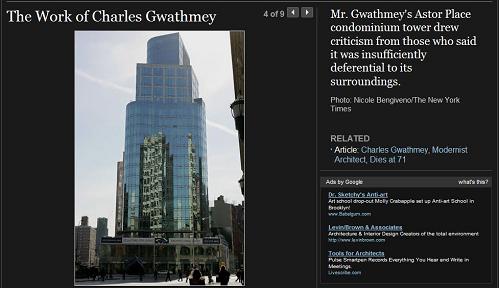
    "Mr. Gwathmey's Astor Place
    condominium tower drew
    criticism from those who
    said it was insufficiently
    deferential to its
      surroundings."

    Astor Place tower
    (click to enlarge):

    The image “http://www.log24.com/log/pix09A/090804-GwathmeyTowerSm.jpg” cannot be displayed, because it contains errors.

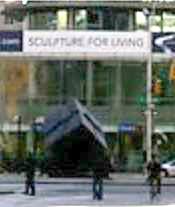
    Surroundings:

    http://www.log24.com/log/pix09A/090804-GwathmeyTowerDetail.jpg

    The above sculpture,
    popularly known as
    The Borg Cube,
    appeared here on
    Saturday:

    http://www.log24.com/log/pix09A/090801-CooperCube2.jpg

    Photo by Jesse Chan-Norris

    The Borg Cube, with
    Cooper Union at left

    For deferential remarks, see
    Annals of Collective Consciousness.

    See also the link
    from noon today to
    Nobel Prize Day, 2006,
    and the link there to
    J. G. Ballard on modernism.

    "So, there is one place
    where modernism triumphs.
    As in the cases of the pyramids
    and the Taj Mahal, the Siegfried line
     and the Atlantic wall, death always
     calls on the very best architects."

    -- J. G. Ballard,
    "A Handful of Dust"

  • Show and Tell:

    High Noon

    Images from Log24 on
    December 10, 2006 --
    Nobel Prize Day, and
    the day after
      Kirk Douglas's birthday--

    Kirk Douglas promoting his film 'Diamonds'

    Kirk Douglas ad for
    the film "Diamonds"
    (2000)

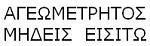
    Motto of Plato's Academy: 'Let no one ignorant of geometry enter'

    The 3x3 grid

    Images from
    Google News
       at noon today --

    (Click for details.)

    3x3 array of Cameron Douglas images from Google News, August 4, 2009

    "The serpent's eyes shine
        as he wraps around the vine..."

    -- Don Henley on a California hotel