Saturday Mourning
Part I:
Part II:

Click on images for details.
Part I:
Part II:
Click on images for details.
At right below, an image from the opening of Fox Studios Australia in Sydney on November 7, 1999. The Fox ceremonies included, notably, Kylie Minogue singing “Diamonds are a Girl’s Best Friend.”
For the mathematical properties of the red windmill (moulin rouge) figure at left, see Diamond Theory. |
First you will need to
prepare your sacred space….
Calling the Corners (or Quarters)
is something you will always do.”
“Some writers describe the
first draft as ‘making clay’….”
Quoted here
a year ago today:
“… she explores
the nature of identity
in a structure of
crystalline complexity.”
– Janet Burroway
(See ART WARS.)
Related material:

Amy Adams in Doubt

Amy Adams and Meryl Streep
at premiere of Doubt

Above:
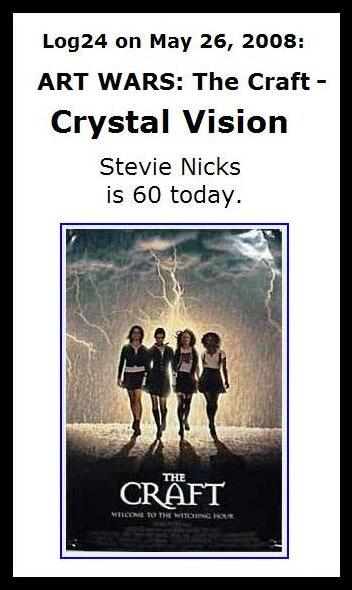
Craft, 1999
“The matron had given her
leave to go out as soon as
the women’s tea was over….”
– James Joyce, “Clay“
Plot:
“After arriving in India,
Indiana Jones is asked
by a desperate village
to find a mystical stone….”
New York Times
banner this morning:
Related material from
July 11, 2008:
|
The HSBC Logo Designer – Henry Steiner
Born in Austria and raised in New York, Steiner was educated at Yale under Paul Rand and attended the Sorbonne as a Fulbright Fellow. He is a past President of Alliance Graphique Internationale. Other professional affiliations include the American Institute of Graphic Arts, Chartered Society of Designers, Design Austria, and the New York Art Directors’ Club. His Cross-Cultural Design: Communicating in the Global Marketplace was published by Thames and Hudson (1995). |
|
Charles Taylor,
“Epiphanies of Modernism,” Chapter 24 of Sources of the Self (Cambridge U. Press, 1989, p. 477): “… the object sets up
See also Talking of Michelangelo.
|
Related material suggested by
an ad last night on
ABC’s Ugly Betty season finale:

Diamond from last night’s
Log24 entry, with
four colored pencils from
Diane Robertson Design:

See also
A Four-Color Theorem.
 |
Die (Tony Smith) |
|
|
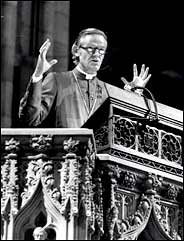
Paul Moore, Jr., retired Episcopal Bishop of New York, who died at home at 83 on the First of May, 2003 |
From “Secondary Structures,” by Tom Moody, Sculpture Magazine, June 2000:
“By the early ’90s, the perception of Minimalism as a ‘pure’ art untouched by history lay in tatters. The coup de grâce against the movement came not from an artwork, however, but from a text. Shortly after the removal of Richard Serra’s Tilted Arc from New York City’s Federal Plaza, Harvard art historian Anna Chave published ‘Minimalism and the Rhetoric of Power’ (Arts Magazine, January 1990), a rousing attack on the boys’ club that stops just short of a full-blown ad hominem rant. Analyzing artworks (Walter de Maria’s aluminum swastika, Morris’s ‘carceral images,’ Flavin’s phallic ‘hot rods’), critical vocabulary (Morris’s use of ‘intimacy’ as a negative, Judd’s incantatory use of the word ‘powerful’), even titles (Frank Stella’s National Socialist-tinged Arbeit Macht Frei and Reichstag), Chave highlights the disturbing undercurrents of hypermasculinity and social control beneath Minimalism’s bland exterior. Seeing it through the eyes of the ordinary viewer, she concludes that ‘what [most] disturbs [the public at large] about Minimalist art may be what disturbs them about their own lives and times, as the face it projects is society’s blankest, steeliest face; the impersonal face of technology, industry and commerce; the unyielding face of the father: a face that is usually far more attractively masked.’”
For a more attractively masked father figure, see the Terminator series:

For further religious background,
see “Jesus and the Terminator“
in Christianity Today.
The connection:
Abstract: “The Steiner system S(4,7,23) is constructed from the geometry of PG(3,2).”
Abstract: “The Steiner system S(5,8,24) is constructed from the geometry of PG(3,2).”
“By far the most important structure in design theory is the Steiner system
— “Block Designs,” 1995, by Andries E. Brouwer
“The Steiner system S(5, 8, 24) is a set S of 759 eight-element subsets (‘octads’) of a twenty-four-element set T such that any five-element subset of T is contained in exactly one of the 759 octads. Its automorphism group is the large Mathieu group M24.”
– The Miracle Octad Generator (MOG) of R.T. Curtis (webpage)
“… in 1861 Mathieu… discovered five multiply transitive permutation groups…. In a little-known 1931 paper of Carmichael… they were first observed to be automorphism groups of exquisite finite geometries.”
The 1931 paper of Carmichael is now available online from the publisher for $10.




 He is an internationally recognized corporate identity consultant. Based in Hong Kong, his work for clients such as HongkongBank, IBM and Unilever is a major influence in Pacific Rim design.



Recent Comments