Month: April 2009

  • For Shakespeare's Birthday:

    The Geometry
    of Language

    (continued from April 16)

    Background:

    Professor Arielle Saiber with chess set

    Click on the image for an
    interview with the author of
    Giordano Bruno and
    the Geometry of Language
    .

    Related material:

    Joyce on language --

    The sigla of 'Finnegans Wake'

    Bruno, Joyce, and coincidentia oppositorum

    Cullinane on geometry --

    Geometry of the I Ching (for comparison to Joyce's 'sigla')

    Click on images for details.

  • Annals of Religion:

    Theology for Holst

    "Timothy J. Holst, who joined the Ringling Brothers and Barnum & Bailey Circus as a lowly Keystone Kops clown, rose to the role of singing ringmaster, and ultimately became the show’s talent czar, died April 16 in São Paulo, Brazil, during a visit to sign up circus acts. He was 61."

    Tiene angel.

  • Today's Sermon:

    The Crimson Passion
    continues...

    (Background:
     Truth and Style)

    "We are here in the
    Church of St. Frank,
    where moral judgments
    permit the true believer
    to avoid any semblance
    of thought."
    -- Marjorie Garber on  
    Frank Kermode

    Today's sermon is a
    link to a London publication
    where one can purchase
     Kermode's excellent review
    of the following:

    Cover of Vermes's 'The Resurrection' - Picture of the Resurrection by Piero della Francesca

    Those who prefer
    Garber's Harvard sneer
    may consult
    The Crimson Passion
    and the following
     resurrection figure:

    The Harvard Jesus, by Nancy K. Dutton in the Harvard Crimson

    The Harvard Jesus     
    Crimson/Nancy K. Dutton    

  • Notes Toward a Fiction:

    Begettings of
    the Broken Bold

    Thanks for the following
    quotation ("Non deve...
     nella testa") go to the
    weblog writer who signs
    himself "Conrad H. Roth."

    Autobiography
    of Goethe

    (Vol. II, London, Bell & Daldy,
    1868, at Google Books):

    ... Yesterday I took leave of my Captain, with a promise of visiting him at Bologna on my return. He is a true 

    A PAPAL SOLDIER'S IDEAS OF PROTESTANTS 339
     
    representative of the majority of his countrymen. Here, however, I would record a peculiarity which personally distinguished him. As I often sat quiet and lost in thought he once exclaimed "Che pensa? non deve mai pensar l'uomo, pensando s'invecchia;" which being interpreted is as much as to say, "What are you thinking about: a man ought never to think; thinking makes one old." And now for another apophthegm of his; "Non deve fermarsi l'uomo in una sola cosa, perche allora divien matto; bisogna aver mille cose, una confusione nella testa;" in plain English, "A man ought not to rivet his thoughts exclusively on any one thing, otherwise he is sure to go mad; he ought to have in his head a thousand things, a regular medley."

    Certainly the good man could not know that the very thing that made me so thoughtful was my having my head mazed by a regular confusion of things, old and new. The following anecdote will serve to elucidate still more clearly the mental character of an Italian of this class. Having soon discovered that I was a Protestant, he observed after some circumlocution, that he hoped I would allow him to ask me a few questions, for he had heard such strange things about us Protestants that he wished to know for a certainty what to think of us.

    Notes for Roth:

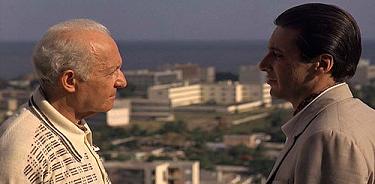
    Roth and Corleone in Havana

    The title of this entry,
    "Begettings of the Broken Bold,"
    is from Wallace Stevens's
    "The Owl in the Sarcophagus"--

    This was peace after death, the brother of sleep,
    The inhuman brother so much like, so near,
    Yet vested in a foreign absolute,

    Adorned with cryptic stones and sliding shines,
    An immaculate personage in nothingness,
    With the whole spirit sparkling in its cloth,

    Generations of the imagination piled
    In the manner of its stitchings, of its thread,
    In the weaving round the wonder of its need,

    And the first flowers upon it, an alphabet
    By which to spell out holy doom and end,
    A bee for the remembering of happiness.

    Peace stood with our last blood adorned, last mind,
    Damasked in the originals of green,
    A thousand begettings of the broken bold.

    This is that figure stationed at our end,
    Always, in brilliance, fatal, final, formed
    Out of our lives to keep us in our death....

    Related material:

    • Yesterday's entry on Giordano Bruno and the Geometry of Language
    • James Joyce and Heraldry
    • "One might say that he [Joyce] invented a non-Euclidean geometry of language; and that he worked over it with doggedness and devotion...." --Unsigned notice in The New Republic, 20 January 1941
    • Joyce's "collideorscape" (scroll down for a citation)
    • "A Hanukkah Tale" (Log24, Dec. 22, 2008)
    • Stevens's phrase from "An Ordinary Evening in New Haven" (Canto XXV)--

    Some further context:

    Roth's entry of Nov. 3, 2006--
    "Why blog, sinners?"--
    and Log24 on that date:
    "First to Illuminate."

  • Mathematics and Narrative, continued--

    Happy Birthday,
    Benedict XVI:


    A Game for Bishops
    continued from April 3

    Professor Arielle Saiber with chess set

    Click on the image for an
    interview with the author of
    Giordano Bruno and
    the Geometry of Language
    .

  • Annals of Fiction:

    Happy Ending

    For the birthday of
    red-haired revolutionary
    Thomas Jefferson

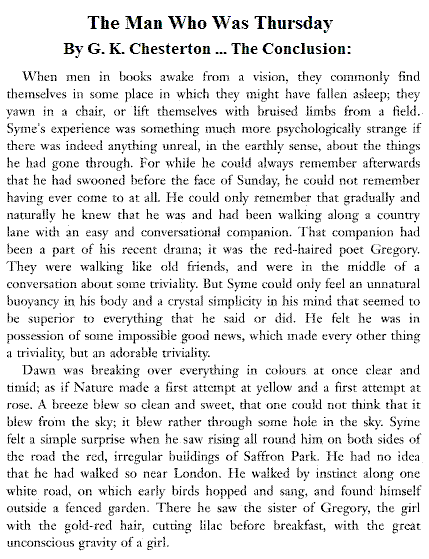
    'The Man Who Was Thursday'-- the conclusion

    Reba McEntire, illustration for her Palm Sunday, 2009, single 'Strange'

  • Easter Egg:

    Where Entertainment
    Is God
    , continued

    Dialogue from the classic film Forbidden Planet--

    "... Which makes it a gilt-edged priority that one of us gets into that Krell lab and takes that brain boost."

    -- Taken from a video (5:18-5:24 of 6:09) at David Lavery's weblog in the entry of Tuesday, April 7.

    (Cf. this journal on that date.)

    Thanks to Professor Lavery for his detailed notes on his viewing experiences.

    My own viewing recently included, on the night of Good Friday, April 10, the spiritually significant film Indiana Jones and the Kingdom of the Crystal Skull.

    The mystic circle of 13 aliens at the end of that film, together with Leslie Nielsen's Forbidden Planet remark quoted above, suggests the following:

    "The aim of Conway’s game M13 is to get the hole at the top point and all counters in order 1,2,…,12 when moving clockwise along the circle." --Lieven Le Bruyn

    http://www.log24.com/log/pix09/090411-M13.gif

    The illustration is from the weblog entry by Lieven Le Bruyn quoted below. The colored circles represent 12 of the 13 projective points described below, the 13 radial strokes represent the 13 projective lines, and the straight lines in the picture, including those that form the circle, describe which projective points are incident with which projective lines. The dot at top represents the "hole."

    From "The Mathieu Group M12 and Conway’s M13-Game" (pdf), senior honors thesis in mathematics by Jeremy L. Martin under the supervision of Professor Noam D. Elkies, Harvard University, April 1, 1996--

    "Let P3 denote the projective plane of order 3. The standard construction of P3 is to remove the zero point from a three-dimensional vector space over the field F3 and then identify each point x with -x, obtaining a space with (33 - 1)/2 = 13 points. However, we will be concerned only with the geometric properties of the projective plane. The 13 points of P3 are organized into 13 lines, each line containing four points. Every point lies on four lines, any two points lie together on a unique line, and any two lines intersect at a unique point....

    Conway [3] proposed the following game.... Place twelve numbered counters on the points... of P3 and leave the thirteenth point... blank. (The empty point will be referred to throughout as the "hole.") Let the location of the hole be p; then a primitive move of the game consists of selecting one of the lines containing the hole, say {p, q, r, s}. Move the counter on q to p (thus moving the hole to q), then interchange the counters on r and s....

    There is an obvious characterization of a move as a permutation in S13, operating on the points of P3. By limiting our consideration to only those moves which return the hole to its starting point.... we obtain the Conway game group. This group, which we shall denote by GC, is a subgroup of the symmetric group S12 of permutations of the twelve points..., and the group operation of GC is concatenation of paths. Conway [3] stated, but did not prove explicitly, that GC is isomorphic to the Mathieu group M12. We shall subsequently verify this isomorphism.

    The set of all moves (including those not fixing the hole) is given the name M13 by Conway. It is important that M13 is not a group...."

    [3] John H. Conway, "Graphs and Groups and M13," Notes from New York Graph Theory Day XIV (1987), pp. 18–29.


    Another exposition (adapted to Martin's notation) by Lieven le Bruyn (see illustration above):

    "Conway’s puzzle M13 involves the 13 points and 13 lines of P3. On all but one point numbered counters are placed holding the numbers 1,…,12 and a move involves interchanging one counter and the 'hole' (the unique point having no counter) and interchanging the counters on the two other points of the line determined by the first two points. In the picture [above] the lines are represented by dashes around the circle in between two counters and the points lying on this line are those that connect to the dash either via a direct line or directly via the circle. In the first part we saw that the group of all reachable positions in Conway's M13 puzzle having the hole at the top position contains the sporadic simple Mathieu group M12 as a subgroup."

    For the religious significance of the circle of 13 (and the "hole"), consider Arthur and the 12 knights of the round table, et cetera.

    But seriously...
     
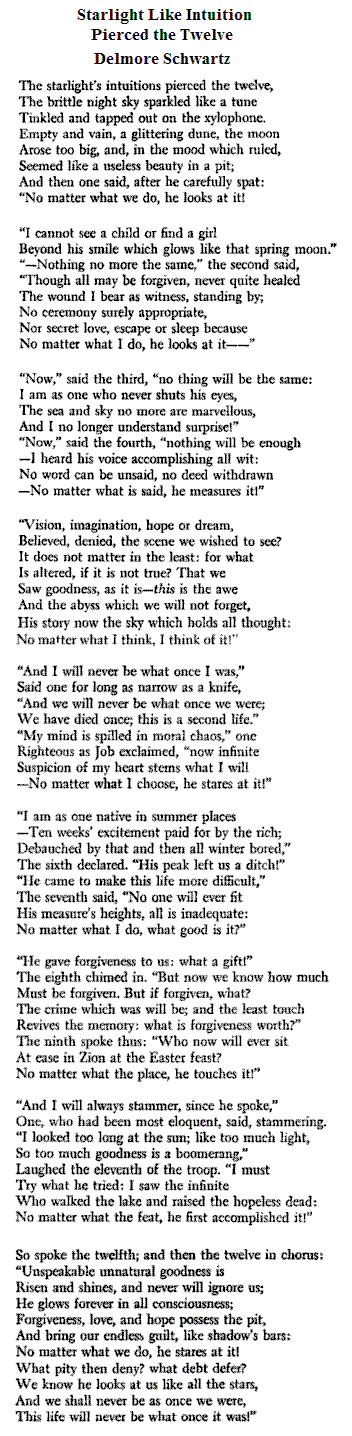
    Delmore Schwartz, 'Starlight Like Intuition Pierced the Twelve'
  • On Holy Saturday:

    Meditation

    From a professor's weblog:

    Saturday, April 11, 2009

    Quote of the Day (4/11/09) (Elias Canetti Week)

    "The novel should not be in any hurry. Once, hurry belonged to its sphere, now the film has taken that over; measured by the film, the hasty novel must always remain inadequate. The novel, as a creature of calmer times, may carry something of that old calm into our new hastiness. It could serve many people as slow-motion; it could induce them to tarry; it could replace the empty meditations of their cults."

    --Elias Canetti, The Human Province

    Posted by David Lavery at 1:00 AM

  • Good Friday Meditation:

    Pilate Goes
    to Kindergarten

    "There is a pleasantly discursive
     treatment of Pontius Pilate's
    unanswered question
    'What is truth?'."

    -- H. S. M. Coxeter, 1987,
    introduction to Trudeau's
     remarks on the "Story Theory"
     of truth as opposed to the
    "Diamond Theory" of truth in
     The Non-Euclidean Revolution

    Consider the following question in a paper cited by V. S. Varadarajan:

    E. G. Beltrametti, "Can a finite geometry describe physical space-time?" Universita degli studi di Perugia, Atti del convegno di geometria combinatoria e sue applicazioni, Perugia 1971, 57–62.

    Simplifying:

    "Can a finite geometry describe physical space?"

    Simplifying further:

    "Yes. Vide 'The Eightfold Cube.'"

    Froebel's 'Third Gift' to kindergarteners: the 2x2x2 cube

  • Holy Thursday:

    Rhetorical Question

    "What wine does one drink?
    What bread does one eat?"

    -- Wallace Stevens

    Image from April 4, 2007:
    the key date in The Eight
    and the date that year of
    Spy Wednesday:

    Baugin: Bread, Wine, Chessboard

    Nature morte à l'échiquier
     (les cinq sens),
    "vers 1655, une narration
    à valeur symbolique..."
    Huile sur bois, 73 x 55 cm
    Musée du Louvre, Paris