Month: February 2009

  • Today's Sermon:

    The Sound of Silence
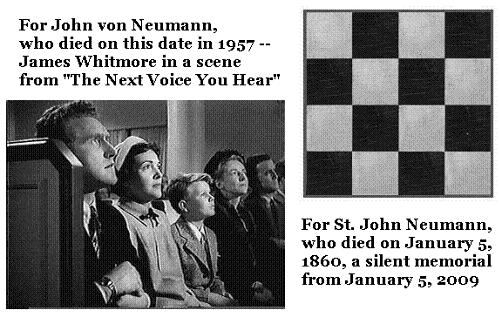
    Memorial sermon for John von Neumann, who died on Feb. 8,  1957

    See also yesterday's entry
    on philosophy professor
    Joan Stambaugh and the
    fabrication of a now-famous saying
       falsely attributed to Einstein--
    that the Bible is "pretty childish."

    Stambaugh advocates
    a Zen form of nihilism.

    The 4x4 space illustrated
    above is a Western form
    of the the Sunyata, or
    emptiness, discussed by
    Stambaugh in
    The Formless Self.

    It appeared in this journal
    on the feast day this year
    of St. John Neumann.

  • Culture Wars continued:

    Childish Things

    (continued from Thursday's
    "Through the Looking Glass")

    DENNIS OVERBYE


    "From the grave, Albert Einstein poured gasoline on the culture wars between science and religion this week.

    A letter the physicist wrote in 1954 to the philosopher Eric Gutkind, in which he described the Bible as 'pretty childish' and scoffed at the notion that the Jews could be a 'chosen people,' sold for $404,000 at an auction in London. That was 25 times the presale estimate."

    Einstein did not, at least in the place alleged, call the Bible "childish." Proof:

    Proof that Einstein did not call the Bible 'childish'

    The image of the letter is
    from the Sept./Oct. 2008
    Search Magazine
    .

    By the way, today is
    the birthday of G. H. Hardy.

    Here is an excerpt from his
    thoughts on childish things:

    "What 'purely aesthetic' qualities can we distinguish in such theorems as Euclid's or Pythagoras's?.... In both theorems (and in the theorems, of course, I include the proofs) there is a very high degree of unexpectedness, combined with inevitability and economy. The arguments take so odd and surprising a form; the weapons used seem so childishly simple when compared with the far-reaching results; but there is no escape from the conclusions."

    Eightfold (2x2x2) cube

    "Space: what you
    damn well have to see."

    -- James Joyce, Ulysses  

  • ART WARS continued:

    Eternal City


    Today's New York Times
    :

    "Olga Raggio was born in Rome on Feb. 5, 1926, to a Russian mother and an Italian father. She earned a diploma from the Vatican library school in 1947 and a Ph.D. from the University of Rome in 1949."

    "... Raggio, an internationally known scholar and curator who in almost 60 years with the Metropolitan Museum of Art organized some of its best-known exhibitions, scoured the world for treasure and coaxed rarely seen artworks from places as far flung as the Vatican and as close at hand as a New Jersey abbey, died on Jan. 24 in the Bronx. She was 82 and lived in Manhattan."

    Quoted here on the date of Raggio's death:

    "Death is not earnest in the same way the eternal is. To the earnestness of death belongs precisely that capacity for awakening, that resonance of a profound mockery which, detached from the thought of the eternal, is an empty and often brash jest, but together with the thought of the eternal is just what it should be, utterly different from the insipid solemness which least of all captures and holds a thought with tension like that of death."

    -- Soren Kierkegaard, Works of Love, Harper Torchbooks, 1964, p. 324

    Related material:

      February 2, 3, and 4 as well as
      February 5 (Raggio's birthday).

  • ART WARS in review--

    Through the
    Looking Glass:

    A Sort of Eternity


    From the new president's inaugural address:

    "... in the words of Scripture, the time has come to set aside childish things."

    The words of Scripture:

    9  For we know in part, and we prophesy in part.
    10  But when that which is perfect is come, then that which is in part shall be done away.
    11  When I was a child, I spake as a child, I understood as a child, I thought as a child: but when I became a man, I put away childish things.
    12  For now we see through a glass, darkly, but then face to face: now I know in part; but then shall I know even as also I am known.

    -- First Corinthians 13


    "through a glass"
    --

    [di’ esoptrou].
    By means of
    a mirror [esoptron]
    .

    Childish things:

    Froebel's third gift, the eightfold cube
    © 2005 The Institute for Figuring

    Photo by Norman Brosterman
    fom the Inventing Kindergarten
    exhibit at The Institute for Figuring
    (co-founded by Margaret Wertheim)


    Not-so-childish:

    Three planes through
    the center of a cube
    that split it into
    eight subcubes:
    Cube subdivided into 8 subcubes by planes through the center
    Through a glass, darkly:

    A group of 8 transformations is
    generated by affine reflections
    in the above three planes.
    Shown below is a pattern on
    the faces of the 2x2x2 cube
     that is symmetric under one of
    these 8 transformations--
    a 180-degree rotation:

    Design Cube 2x2x2 for demonstrating Galois geometry

    (Click on image
    for further details.)

    But then face to face:

    A larger group of 1344,
    rather than 8, transformations
    of the 2x2x2 cube
    is generated by a different
    sort of affine reflections-- not
    in the infinite Euclidean 3-space
    over the field of real numbers,
    but rather in the finite Galois
    3-space over the 2-element field.

    Galois age fifteen, drawn by a classmate.

    Galois age fifteen,
    drawn by a classmate.


    These transformations

    in the Galois space with
    finitely many points
    produce a set of 168 patterns
    like the one above.
    For each such pattern,
    at least one nontrivial
    transformation in the group of 8
    described above is a symmetry
    in the Euclidean space with
    infinitely many points.

    For some generalizations,
    see Galois Geometry.

    Related material:

    The central aim of Western religion--

    "Each of us has something to offer the Creator...
    the bridging of
    masculine and feminine,
    life and death.
    It's redemption.... nothing else matters."
    -- Martha Cooley in The Archivist (1998)

    The central aim of Western philosophy--

     Dualities of Pythagoras
    as reconstructed by Aristotle:
      Limited Unlimited
      Odd Even
      Male Female
      Light Dark
      Straight Curved
      ... and so on ....

    "Of these dualities, the first is the most important; all the others may be seen as different aspects of this fundamental dichotomy. To establish a rational and consistent relationship between the limited [man, etc.] and the unlimited [the cosmos, etc.] is... the central aim of all Western philosophy."

    -- Jamie James in The Music of the Spheres (1993)

    "In the garden of Adding
    live Even and Odd...
    And the song of love's recision
    is the music of the spheres."

    -- The Midrash Jazz Quartet in City of God, by E. L. Doctorow (2000)

    A quotation today at art critic Carol Kino's website, slightly expanded:

    "Art inherited from the old religion
    the power of consecrating things
    and endowing them with
    a sort of eternity;
    museums are our temples,
    and the objects displayed in them
    are beyond history."

    -- Octavio Paz,"Seeing and Using: Art and Craftsmanship," in Convergences: Essays on Art and Literature (New York: Harcourt Brace Jovanovich 1987), 52 

    From Brian O'Doherty's 1976 Artforum essays-- not on museums, but rather on gallery space:

    "Inside the White Cube"

    "We have now reached
    a point where we see
    not the art but the space first....
    An image comes to mind
    of a white, ideal space
    that, more than any single picture,
    may be the archetypal image
    of 20th-century art."

    http://www.log24.com/log/pix09/090205-cube2x2x2.gif

    "Space: what you
    damn well have to see."

    -- James Joyce, Ulysses  

  • ART WARS continued:

    Overkill
     
    In memory of
    James Joyce and of
    Patrick McGoohan.
    who both died on
    a January 13th --
    Scene from 'The Seventh Seal
    Baby Blues cartoon on global positioning systems

    Related material:

    The phrase
    "Habitat Global Village"
    in the previous entry.

    Marshall McLuhan was
    apparently the originator
    of the phrase
    "global village."

    The phrase, coined by McLuhan,
     a Catholic, should be associated
    more with Rome than
    with Americus, Georgia.

    "The association is the idea."
    -- Ian Lee, The Third Word War

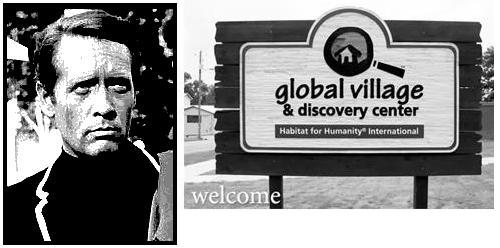
    Number Six meets Global Village

  • Knock, Knock, Knockin'...

    Enter

    'Times Talks' at The New York Times

    Click on images below
    for further details.

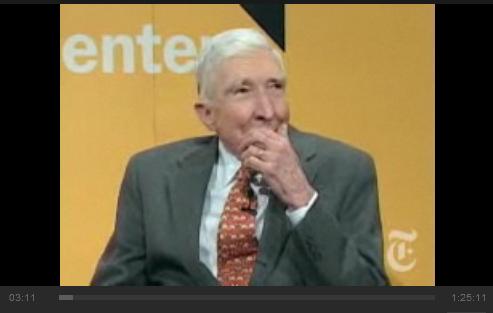
    Millard Fuller and John Updike in the New York Times obituaries

    John Updike discusses his sequel to 'The Witches of Eastwick'

    "A strange thing then happened."

    -- L. Frank Baum

  • Annals of Religion:

    Roger Cohen's Version

    From this afternoon's footprints:

    Israel
    A
    /438080412/item/?
    Your Site
    2/3/2009
    3:34 PM

  • Annals of Philosophy:

    Everything and Nothing

    "I know what 'nothing' means...."

    -- Joan Didion, Play It As It Lays, Farrar, Straus and Giroux, 1990 paperback, page 214

    "In 1935, near the end of a long affectionate letter to his son George in America, James Joyce wrote: 'Here I conclude. My eyes are tired. For over half a century they have gazed into nullity, where they have found a lovely nothing.'"

    -- Lionel Trilling, "James Joyce in His Letters," Commentary, 45, no. 2 (Feb. 1968), abstract

    "The quotation is from The Letters of James Joyce, Volume III, ed. Richard Ellman (New York, 1966), p. 359. The original Italian reads 'Adesso termino. Ho gli occhi stanchi. Da più di mezzo secolo scrutano nel nulla dove hanno trovato un bellissimo niente.'"

    -- Lionel Trilling: Criticism and Politics, by William M. Chace, Stanford U. Press, 1980, page 198, Note 4 to Chapter 9

    "Space: what you damn well have to see."

    -- James Joyce, Ulysses

    "What happens to the concepts of space and direction if all the matter in the universe is removed save a small finite number of particles?"

    -- "On the Origins of Twistor Theory," by Roger Penrose

    "... we can look to the prairie, the darkening sky, the birthing of a funnel-cloud to see in its vortex the fundamental structure of everything..."

    -- Against the Day, by Thomas Pynchon (See previous entry.)

    "A strange thing then happened."

    -- L. Frank Baum

  • ART WARS continued:

    Against the Day

    is a novel by Thomas Pynchon
    published on Nov. 21, 2006, in
    hardcover, and in paperback on
    Oct. 30, 2007 (Devil's Night).

    Perhaps the day the title
    refers to is one of the above
    dates... or perhaps it is--

    Groundhog Day

    The Candlebrow Conference
    in Pynchon's Against the Day:

    The conferees had gathered here from all around the world.... Their spirits all one way or another invested in, invested by, the siegecraft of Time and its mysteries.

    "Fact is, our system of so-called linear time is based on a circular or, if you like, periodic phenomenon-- the earth's own spin. Everything spins, up to and including, probably, the whole universe. So we can look to the prairie, the darkening sky, the birthing of a funnel-cloud to see in its vortex the fundamental structure of everything--"

    Quaternion in finite geometry
    Quaternion by
    S. H. Cullinane

    "Um, Professor--"....

    ... Those in attendance, some at quite high speed, had begun to disperse, the briefest of glances at the sky sufficing to explain why. As if the professor had lectured it into being, there now swung from the swollen and light-pulsing clouds to the west a classic prairie "twister"....

    ... In the storm cellar, over semiliquid coffee and farmhouse crullers left from the last twister, they got back to the topic of periodic functions....

    "Eternal Return, just to begin with. If we may construct such functions in the abstract, then so must it be possible to construct more secular, more physical expressions."

    "Build a time machine."

    "Not the way I would have put it, but if you like, fine."

    Vectorists and Quaternionists in attendance reminded everybody of the function they had recently worked up....

    "We thus enter the whirlwind. It becomes the very essence of a refashioned life, providing the axes to which everything will be referred. Time no long 'passes,' with a linear velocity, but 'returns,' with an angular one.... We are returned to ourselves eternally, or, if you like, timelessly."

    "Born again!" exclaimed a Christer in the gathering, as if suddenly enlightened.

    Above, the devastation had begun.

    Related material:
    Yesterday's entry and
    Pynchon on Quaternions.

    Happy birthday,
    James Joyce.

  • Mathematics and Narrative, continued:

    "For every kind of vampire,
    there is a kind of cross."
    -- Gravity's Rainbow

    Quaternion in finite geometry

    Quaternion

    Happy St. Brigid's Day.