Month: January 2009

  • Signs of the Times:

    Harvard, Magic,
    and The New York Times

    The New York Times Magazine for next Sunday:

    The Edge of the Mystery, by Matt Bai–

    “Weeks before the election of 1960, Norman Mailer, already an accomplished novelist, sat down to write his first major work of political journalism, an essay for Esquire in which he argued that only John F. Kennedy could save America… the only kind of leader who could rescue it, who could sweep in an era of what Mailer called ‘existential’ politics, was a ‘hipster’ hero– someone who welcomed risk and adventure, someone who sought out new experience, both for himself and for the country….

    … Mailer essentially created a new genre for a generation of would-be literary philosophers covering politics….  By 1963, Mailer and other idealists were crushed to discover that Kennedy was in fact a fairly conventional and pragmatic politician, more Harvard Yard than Fortress of Solitude.”

    The New York Times today:

    Magic and Realism, by Roger Cohen–

    “… what I want from the Obama administration is something more than Harvard-to-the-Beltway smarts. I want magical realism.”

    Mailer and Cohen, taken together, suggest I should review two authors– Picard and Hesse– I encountered as a Harvard freshman in 1960.

    Max Picard:

    “In the ‘Prologue in Heaven’ in Goethe’s Faust a powerful silence is produced by the powerful word after each verse. There is an active, audible silence after every verse. The things that were moved into position by the word stand motionless in the silence, as if they were waiting to be called back into the silence and to disappear therein. The word not only brings the things out of silence; it also produces the silence in which they can disappear again.”

    Goethe:

    DER HERR:
    Kennst du den Faust?

    MEPHISTOPHELES:
    Den Doktor?

    DER HERR:
    Meinen Knecht!

    Online Etymology Dictionary:

    knight
    O.E. cniht “boy, youth, servant,” common W.Gmc. (cf. O.Fris. kniucht, Du. knecht, kneht “boy, youth, lad,” Ger. Knecht “servant, bondsman, vassal”), of unknown origin. Meaning “military follower of a king or other superior” is from c.1100. Began to be used in a specific military sense in Hundred Years War, and gradually rose in importance through M.E. period until it became a rank in the nobility 16c. The verb meaning “to make a knight of (someone)” is from c.1300. Knighthood is O.E. cnihthad M.H.G. “the period between childhood and manhood;” sense of “rank or dignity of a knight” is from c.1300. The chess piece so called from c.1440.

    Further background on the word “Knecht”–

    'Magister Ludi,' or 'The Glass Bead Game,' by Hermann Hesse

    Epigraph to Magister Ludi
    (Joseph Knecht’s translation):


    “… For although in a certain sense and for light-minded persons non-existent things can be more easily and irresponsibly represented in words than existing things, for the serious and conscientious historian it is just the reverse. Nothing is harder, yet nothing is more necessary, than to speak of certain things whose existence is neither demonstrable nor probable. The very fact that serious and conscientious men treat them as existing things brings them a step closer to existence and to the possibility of being born.”

  • Heaven’s…

    Gate
     or, Everybody
    Comes to Rick’s
    (abstract version)

    For Mary Gaitskill,
    continued from
    June 21, 2008:
     
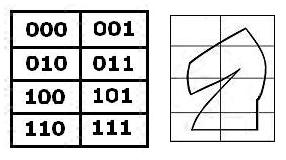
    Designer's grid-- 6x4 array of squares, each with 4 symmetry axes

    This minimal art
    is the basis of the
    chess set image
    from Tuesday:

     Chess set design by F. Lanier Graham, 1967

    Related images:

    Doors of Rick's Cafe Americain in 'Casablanca'

    Bogart and Lorre in 'Casablanca' with chessboard and cocktail

    The key is the
    cocktail that begins
    the proceedings.”

    – Brian Harley,
    Mate in Two Moves

  • Still the same old story:


    A Fight for
    Love and Glory

    The 8-point star
    of Venus:

    Eight-point star of Venus

    This star is suggested by
    the Spanish name “Lucero”
    and by the following
    passage from Heinlein’s
    classic novel Glory Road:

        ”I have many names. What would you like to call me?”

        “Is one of them ‘Helen’?”

        She smiled like sunshine and I learned that she had dimples. She looked sixteen and in her first party dress. “You are very gracious. No, she’s not even a relative. That was many, many years ago.” Her face turned thoughtful. “Would you like to call me ‘Ettarre’?”

        “Is that one of your names?”

        “It is much like one of them, allowing for different spelling and accent. Or it could be ‘Esther’ just as closely. Or ‘Aster.’ Or even ‘Estrellita.’”

        “‘Aster,’” I repeated. “Star. Lucky Star!”

    Ricardo Montalban, d. Jan. 14, 2009-- NY Times
     
    Que descanse en paz.

    Little Mermaid bed

    Later the same evening…
    an update in memory
    of Patrick McGoohan:

    NYT obituaries 1/14/09 for both Ricardo Montalban and Patrick McGoohan

    “There is one story and one story only
    That will prove worth your telling….
     
    …of the undying snake from chaos hatched,
    Whose coils contain the ocean,
    Into whose chops with naked sword he springs,
    Then in black water, tangled by the reeds,
    Battles three days and nights,
    To be spewed up beside her scalloped shore….”
     
    – Robert Graves,
       “To Juan at the Winter Solstice”

  • Mathematics and Narrative, continued:

    Eight is a Gate

    'The Eight,' by Katherine Neville

    Customer reviews of Neville's 'The Eight'

    From the most highly
    rated negative review:

    “I never did figure out
    what ‘The Eight’ was.”

    Various approaches
    to this concept
    (click images for details):

    The Fritz Leiber 'Spider' symbol in a square

    A Singer 7-cycle in the Galois field with eight elements

    The Eightfold (2x2x2) Cube

    The Jewel in Venn's Lotus (photo by Gerry Gantt)

    Tom O'Horgan in his loft. O'Horgan died Sunday, Jan. 11, 2009.

    Bach, Canon 14, BWV 1087

  • Annals of Aesthetics:

    Something Traditional –

    “German Chancellor Dr. Angela Merkel is the Charlemagne Prize laureate of 2008…. The prize will be awarded on 1 May, Ascension Day.”

    The City of Aachen

    Something Modern –

    Previously undescribed in this journal:

    A chess set
    by F. Lanier Graham
    of modular design:

    Interlocking chess pieces by F. Lanier Graham, 1967

    A NOTE BY THE DESIGNER

    “The traditional chess set, with its naturalistic images of medieval armies, suggests a game between combatants who enjoy the winning of battles. This chess set, with its articulated images of abstract force, suggests a game between contestants who enjoy the process of thinking.
       
    The primary principle of this design… is that the operating reality or function of each piece– both its value and how it moves– is embodied in a simple self-expressive form….

    Chess pieces by F. Lanier Graham, 1967

    Design Copyright F. Lanier Graham 1967


    These pieces are designed to have the look and feel of little packages of power. The hardwoods (walnut and korina) are left unfinished, not only because of tactile values, but also to emphasize the simplicity of the design. The interlocking blocks are packaged to reflect the essential nature of the game– rational recreation, played with basic units whose fields of force continuously interact in subtle, complex patterns.”

    – F. Lanier Graham, 1967

    For those whose tastes in recreation are less rational, there is also the legendary chess set of Charlemagne described in novels by Katherine Neville. (See ART WARS.)

    Related material: this journal on the First of May, 2008, the date of last year’s Charlemagne award.

  • ART WARS continued:

    The Mists of
    Brooklyn

    Carol Kino
    in today’s New York Times:

    “Typically, each piece depicts a monumentally sized object that often comments archly on its surroundings….”

    Architectural vesica piscis

    Architectural
    Vesica Piscis

    Arch at Glastonbury Tor

    Arch at
    Glastonbury Tor

    For some context, see

    NY Times front page, Sunday morning, Jan. 11, 2009: Brooklyn Bridge and Sinatra

    The ashes of Bradley,
    who wrote about Camelot
    in The Mists of Avalon,
     are said to have been
    scattered at Glastonbury Tor.

    For material on the afterlife
    and Brooklyn, see
    Only the Dead.

  • Today’s Sermon:

    A Minor Metaphor

                         … we know that we use
    Only the eye as faculty, that the mind
    Is the eye, and that this landscape of the mind


    Is a landscape only of the eye; and that
    We are ignorant men incapable
    Of the least, minor, vital metaphor….


    – Wallace Stevens, “Crude Foyer”


                                                   … So, so,
    O son of man, the ignorant night, the travail
    Of early morning, the mystery of the beginning
    Again and again,
                             while History is unforgiven.

    – Delmore Schwartz,
      “In the Naked Bed, in Plato’s Cave

    For those who prefer
    stories to truth,
    I recommend the
    blue matrices of
    Marion Zimmer Bradley’s
    Darkover stories.
    Bradley also wrote
    The Mists of Avalon.

    Happy birthday to
    David Wolper,
    who produced the
    TV version of Mists.

    Related material:
    Diamonds Are Forever

  • O Tannenbaum:

    A Russian Doll

    Introduction

    The 3x3 square

    For details of the story,
    click on the images.

    Chapter I:

    'The Power Of The Center: A Study of Composition in the Visual Arts,' by Rudolf Arnheim

    Chapter II:

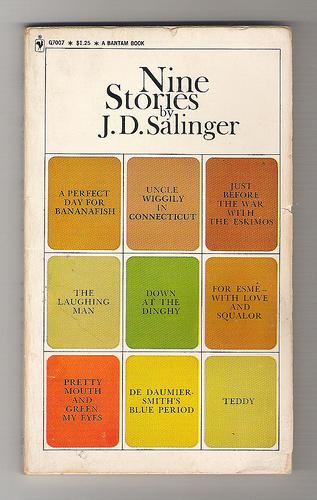
    Cover of 'Nine Stories' with 'Dinghy' at center

    Chapter III:

    Natasha’s Dance

    Orson Welles with chessboard


    and the following quotation:

    There is no landing fee in Avalon,
     or anywhere else in Catalina.”

  • In Loco Citato:

    Stories
    for Mary Karr

    “In reality, my prose books
    probably sit between
    I Was a Teenage Sex Slave
    and some other contemporary
    memoir written in five minutes….”

    Mary Karr in the NY Times
    of July 6, 2007

    Story of M, Story of N, Story of O

    See also
    Ballet Blanc
    and the true story
    0, 1, 2, 3, ….

    “In a dream scenario, my memoirs…
    would find another shelf.
    They’d sit between St. Augustine
      and Nabokov’s Speak, Memory….”

    – Mary Karr, loc. cit.

    Recall the
    mnemonic rhyme
    Nine is a Vine.”