Month: October 2008

  • Annals of Philosophy:

    Serious Numbers

    A Yom Kippur
    Meditation

    “When times are mysterious
    Serious numbers
    Will always be heard.”
    — Paul Simon,
    “When Numbers Get Serious”

    “There is a pleasantly discursive treatment of Pontius Pilate’s unanswered question ‘What is truth?’”

    – H. S. M. Coxeter, introduction to Richard J. Trudeau’s remarks on the “story theory” of truth as opposed to the “diamond theory” of truth in The Non-Euclidean Revolution

    Trudeau’s 1987 book uses the phrase “diamond theory” to denote the philosophical theory, common since Plato and Euclid, that there exist truths (which Trudeau calls “diamonds”) that are certain and eternal– for instance, the truth in Euclidean geometry that the sum of a triangle’s angles is 180 degrees. As the excerpt below shows, Trudeau prefers what he calls the “story theory” of truth–

    “There are no diamonds. People make up stories about what they experience. Stories that catch on are called ‘true.’”

    (By the way, the phrase “diamond theory” was used earlier, in 1976, as the title of a monograph on geometry of which Coxeter was aware.)
    Richard J. Trudeau on the 'Story Theory' of truth

    Excerpt from
    The Non-Euclidean Revolution

    What does this have to do with numbers?

    Pilate’s skeptical tone suggests he may have shared a certain confusion about geometric truth with thinkers like Trudeau and the slave boy in Plato’s Meno. Truth in a different part of mathematics– elementary arithmetic– is perhaps more easily understood, although even there, the existence of what might be called “non-Euclidean number theory”– i.e., arithmetic over finite fields, in which 1+1 can equal zero– might prove baffling to thinkers like Trudeau.

    Trudeau’s book exhibits, though it does not discuss, a less confusing use of numbers– to mark the location of pages. For some philosophical background on this version of numerical truth that may be of interest to devotees of the Semitic religions on this evening’s High Holiday, see Zen and Language Games.

    For uses of numbers that are more confusing, see– for instance– the new website The Daily Beast and the old website Story Theory and the Number of the Beast.

  • Something Eternal:

    The Color Grey

    The previous two entries mention,
     and illustrate, the color grey.

    Another illustration, on the cover
    of one of my favorite books:

    'Winter Count,' by Barry Holstun Lopez

    “A
    colour is eternal.
    It haunts time like a spirit.”
    Alfred North Whitehead   

    From John Lahr’s
    winter 2002 review
    of “Our Town”–


    “We all know that something is eternal,”
    the Stage Manager says. “And it ain’t houses and it ain’t names, and it
    ain’t earth, and it ain’t even stars– everybody knows in their bones
    that something is eternal, and that something has to do with human beings.”

    The Stage Manager was played by Paul Newman. The review was subtitled “Getting the Spirit Onstage.”

  • Annals of Religion:

    Leap Day of Faith

    Yesterday’s entry contained the following unattributed quotation:

    “One must join forces with friends of like mind.”

    As the link to Leap Day indicated, the source of the quotation is the I Ching.

    Yesterday’s entry also quoted the late Terence McKenna, a confused writer on psychosis and the I Ching. Lest the reader conclude that I consider McKenna or similar authors (for instance, Timothy Leary in Cuernavaca) as “friends of like mind,” I would point rather to more sober students of the I Ching (cf. my June 2002 notes on philosophy, religion, and science) and to the late Scottish theologian John Macquarrie:


    The Rev. John Macquarrie, Scottish Theologian, Dies at 87

    Macquarrie’s connection in this journal to the I Ching is, like that book itself, purely coincidental.  For details, click on the figure below.

    A 4x4x4 cube

    The persistent reader will
    find a further link that
    leads to an entry titled
    “Notes on the I Ching.”

    McKenna’s writing was of value to me for its (garbled) reference to a thought of Alfred North Whitehead:

    “A
    colour is eternal.  It haunts time like a spirit.  It comes
    and it goes.  But where it comes it is the same colour.  It
    neither survives nor does it live.  It appears when it is wanted.”


    Science and the Modern World, 1925

  • Annals of Religion:

    To Make a
    Short Story Long


    Last night’s entry presented a

    short story summarized by

    four lottery numbers.

    Today’s mid-day lotteries

    and associated material:

    Pennsylvania, 201– i.e., 2/01:
    Kindergarten
    Theology


    Theologian James Edwin Loder:

    “In a game of chess, the knight’s move
    is unique because it alone
    goes around corners. In this way, it combines the continuity of a set
    sequence with the discontinuity of an unpredictable turn in the middle.
    This meaningful combination of continuity and discontinuity in an
    otherwise linear set of possibilities has led some to refer to the
    creative act of discovery in any field of research as a ‘knight’s move’
    in intelligence.”


    New York, 229– i.e., 2/29:

    I
    Have a Dreamtime

    “One
    must join forces with friends of like mind”

    Related material:

    Terence McKenna:

    “Schizophrenia
    is not a psychological disorder peculiar to human beings. Schizophrenia
    is not a disease at all but rather a localized traveling discontinuity
    of the space time matrix itself. It is like a travelling whirl-wind of
    radical understanding that haunts time. It haunts time in the same way
    that Alfred North Whitehead said that the color dove grey ‘haunts time
    like a ghost.’”

    Anonymous author:

    “‘Knight’s move thinking’ is a psychiatric term describing a thought
    disorder where in speech the usual logical sequence of ideas is lost, the sufferer
    jumping from one idea to
    another with no apparent connection. It is most commonly found in schizophrenia.”

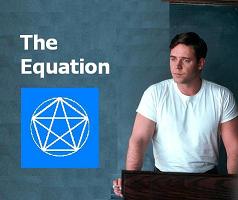
    John Nash, as portrayed by Russell Crowe


    I know more than Apollo,
    For oft when he lies sleeping
    I see the stars at mortal wars
    In the wounded welkin weeping.

    Tom O’Bedlam’s Song

    For more on the sleep of Apollo,
    see the front page of today’s

    New York Times Book Review.

    Garrison Keillor’s piece there,
    Dying of the Light,” is
    about the fear of death felt
    by an agnostic British twit.

    For relevant remarks by
    a British non-twit, see
    William Dunbar–

    Timor Mortis conturbat me.


  • Revelation Game, continued:

    Lotteries
    10/4/08
    PA NY
    Midday 919 501
    Evening 522 828
  • Mathematics and Narrative, continued:

    “The Ambition of the Short Story,” the essay by Steven Millhauser quoted here on Tuesday, September 30, is now online.

    “Hoo ha!” cries the novel.
    Here ah come!

  • Not-So-Ig Nobel:

    The Prize

    Paul Newman and Elke Sommer in 'The Prize'

    “The secret to life, and
    to love, is getting started,
    keeping going, and then
    getting started again.”

    Nobel Laureate
    Seamus Heaney
    at Sanders Theatre,
    Harvard College,
    September 30, 2008

    On Elke Sommer:

    “…Young Elke… studied
    in the prestigious
    Gymnasium School
    in Erlangen….”

    Film Fatales

    Erlangen Prize Lecture:

    Variations on a Theme of
    Plato, Goethe, and Klein

    (Background:
    Christmas Knot, Sept. 26,
    and Hard Core, July 17-18.)