The Holy Spook
continues:
Classics 101 --
(See
September 15. )
"The communication
of the dead is tongued with fire
beyond the language of the living."
-- T. S. Eliot, Four Quartets
The Boston Globe,
Tuesday, Sept.
25, 2007
By Anna Badkhen, Globe
Correspondent
"When Boston psychiatrist Jonathan
Shay wanted to understand the psychological toll of the Vietnam War on
the veterans he treated, he turned to the 'Iliad' and the 'Odyssey.'
The classical Greek epics perfectly encapsulate
the mental damage of combat, said Shay, who works for the Department of
Veterans Affairs in Boston....
Today, the John D. and Catherine T. MacArthur Foundation will
announce
that Shay, 65, has been selected as a 2007 MacArthur fellow 'for his
work in using literary parallels from Homer's "Iliad" and "Odyssey" to
treat combat trauma suffered by Vietnam veterans.'....
'I was hearing elements of the story of Achilles
over and over
again,' Shay said.
Achilles, the hero of the 'Iliad,' is mistreated
by his commander, who takes a girl, a prize of war, from him. Achilles
is also tormented by the loss of his best friend in the Trojan War.
With his ethical universe upended, he goes berserk.
Soon, Shay began to work on his first book, 'Achilles
in Vietnam:
Combat Trauma and the Undoing of Character.'
In
the book, he interspersed the story of Achilles with examples of his
patients' losses and contentious relationships with their commanders in
Vietnam to illustrate some of the causes of the troops' psychological
wounds."
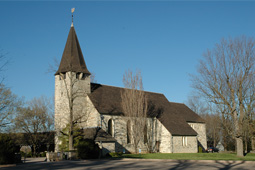
The
first word of the 'Iliad,'
Menin, is written in Greek
on Professor
Silk's blackboard
in the photo at top.
It means "wrath."
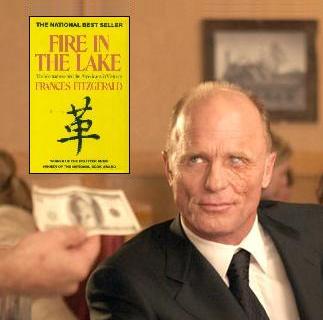
Related material:
The wrath of a Vietnam
veteran, portrayed by
Ed Harris, in the film
"The Human Stain,"
and a calmer Harris in
the illustration below,
from Log24, Oct. 8, 2005:
A History of Death

Adapted from
the film
"A History of Violence"
Recent Comments