Month: August 2007

  • Mathematics and Narrative, continued:

    Adam Gopnik in
    The New Yorker of
    August 20, 2007--

    On Philip K. Dick:

    "...
    the kind of guy who can't drink one cup of coffee without drinking six,
    and then stays up all night to tell you what Schopenhauer really said
    and how it affects your understanding of Hitchcock and what that had to
    do with Christopher Marlowe."

    Modernity: A Film by
    Alfred Hitchcock
    :

    "...
    the most thoroughgoing modernist design element in Hitchcock's films
    arises out of geometry, as Francois Regnault has argued, identifying 'a
    global movement for each one, or a "principal geometric or dynamic
    form
    ," which can appear in the pure state in the credits....'" --Peter
    J. Hutchings (my italics)

    More >>

    Epilogue:

    Adam Gopnik is also the author
    of The King in the Window, a tale
    of the Christian feast of Epiphany
    and a sinister quantum computer.

    For more on Epiphany, see
    the Log24 entries of August 1.

    For more on quantum computing,
    see What is Quantum Computation?.

    See also
    the previous entry.

  • Mathematics and the Ring Saga:

    In the context of quantum information theory, the following structure seems to be of interest--

    "... the full two-by-two matrix ring with entries in GF(2), M2(GF(2))-- the unique simple non-commutative ring of order 16 featuring six units (invertible elements) and ten zero-divisors."

    -- "Geometry of Two-Qubits," by Metod Saniga (pdf, 17 pp.), Jan. 25, 2007

    A 16-element affine space and a corresponding 16-element matrix ring

    This ring is another way of looking at the 16 elements of the affine space A4(GF(2))
    over the 2-element field.  (Arrange the four coordinates of each
    element-- 1's and 0's-- into a square instead of a straight line, and
    regard the resulting squares as matrices.)  (For more on A4(GF(2)), see Finite Relativity and related notes at Finite Geometry of the Square and Cube.) 
    Using the above ring, Saniga constructs a system of 35 objects (not unlike the 35 lines of the finite geometry PG(3,2)) that he calls a "projective line" over the ring.  This system of 35 objects has
    a subconfiguration isomorphic to the (2,2) generalized quadrangle W2 (which occurs naturally as a subconfiguration of PG(3,2)-- see Inscapes.)

    Saniga concludes:

    "We have demonstrated that the basic properties of a system
    of two interacting spin-1/2 particles are uniquely embodied in the
    (sub)geometry of a particular projective line, found to be equivalent
    to the generalized quadrangle of order two. As such systems are the
    simplest ones exhibiting phenomena like quantum entanglement and
    quantum non-locality and play, therefore, a crucial role in numerous
    applications like quantum cryptography, quantum coding, quantum
    cloning/teleportation and/or quantum computing to mention the most
    salient ones, our discovery thus

    • not only offers a principally new geometrically-underlined insight into their intrinsic nature,
    • but also gives their applications a wholly new perspective
    • and opens up rather unexpected vistas for an algebraic geometrical modelling of their higher-dimensional counterparts."
    It would seem that my own
    study of pure mathematics--
    for instance, of the following
    "diamond ring"--

    The image “http://www.log24.com/theory/images/FourD.gif” cannot be displayed, because it contains errors.

    is not without relevance to
    the physics of quantum theory.

  • The Ring Saga continues:

    Four Colours


    The previous entry
    dealt with Plato's myth of the ring of Gyges that
    conferred invisibility. Another legendary ring, from Hermann
    Hesse, with some background from Carl Jung:

    From C. G. Jung, Collected Works (Princeton U. Press), Volume 12--
    Psychology and Alchemy (1944)-- Part II-- "Individual Dream Symbolism in
    Relation to Alchemy"-- Chapter 3, "The Symbolism of the Mandala"-- as
    quoted in Jung, Dreams, published by Routledge, 2001-- Page 265--

    "... the dreamer is wandering about in a dark cave, where a battle is
    going on between good and evil. But there is also a prince who knows
    everything. He gives the dreamer a ring set with a diamond....

    Visual impression (waking dream):

    The dreamer is falling into the abyss. At the bottom there is a bear
    whose eyes gleam alternately in four colours: red, yellow, green, and
    blue. Actually it has four eyes that change into four lights. The bear
    disappears and the dreamer goes through a long dark tunnel. Light is
    shimmering at the far end. A treasure is there, and on top of it the
    ring with the diamond. It is said that this ring will lead him on a
    long journey to the east."

    Hermann Hesse, The Journey to the East (1932):

    "'... Despair is the result of each earnest attempt to go through life
    with virtue, justice, and understanding and to fulfil their
    requirements. Children live on one side of despair, the awakened on the
    other side. Defendant H. is no longer a child and is not yet fully
    awakened. He is still in the midst of despair. He will overcome it and
    thereby go through his second novitiate. We welcome him anew into the
    League, the meaning of which he no longer claims to understand. We give
    back to him his lost ring, which the servant Leo has kept for him.'

    The Speaker then brought the ring, kissed me on the cheek and placed
    the ring on my finger. Hardly had I looked at the ring, hardly had I
    felt its metallic coolness on my fingers, when a thousand things
    occurred to me, a thousand inconceivable acts of neglect. Above all, it
    occurred to me that the ring had four stones at equal distances apart,
    and that it was a rule of the League and part of the vow to turn the
    ring slowly on the finger at least once a day, and at each of the four
    stones to bring to mind one of the four basic precepts of the vow. I
    had not only lost the ring and had not once missed it, but during all
    those dreadful years I had also no longer repeated the four basic
    precepts or thought of them. Immediately, I tried to say them again
    inwardly. I had an idea what they were, they were still within me, they
    belonged to me as does a name which one will remember in a moment but
    at that particular moment cannot be recalled. No, it remained silent
    within me, I could not repeat the rules, I had forgotten the wording. I
    had forgotten the rules; for many years I had not repeated them, for
    many years I had not observed them and held them sacred-- and yet I had
    considered myself a loyal League brother.

    The Speaker patted my arm kindly when he observed my dismay and deep shame."

  • Puppet Magic:

    The Ring of Gyges

    10:31:32 AM ET

    Commentary by Richard Wilhelm
    on I Ching Hexagram 32:

    "Duration is... not a state of rest, for mere
    standstill is
    regression. Duration is rather the self-contained and therefore
    self-renewing movement of an organized, firmly integrated whole, taking
    place in accordance with immutable laws and beginning anew at every
    ending."

    Related material

    The Ring of the Diamond Theorem

    Jung and the Imago Dei

    Log24
    on June 10, 2007
    :

    WHAT MAKES IAGO EVIL? some
    people ask. I never ask. --Joan Didion

    Iago states that he is not who he is. --Mark
    F. Frisch


    "Not Being
    There,"
    by Christopher Caldwell
    ,

    from next Sunday's

    New York Times Magazine:

    "The chance to try on fresh identities was the great boon that
    life
    online was supposed to afford us. Multiuser role-playing games and
    discussion groups would be venues for living out fantasies. Shielded by
    anonymity, everyone could now pass a 'second life' online as Thor the
    Motorcycle Sex God or the Sage of Wherever. Some warned, though, that
    there were other possibilities. The Stanford Internet expert Lawrence Lessig
    likened online anonymity to the ring of invisibility that surrounds the
    shepherd Gyges in one of Plato's dialogues. Under such circumstances,
    Plato feared, no one is 'of such an iron nature that he would stand
    fast in justice.'

    Time, along with a string of sock-puppet scandals, has proved Lessig
    and Plato right."


    "The Boy Who Lived,"

    by Christopher Hitchens,

    from next Sunday's

    New York Times Book Review:

    On the conclusion of the Harry Potter series:
     
    "The toys have been put firmly back in the box, the
    wand has been folded up, and the conjuror is discreetly accepting
    payment while the children clamor for fresh entertainments. (I
    recommend that they graduate to Philip Pullman, whose daemon scheme is
    finer than any patronus.)"

    I, on the other hand,

    recommend Tolkien...

    or, for those who are

    already familiar with

    Tolkien, Plato-- to whom

    "The Ring of Gyges" may

    serve as an introduction.

    "It's all in Plato, all in Plato:
    bless me, what do they
    teach them at these schools!"
    -- C. S. Lewis

  • Amalfi Conjecture:

    "Serious numbers  

    will always be heard."


    -- Paul Simon

    (See St. Luke's Day, 2005.)  


    Bulletin of the American Mathematical Society
    ,

    Volume 31, Number 1, July 1994, Pages 1-14

    Selberg's Conjectures
    and Artin L-Functions

    (pdf)

    M. Ram Murty

    Introduction

    In its comprehensive form, an identity between an automorphic
    L-function and
    a "motivic" L-function is called a reciprocity law. The celebrated
    Artin reciprocity
    law is perhaps the fundamental example. The conjecture of
    Shimura-Taniyama that
    every elliptic curve over Q is "modular" is certainly the most
    intriguing reciprocity
    conjecture of our time. The "Himalayan peaks" that hold the secrets of
    these
    nonabelian reciprocity laws challenge humanity, and, with the visionary
    Langlands
    program
    , we have mapped out before us one means of ascent to those
    lofty peaks.
    The recent work of Wiles suggests that an important case (the
    semistable case)
    of the Shimura-Taniyama conjecture is on the horizon and perhaps this
    is another
    means of ascent. In either case, a long journey is predicted.... At the
    1989 Amalfi meeting, Selberg [S] announced a series of
    conjectures which
    looks like another approach to the summit. Alas, neither path seems the
    easier
    climb....


    [S]
    A. Selberg, Old and new
          conjectures and results
          about a class of Dirichlet series,
          Collected Papers, Volume II,
          Springer-Verlag, 1991, pp. 47-63.

    Zentralblatt MATH Database on the above Selberg paper:

    "These are notes of lectures presented at the Amalfi Conference on Number Theory, 1989.... There are various stimulating conjectures
    (which are related to several other conjectures like the Sato-Tate
    conjecture, Langlands conjectures, Riemann conjecture...).... Concluding
    remark of the author: 'A more complete account with proofs is under preparation and will in time appear elsewhere.'"

    Related material: Previous entry.

  • Three church scenes

    In memory of

    Atle Selberg, mathematician,
    dead at 90 on August 6, 2007


    According to the
    American Mathematical Society,
    Selberg died, like André Weil, on
     the Feast of the Metamorphosis.

    Endgame

    The image “http://www.log24.com/log/pix07A/070807-escher.jpg” cannot be displayed, because it contains errors.

    Metaphor for Morphean morphosis,
    Dreams that wake, transform, and die,
    Calm and lucid this psychosis,
    Joyce's nightmare in Escher's eye.

    -- Steven H. Cullinane, Nov. 7, 1986

    Read more.

    For further views of
    the Amalfi coast, site of
    the above Escher scene,
    see the film "A Good Woman"
    (made in 2004, released in 2006)
    starring Scarlett Johansson--

    The image “http://www.log24.com/log/pix07A/070807-GoodWoman.jpg” cannot be displayed, because it contains errors.

    Scene from "A Good Woman"

    -- and the following from
     
    The image “http://www.log24.com/log/pix05B/051018-Atrani2.jpg” cannot be displayed, because it contains errors.
     
    Collegiate Church of
    St. Mary Magdalene,
    Atrani, Amalfi Coast, Italy:
     
    "An interior made exterior"
    -- Wallace Stevens

  • Annals of Communication:

    The Horse Whisperer

    Scarlett Johansson and friend in The Horse Whisperer

    Scarlett Johansson and friend
    in "The Horse Whisperer" (1998)

    Thanks to University Diaries (Aug. 6) for the following:

    "'The University of Sydney
    has ordered an independent review into allegations that the dean of the
    Conservatorium of Music hired a horse whisperer to conduct management
    workshops.' [Are you, like UD,
    a bit vague on exactly what a horse whisperer is? And are you having
    trouble figuring out what a horse whisperer would have to offer a
    management workshop? But then, what exactly is a management workshop?
    Read on.]"

    For some background on horse whispering and management workshops, see IABC Steal Sheet, March 2004.

    Related material:

    The recent Log24 entries

    University Diaries:
    "God, isn't there already
    enough crap in this story?"

    See also Log24,

    Dec. 10, 2003
    :

    Putting Descartes Before Dehors


    "Descartes déclare que
    c'est en moi, non hors de
    moi,
    en moi, non dans le monde,
    que je pourrais voir
    si quelque chose
    existe
    hors de moi."

    -- ATRIUM, Philosophie     

    For further details,
    see ART WARS.

  • Philosophy Wars continued:

    The Divine Universals

    "The tigers of wrath          
     are wiser than                
     the horses of instruction."

    -- William Blake,
    Proverbs of Hell

    From Shining Forth:

      The Place of the Lion, by Charles Williams, 1931, Chapter Eight:

    "Besides,
    if this fellow were right, what harm would the Divine Universals do us?
    I mean, aren't the angels supposed to be rather gentle and helpful and
    all that?"

    "You're doing what Marcellus warned you
    against... judging them by English pictures. All nightgowns and body
    and a kind of flacculent sweetness. As in cemeteries, with broken bits
    of marble. These are Angels-- not a bit the same thing. These are the
    principles of the tiger and the volcano and the flaming suns of space."

     Under the Volcano, Chapter Two:

    "But
    if you look at that sunlight there, then perhaps you'll get the answer,
    see, look at the way it falls through the window: what beauty can
    compare to that of a cantina in the early morning? Your volcanoes
    outside? Your stars-- Ras Algethi? Antares raging south southeast?
    Forgive me, no." 

     A Spanish-English dictionary:

    lucero m.
    morning or evening star:
    any bright star....
    hole in a window panel
         for the admission of light....

    Look at the way it
    falls through the window....

    -- Malcolm Lowry

    How art thou fallen from heaven,
    O Lucifer, son of the morning!
    -- Isaiah 14:12

    For more on Spanish
    and the evening star,
    see Plato, Pegasus, and
    the Evening Star.

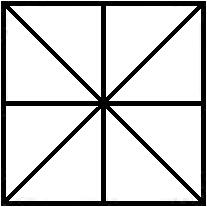
     Symmetry axes
    of the square:

    Symmetry axes of the square

    (See Damnation Morning.)

    From the cover of the
     Martin Cruz Smith novel
    Stallion Gate:

    Atom on cover of Stallion

    "That old Jew
    gave me this here."

    -- Dialogue from the
    Robert Stone novel
    A Flag for Sunrise.

    Related material:

    A Mass for Lucero,

    Log24, Sept. 13, 2006--

    Mathematics, Religion, Art

    -- and this morning's online
    New York Times obituaries:

    Cardinal Lustiger of Paris and jazz pianist Sal Mosca, New York Times obituaries on August 6, 2007

    The above image contains summary obituaries for Cardinal Lustiger, Archbishop of Paris, 1981-2005, and for Sal Mosca,
    jazz pianist and teacher. In memory of the former, see all of the
    remarks preceding the image above. In memory of the latter, the remarks
    of a character in Martin Cruz Smith's Stallion Gate on jazz piano may have some relevance:

    "I
    hate arguments. I'm a coward. Arguments are full of words, and each
    person is sure he's the only one who knows what the words mean. Each
    word is a basket of eels, as far as I'm concerned. Everybody gets to
    grab just one eel and that's his interpretation and he'll fight to the
    death for it.... Which is why I love music. You hit a C and it's a C
    and that's all it is. Like speaking clearly for the first time. Like
    being intelligent. Like understanding. A Mozart or an Art Tatum sits at
    the piano and picks out the undeniable truth."

  • Smiles of a Summer Evening:

    Lucero


    Under the Volcano, by Malcolm Lowry, 1947, Chapter VI:

    "What
    have I got out of my life? Contacts with famous men... The occasion
    Einstein asked me the time, for instance. That summer evening....
    smiles when I say I don't know. And yet asked me. Yes: the great Jew,
    who has upset the whole world's notions of time and space, once leaned
    down... to ask me... ragged freshman... at the first approach of the
    evening star, the time. And smiled again when I pointed out the clock
    neither of us had noticed."

    To Ride Pegasus, by Anne McCaffrey, 1973: 

    "Mary-Molly
    luv, it's going to be accomplished in steps, this establishment of the
    Talented in the scheme of things. Not society, mind you, for we're the
    original nonconformists.... and Society will never permit us to
    integrate. That's okay!" He consigned Society to
    insignificance with a flick of his fingers. "The Talented form
    their own society and that's as it should be: birds of a feather.
    No, not birds. Winged horses! Ha! Yes, indeed. Pegasus... the
    poetic winged horse of flights of fancy. A bloody good symbol for us.
    You'd see a lot from the back of a winged horse..."

    From Holt Spanish and English Dictionary, 1955:

    lucero m Venus
    (as morning or evening star);
    bright star...
    star (in forehead of animal)....

    Scarlett Johansson and friend in The Horse Whisperer

    Scarlett Johansson and friend
    in "The Horse Whisperer" (1998)

  • MySpace and...

    Venus

    The image “http://www.log24.com/log/pix07A/070805-Otoole1.jpg” cannot be displayed, because it contains errors.

    "Take us the foxes,

    the little foxes..."

    The image “http://www.log24.com/log/pix07A/070805-Foxes.jpg” cannot be displayed, because it contains errors.


    WARNING:

    Objects in rear view mirror

    may be older than they appear.