August 6, 2007
-
Philosophy Wars continued:
The Divine Universals“The tigers of wrath
are wiser than
the horses of instruction.”– William Blake,
Proverbs of HellFrom Shining Forth:
The Place of the Lion, by Charles Williams, 1931, Chapter Eight:
“Besides,
if this fellow were right, what harm would the Divine Universals do us?
I mean, aren’t the angels supposed to be rather gentle and helpful and
all that?”“You’re doing what Marcellus warned you
against… judging them by English pictures. All nightgowns and body
and a kind of flacculent sweetness. As in cemeteries, with broken bits
of marble. These are Angels– not a bit the same thing. These are the
principles of the tiger and the volcano and the flaming suns of space.”Under the Volcano, Chapter Two:
“But
if you look at that sunlight there, then perhaps you’ll get the answer,
see, look at the way it falls through the window: what beauty can
compare to that of a cantina in the early morning? Your volcanoes
outside? Your stars– Ras Algethi? Antares raging south southeast?
Forgive me, no.”A Spanish-English dictionary:
lucero m.
morning or evening star:
any bright star….
hole in a window panel
for the admission of light….Look at the way it
falls through the window….
– Malcolm LowryHow art thou fallen from heaven,
O Lucifer, son of the morning!
– Isaiah 14:12For more on Spanish
and the evening star,
see Plato, Pegasus, and
the Evening Star.Symmetry axes
of the square: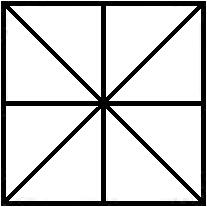
(See Damnation Morning.)
From the cover of the
Martin Cruz Smith novel
Stallion Gate:
“That old Jew
gave me this here.”– Dialogue from the
Robert Stone novel
A Flag for Sunrise.Related material:

– and this morning’s online
New York Times obituaries: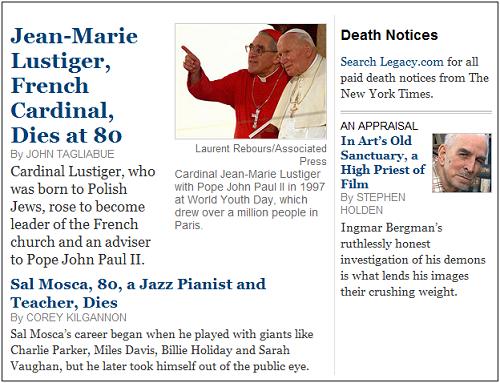
The above image contains summary obituaries for Cardinal Lustiger, Archbishop of Paris, 1981-2005, and for Sal Mosca,
jazz pianist and teacher. In memory of the former, see all of the
remarks preceding the image above. In memory of the latter, the remarks
of a character in Martin Cruz Smith’s Stallion Gate on jazz piano may have some relevance:“I
hate arguments. I’m a coward. Arguments are full of words, and each
person is sure he’s the only one who knows what the words mean. Each
word is a basket of eels, as far as I’m concerned. Everybody gets to
grab just one eel and that’s his interpretation and he’ll fight to the
death for it…. Which is why I love music. You hit a C and it’s a C
and that’s all it is. Like speaking clearly for the first time. Like
being intelligent. Like understanding. A Mozart or an Art Tatum sits at
the piano and picks out the undeniable truth.”
