Log24, June 6:
"If Cullinane College
were Hogwarts...."

A word to the wise:
desconvencida.
Related material:
and

"If Cullinane College
were Hogwarts...."
A word to the wise:
desconvencida.
Related material:
and
-- Glenna Whitley, "Voodoo Justice,"
The New York Times, March 20, 1994

In Other Game News:

Related material:
and
The proportions of
the above rectangle
may suggest to some
a coffin; they are
meant to suggest
a monolith.

Jazz singer, raconteur,
imitator of Bessie Smith,
he apparently named
his daughter Pandora.
|
GEORGE MELLY
1926 - 2007 WHAT AFTERLIFE
|
(vs. sophists' nominalism--
see recent entries.)
Plato cited geometry,
notably in the Meno,
in defense of his realism.
Consideration of the
Meno's diamond figure
leads to the following:

Click on image for details.
As noted in an entry,
Plato, Pegasus, and
the Evening Star,
linked to
at the end of today's
previous entry,
the "universals"
of Platonic realism
are exemplified by
the hexagrams of
the I Ching,
which in turn are
based on the seven
trigrams above and
on the eighth trigram,
of all yin lines,
not shown above:

K'un
The Receptive
The previous entry linked to an entry of June 2002 that attacked the
nominalism of Stanley Fish. Here is another such attack:
| From "Stanley Fish: The Critic as Sophist," by R.V. Young, in Modern Age, June 22, 2003:
In one of the definitive works of conservatism in the twentieth It was William of Occam who propounded the fateful doctrine of (4). Ideas Have Consequences (Chicago and London, 1948), 3.
|
Simon Blackburn on
Plato and sophists,
realism and nominalism
(previous entry)
(continued from
June 18, 2002)
The "ignorance" referred to
is Fish's ignorance of the
philosophical background
of the words
"particular" and "universal."
It is this same preference for the vacuously general over the
disturbingly particular that informs the attacks on college and
university professors who spoke out in ways that led them to be branded
as outcasts by those who were patrolling and monitoring the narrow
boundaries of acceptable speech. Here one must be careful, for there
are fools and knaves on all sides."
"Although it may not at first be obvious, the substitution for real
religions of a religion drained of particulars is of a piece with the
desire to exorcise postmodernism."
"What must be protected, then, is the general, the possibility of
making pronouncements from a perspective at once detached from and
superior to the sectarian perspectives of particular national
interests, ethnic concerns, and religious obligations; and the threat
to the general is posed by postmodernism and strong religiosity alike,
postmodernism because its critique of master narratives deprives us of
a mechanism for determining which of two or more fiercely held beliefs
is true (which is not to deny the category of true belief, just the
possibility of identifying it uncontroversially), strong religiosity
because it insists on its own norms and refuses correction from the
outside. The antidote to both is the separation of the private from the
public, the establishing of a public sphere to which all could have
recourse and to the judgments of which all, who are not criminal or
insane, would assent. The point of the public sphere is obvious: it is
supposed to be the location of those standards and measures that belong
to no one but apply to everyone. It is to be the location of the
universal. The problem is not that there is no universal--the
universal, the absolutely true, exists, and I know what it is. The
problem is that you know, too, and that we know different things, which
puts us right back where we were a few sentences ago, armed with
universal judgments that are irreconcilable, all dressed up and nowhere
to go for an authoritative adjudication.
What to do? Well, you do the only thing you can do, the only honest
thing: you assert that your universal is the true one, even though your
adversaries clearly do not accept it, and you do not attribute their
recalcitrance to insanity or mere criminality--the desired public
categories of condemnation--but to the fact, regrettable as it may be,
that they are in the grip of a set of beliefs that is false. And there
you have to leave it, because the next step, the step of proving the
falseness of their beliefs to everyone, including those in their grip,
is not a step available to us as finite situated human beings. We have
to live with the knowledge of two things: that we are absolutely right
and that there is no generally accepted measure by which our rightness
can be independently validated. That's just the way it is, and we
should just get on with it, acting in accordance with our true beliefs
(what else could we do?) without expecting that some God will descend,
like the duck in the old Groucho Marx TV show, and tell us that we have
uttered the true and secret word."
From the public spheres
of the Pennsylvania Lottery:


"'From your lips
to God's ears,'
goes the old
Yiddish wish.
The writer, by contrast,
tries to read God's
lips
and pass along
the words...."
-- Richard Powers
268 --
This is a page number
that appears, notably,
in my June 2002
journal entry on Fish,
and again in an entry,
"The Transcendent Signified,"
dated July 26, 2003,
that argues against
Fish's school, postmodernism,
and in favor of what the pomos
call "logocentrism."
Page 268
of Simon Blackburn's Think
(Oxford Univ. Press, 1999):
When not arguing politics,
Fish, though from
a Jewish background, is
said to be a Milton scholar.
Let us therefore hope he
is by now, or comes to be,
aware of the Christian
approach to universals--
an approach true to the
philosophical background
sketched in 1999 by
Blackburn and made
particular in a 1931 novel
by Charles Williams,
The Place of the Lion.
-- Wallace Stevens,
"An Ordinary Evening
in New Haven"
|
A Text Time and Chance today in the Keystone State: |
From 8/02
in 2005:
For a text on today's mid-day number, see
50 Years Ago
on this date, poet
Wallace Stevens died.
Memorial: at the
Wallace Stevens
Concordance,
enter center.
Result:
The Man with the Blue Guitar
line 150 (xiii.6):
The heraldic center of the world
Human Arrangement
line 13:
The center of transformations that
This Solitude of Cataracts
line 18:
Breathing his bronzen breath at the azury center of time.
A Primitive Like an Orb
line 1 (i.1):
The essential poem at the center of things,
line 87 (xi.7):
At the center on the horizon, concentrum, grave
Reply to Papini
line 33 (ii.15):
And final. This is the center. The poet is
Study of Images II
line 7:
As if the center of images had its
An Ordinary Evening in New Haven
line 291 (xvii.3):
It fails. The strength at the center is serious.
line 371 (xxi.11):
At the center, the object of the will, this place,
Things of August
line 154 (ix.18):
At the center of the unintelligible,
The Hermitage at the Center
Title:
The Hermitage at the Center
Owl's Clover, The Old Woman and the Statue (OP)
line 13 (ii.9):
At the center of the mass, the haunches low,
The Sail of Ulysses (OP)
line 50 (iv.6):
The center of the self, the self
Someone Puts a Pineapple Together (NA)
line 6 (i.6):
The angel at the center of this rind,
Of Ideal Time and Choice (NA)
line 29:
At last, the center of resemblance, found
line 32:
Stand at the center of ideal time,
Theme and Variations.

From a Log24 entry
of March 20, 2005,
as rendered today
by a Xanga server
and my Mozilla browser:
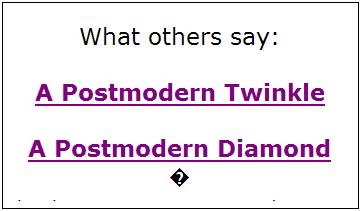
The above screenshot is only
an image of the links;
here are the links themselves:
A Postmodern Twinkle
A Postmodern Diamond
The question mark in the
diamond is the browser's
rendition of the server's
baffled response to
a character it cannot
recognize-- in this case,
the HTML code for
a blank space:
" "
Related material:
The God-Shaped Hole
| "Three times the concentred self takes hold, three times The thrice concentred self, having possessed The object, grips it in savage scrutiny, Once to make captive, once to subjugate Or yield to subjugation, once to proclaim The meaning of the capture, this hard prize, Fully made, fully apparent, fully found." -- "Credences of Summer," VII, |

For a religious
interpretation
of 265, see
Sept. 30, 2004.
For a religious
interpretation
of 153, see
Fish Story.
A quotation from
the Eater of Souls:


Recent Comments