Month: May 2007

  • L'Affaire Dharwadker continues:

    Blitz by anonymous
    New Delhi user

    From Wikipedia on 31 May, 2007:

    Shown below is a list of 25 alterations to Wikipedia math articles made today by user 122.163.102.246.

    All of the alterations involve removal of links placed by user Cullinane (myself).

    The 122.163... IP address is from an internet service provider in New Delhi, India.

    The New Delhi anonymous user was apparently inspired by an earlier
    blitz
    by Wikipedia administrator Charles Matthews. (See User talk: Cullinane.)

    Related material:

    Ashay Dharwadker and Usenet Postings
    and Talk: Four color theorem/Archive 2.
    See also some recent comments from 122.163...
    at Talk: Four color theorem.

    May 31, 2007, alterations by
    user 122.163.102.246:

    1. 17:17 Orthogonality (rm spam)
    2. 17:16 Symmetry group (rm spam)
    3. 17:14 Boolean algebra (rm spam)
    4. 17:12 Permutation (rm spam)
    5. 17:10 Boolean logic (rm spam)
    6. 17:08 Gestalt psychology (rm spam)
    7. 17:05 Tesseract (rm spam)
    8. 17:02 Square (geometry) (rm spam)
    9. 17:00 Fano plane (rm spam)
    10. 16:55 Binary Golay code (rm spam)
    11. 16:53 Finite group (rm spam)
    12. 16:52 Quaternion group (rm spam)
    13. 16:50 Logical connective (rm spam)
    14. 16:48 Mathieu group (rm spam)
    15. 16:45 Tutte–Coxeter graph (rm spam)
    16. 16:42 Steiner system (rm spam)
    17. 16:40 Kaleidoscope (rm spam)
    18. 16:38 Efforts to Create A Glass Bead Game (rm spam)
    19. 16:36 Block design (rm spam)
    20. 16:35 Walsh function (rm spam)
    21. 16:24 Latin square (rm spam)
    22. 16:21 Finite geometry (rm spam)
    23. 16:17 PSL(2,7) (rm spam)
    24. 16:14 Translation plane (rm spam)
    25. 16:13 Block design test (rm spam)

    The deletions should please Charles Matthews and fans of Ashay Dharwadker's work as a four-color theorem enthusiast and as editor of the Open Directory sections on combinatorics and on graph theory.

    There seems little point in protesting the deletions while Wikipedia still allows any anonymous user to change their articles.

    -- Cullinane 23:28, 31 May 2007 (UTC)

  • The Nature of Evil--

    Al Gore and the
    Absence of Truth

    "Evil is a negation, because
    it is the absence of truth."

    -- Mary Baker Eddy,
    founder of Christian Science,
    in Science and Health
    with Key to the Scriptures,
    (Boston, 1906,
    page 186, line 11)


    M. Scott Peck
    on evil:


    "There are quite popular
     systems of thought these days,
    such as Christian Science
    or the Course in Miracles,
    which define evil as unreality.
    It is a half-truth. The spirit of evil
    is one of unreality, but it itself
    is real. It really exists."

    "We must not fall back into Saint

    Augustine's now discarded doctrine

    of the 'privatio boni,' whereby evil

    was defined as the absence of good.

    Satan's personality cannot be

    characterized simply by

    an absence, a nothingness."

    -- People of the Lie:

    The Hope for Healing Human Evil,
    by Morgan Scott Peck, 1986.
    (Touchstone paperback,
    2nd ed., 1998, page 208)

    Al Gore on M. Scott Peck:

    Al Gore trains a global army - USATODAY.com
    "Peck wrote that 'Evil is the absence of truth,' " Gore
    says, his fingers laced together at the waist, eyes scanning eager
    faces as he wraps up his remarks ...
    www.usatoday.com/news/nation/
    2007-04-24-gore-trainees_N.htm - 55k

    -- Google search 5/30/07


    He did?

    The image “http://www.log24.com/log/pix07/070531-Gore.jpg” cannot be displayed, because it contains errors.

    "The greatest trick the Devil ever pulled

    was convincing the world he didn't exist."

    -- Verbal Kint in "The Usual Suspects"

  • Notes on the I Ching:

    and a Finite Model

    Notes by Steven H. Cullinane
    May 28, 2007

    Part I: A Model of Space-Time

    The following paper includes a figure illustrating
    Penrose's model of  "complexified, compactified Minkowski
    space-time as the Klein quadric in complex projective 5-space."
     
    The image “http://www.log24.com/log/pix07/070528-Twistor.jpg” cannot be displayed, because it contains errors.
    Click on picture to enlarge.

    For some background on the Klein quadric and space-time, see Roger Penrose, "On the Origins of Twistor Theory," from Gravitation and Geometry: A Volume in Honor of Ivor Robinson, Bibliopolis, 1987.


    Part II: A Corresponding Finite Model

    The Klein quadric also occurs in a finite model of projective 5-space.  See a 1910 paper:

    G. M. Conwell, The 3-space PG(3,2) and its group, Ann. of Math. 11, 60-76.

    Conwell discusses the quadric, and the related Klein correspondence, in detail.  This is noted in a more recent paper by Philippe Cara:

    The image “http://www.log24.com/log/pix07/070528-Quadric.jpg” cannot be displayed, because it contains errors.

    As Cara goes on to explain, the Klein correspondence underlies Conwell's discussion of eight heptads.  These play an important role in another correspondence, illustrated in the Miracle Octad Generator of R. T. Curtis, that may be used to picture actions of the large Mathieu group M24.


    Related material:

    The projective space PG(5,2), home of the Klein quadric in the finite model, may be viewed as the set of 64 points of the affine space AG(6,2), minus the origin.

    The 64 points of this affine space may in turn be viewed as the 64 hexagrams of the Classic of Transformation, China's I Ching.

    There is a natural correspondence between the 64 hexagrams and the 64 subcubes of a
    4x4x4 cube.  This correspondence leads to a natural way to generate the affine group AGL(6,2).  This may in turn be viewed as a group of over a trillion natural
    transformations of the 64 hexagrams.

    "Once Knecht confessed to his teacher that he wished to learn enough to be able to incorporate the system of the I Ching
    into the Glass Bead Game.  Elder Brother laughed.  'Go ahead
    and try,' he exclaimed.  'You'll see how it turns out. 
    Anyone can create a pretty little bamboo garden in the world.  But
    I doubt that the gardener would succeed in incorporating the world in
    his bamboo grove.'"

    -- Hermann Hesse, The Glass Bead Game,
      translated by Richard and Clara Winston

  • Reply to...

    A Baffled Reader

    A reader this morning commented on my first Xanga entry (July 20, 2002):

    "To set one up (which I have not done because I don't want anyone to know what I think)," ... William Safire regarding "blogs".

    I still don't know what you think.  Yet ... I try, try, try.

    Here's one thing that I think-- today-- based on my "Hate Speech for Harvard," on "Devil in the Details" (Log24, May 18 and 23), and, more recently, on

    1. last evening's PA lottery number 005,
    2. the I Ching hexagram of the same number, and
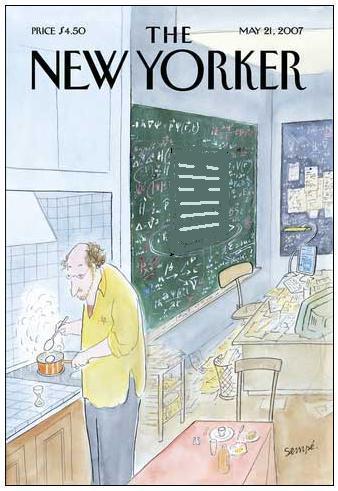
    3. the New Yorker issue linked to at the end of the previous entry:
    Revised New Yorker cover from 5/21/07
    Revised version of the
    New Yorker cover of 5/21/07
    Commentary on the cover
    by the PA lottery
    on 5/25/07
    in the form of the
    evening number, 005.
    In the I Ching, this
    is the number of

    HSU:
    WAITING
    (NOURISHMENT)

    See also the previous entry
    and Natalie Angier's sneer
    at a politician's call for
    prayer, which, she
    said, involved the
    "assumption that prayer is
    some sort of miracle
    Vicks VapoRub."

    Detail from the

    5/21/07 New Yorker:

    Detail, New Yorker cover, 5/21/07

    THE IMAGE

    Hexagram 5: Waiting (Nourishment)

    Clouds rise up to heaven:
    The image of WAITING.
    Thus the superior man
    eats and drinks,
    Is joyous and
    of good cheer.

    AMEN.

  • Philosophy Wars continued:

    On the Religion of Scientism

    Recently,
    believers in the religion of Scientism have become increasingly
    militant.  Christians, though seldom able, like Jesus, to
    love their enemy, might at least try, like Don Vito Corleone, to know their enemy.

    "Examples are the stained-glass
    windows of knowledge." --Nabokov

    Steven Pinker at The New York Times,
    review of a new book by Natalie Angier,
    a priestess of Scientism,
    online today but dated May 27, 2007

    Jesse Tisch at JBooks.com,
    interview with Angier, undated, 2007

    Harvey Blume at The Boston Globe,
    interview with Angier, May 13, 2007

    Marcela Valdes at Publishers Weekly,
    interview with Angier, March 5, 2007

    Angier at The New York Times,
    "Confessions of a Lonely Atheist,"
    Jan. 14, 2001

    Angier at The American Scholar,
    "My God Problem," Spring 2004

    For other recent background,
    see the May 21 New Yorker.

  • A Rite of Spring:

    Dance and the Soul

    From Log24 on
    this date last year:

    "May there be an ennui
    of the first idea?
    What else,
    prodigious scholar,
    should there be?"

    -- Wallace Stevens,
    "Notes Toward a
    Supreme Fiction"

    The Associated Press,
    May 25, 2007--

    Thought for Today:
    "I hate quotations.
     Tell me what you know."
    -- Ralph Waldo Emerson

    [Journals, on May 3, 1849]

    The First Idea:

    The Line, by S. H. Cullinane

    Four Elements (Diamond)

    Square Dance:

    Square Dance (Diamond Theorem)

    This "telling of what
    I know" will of course
    mean little to those
    who, like Emerson,
    have refused to learn
    through quotations.

    For those less obdurate
    than Emerson --

    Harold Bloom
    on Wallace Stevens

    and Paul Valery's
       "Dance and the Soul"--

    "Stevens
    may be playful, yet seriously so, in describing desire, at winter's
    end, observing not only the emergence of the blue woman of early
    spring, but seeing also the myosotis, whose other name is
    'forget-me-not.' Desire, hearing the calendar hymn, repudiates the
    negativity of the mind of winter, unable to bear what Valery's
    Eryximachus had called 'this cold, exact, reasonable, and moderate
    consideration of human life as it is.' The final form of this
    realization in Stevens comes in 1950, in The Course of a Particular,
    in the great monosyllabic line 'One feels the life of that which gives
    life as it is.' But even Stevens cannot bear that feeling for long. As
    Eryximachus goes on to say in Dance and the Soul:

    A
    cold and perfect clarity is a poison impossible to combat. The real, in
    its pure state, stops the heart instantaneously....[...] To a handful
    of ashes is the past reduced, and the future to a tiny icicle. The soul
    appears to itself as an empty and measurable form. --Here, then, things
    as they are come together, limit one another, and are thus chained
    together in the most rigorous and mortal* fashion.... O Socrates, the universe cannot for one instant endure to be only what it is.

    Valery's
    formula for reimagining the First Idea is, 'The idea introduces into
    what is, the leaven of what is not.' This 'murderous lucidity' can be
    cured only by what Valery's Socrates calls 'the intoxication due to
    act,' particularly Nietzschean or Dionysiac dance, for this will rescue
    us from the state of the Snow Man, 'the motionless and lucid
    observer.'" --Wallace Stevens: The Poems of Our Climate

    * "la sorte... la plus mortelle":
        mortal in the sense
       "deadly, lethal"

    Other quotations

    (from March 28,
    the birthday of
    Reba McEntire):

    Logical Songs

    Reba McEntire, Saturday Evening Post, Mar/Apr 1995

    Logical Song I
    (Supertramp)

    "When I was young, it seemed that
    Life was so wonderful, a miracle,
    Oh it was beautiful, magical
    And all the birds in the trees,
    Well they'd be singing so happily,
    Joyfully, playfully watching me"

    Logical Song II
    (Sinatra)

    "You make me feel so young,
    You make me feel like
    Spring has sprung
    And every time I see you grin
    I'm such a happy in-
    dividual....

    You and I are
    Just like a couple of tots
    Running across the meadow
    Picking up lots
    Of forget-me-nots"

  • Happy Birthday, Patti LaBelle

    Born Again

    "Lady Marmalade"
    was a 1974 hit featured
    in the film "Moulin Rouge":

    The image “http://www.log24.com/log/pix07/070524-Moulin.jpg” cannot be displayed, because it contains errors.

    The hit was made famous
    by Patti LaBelle.
    Below is an online profile
    of LaBelle from AOL.com:
    AOL bio of Patti LaBelle

    This agrees with the birth date
    in a Log24 entry of 10/4/02,
    The Agony and the Ya-Ya.

    It now, however, appears that
    LaBelle was born
    on today's date, May 24.

    My apologies to Charlton Heston,
    the archangel Michael,
    and the city of New Orleans--
    all featured in the Ya-Ya entry.

    Congratulations to
    Bob Dylan and Rosanne Cash
    on their new birthday-mate.

    Related material:

    1. An entry from last year
    on this date,  the
    pilgrimage day of St. Sarah
     

    2. An entry from another
    religious holiday
    , the opening
     date of the real Moulin Rouge

    3. The works of Robert Langdon,
    author of "the renowned
    collegiate textbook
    Religious Iconology"

    "Gitchi gitchi ya-ya, Dada...."

  • Strong Emergence Illustrated:

    The Beauty Test

    "There is no royal road
    to geometry"
    -- Attributed to Euclid

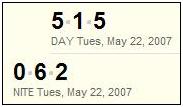
    There are, however, various non-royal roads.  One of these is indicated by yesterday's Pennsylvania lottery numbers:

    PA Lottery May 22, 2007: Mid-day 515, Evening 062

    The mid-day number 515 may be taken as a reference to 5/15. (See the previous entry, "Angel in the Details," and 5/15.)

    The evening number 062, in the context of Monday's entry "No Royal Roads" and yesterday's "Jewel in the Crown,"
    may be regarded as naming a non-royal road to geometry: either U. S. 62, a major route
    from Mexico to Canada (home of the late geometer H.S.M. Coxeter), or a
    road less traveled-- namely, page 62 in Coxeter's classic Introduction to Geometry (2nd ed.):

    The image “http://www.log24.com/log/pix07/070523-Coxeter62.jpg” cannot be displayed, because it contains errors.

    The illustration (and definition) is
    of regular tessellations of the plane.

    This topic Coxeter offers as an
    illustration of remarks by G. H. Hardy
    that he quotes on the preceding page:

    The image “http://www.log24.com/log/pix07/070523-Hardy.jpg” cannot be displayed, because it contains errors.

    One might argue that such beauty is strongly emergent
    because of the "harmonious way" the parts fit
    together: the
    regularity (or fitting together) of the whole is not reducible to the
    regularity of the parts.  (Regular triangles, squares, and
    hexagons fit together, but regular pentagons do not.)

    The symmetries of these regular tessellations
    of the
    plane are less well suited as illustrations of emergence, since they
    are tied rather closely to symmetries of the component parts.

    But the symmetries of regular tessellations of the sphere-- i.e., of the five Platonic solids-- do emerge strongly, being apparently independent of symmetries of the component parts.

    Another example of strong emergence: a group of 322,560 transformations acting naturally on the 4x4 square grid-- a much larger group than the group of 8 symmetries of each component (square) part.

    The lottery numbers above also supply an example of strong emergence-- one that nicely illustrates how it can be, in the words of Mark Bedau, "uncomfortably like magic."

    (Those more comfortable with magic may note the resemblance of the
    central part of Coxeter's illustration to a magical counterpart-- the Ojo de Dios of Mexico's Sierra Madre.)

  • Details, continued

    Angel in the Details

    See the Dickinson poem quoted here on May 15 (the date, as it happens, of Dickinson's death) in the entry "A Flag for Sunrise."  See also Zen and Language Games and a discussion of a detail in a Robert Stone novel.


    "I dwell in Possibility -
    A fairer House than Prose"

    -- Emily Dickinson