January 29, 2007
-
Robot Wisdom continued:
By Indirections
(Hamlet, II, i)"Michael Taylor (1971).... contends that the central conflict in Hamlet is between 'man as victim of fate and as controller of his own destiny.'"-- The Gale Group, Shakespearean Criticism, Vol. 71, at eNotes
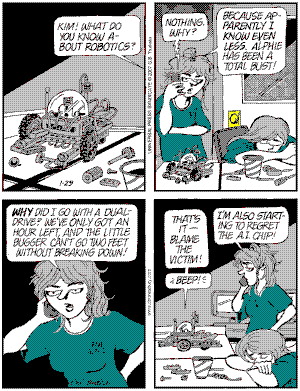
Doonesbury today:
"Personality is a synthesis of possibility and necessity."-- Soren Kierkegaard
On Fate (Necessity),
Freedom (Possibility),
and Machine Personality--
Part I: Google as SkynetGeorge Dyson--
The Godel-to-Google Net [March 8, 2005]
A Cathedral for Turing [October 24, 2005]Dyson: "The correspondence between Google and biology is not an analogy, it's a fact of life."
Part II: The Galois ConnectionDavid Ellerman--
"A Theory of Adjoint Functors-- with some Thoughts about their Philosophical Significance" (pdf) [November 15, 2005]Ellerman:
"Such a mechanism seems key to understanding how an organism can
perceive and learn from its environment without being under the direct
stimulus control of the environment-- thus resolving the ancient
conundrum of receiving an external determination while exercising
self-determination."For a less technical version, see Ellerman's "Adjoints and Emergence: Applications of a New Theory of Adjoint Functors" (pdf).
Ellerman was apparently a friend of, and a co-author
with, Gian-Carlo Rota. His "theory of adjoint functors" is related to the standard mathematical concepts known as profunctors, distributors, and bimodules. The applications of his theory, however, seem to be
less to mathematics itself than to a kind of philosophical poetry that seems rather closely related
to the above metaphors of George Dyson. For a less poetic approach to
related purely mathematical concepts, see, for instance, the survey Practical Foundations of Mathematics by Paul Taylor (Cambridge University Press, 1999).
For less poetically appealing, but perhaps more perspicuous,
extramathematical applications of category theory, see the work of, for instance, Joseph
Goguen: Algebraic Semiotics and Information Integration, Databases, and Ontologies.
