Month: October 2006

  • A Visual Proof

    A Visual Proof

    The great mathematician
    Robert P. Langlands
    is 70 today.

    In honor of his expository work--
    notably, lectures at
    The Institute for Advanced Study
    on "The Practice of Mathematics"
    and a very acerbic review (pdf) of
    a book called Euclid's Window--
    here is a "Behold!" proof of
    the Pythagorean theorem:

    The image “http://www.log24.com/log/pix06A/Pythagorean_Theorem.jpg” cannot be displayed, because it contains errors.

    The picture above is adapted from
     a sketch by Eves of a "dynamical"
    proof suitable for animation.

    The proof has been
     described by Alexander Bogomolny
    as "a variation on" Euclid I.47.
    Bogomolny says it is a proof
    by "shearing and translation."

    It has, in fact, been animated.
    The following version is
    by Robert Foote:
    The image “http://www.log24.com/log/pix06A/RobertFooteAnimation.gif” cannot be displayed, because it contains errors.

  • The Halmos Tombstone

    In Touch with God

    (Title of an interview with
    the late Paul Halmos, mathematician)

    Since Halmos died on Yom Kippur, his thoughts on God may be of interest to some.

    From a 1990 interview:

    "What's
    the best part of being a mathematician? I'm not a religious man, but
    it's almost like being in touch with God when you're thinking about
    mathematics. God is keeping secrets from us, and it's fun to try to
    learn some of the secrets."

    I personally prefer Annie Dillard on God:

    "... if Holy the Firm is matter at its dullest, Aristotle's materia prima,
    absolute zero, and since Holy the Firm is in touch with the Absolute at
    base, then the circle is unbroken.  And it is.... Holy the Firm is
    in short the philosopher's stone."

    Some other versions of
    the philosopher's stone:

    The image �http://www.log24.com/log/pix06/060101-SixOfOne.jpg� cannot be displayed, because it contains errors.

    And, more simply,
    April 28, 2004:

    This last has the virtue of
    being connected with Halmos
    via his remarks during the
    "In Touch with God" interview:

    "...at
    the root of all deep mathematics there is a combinatorial insight...
    the really original, really deep insights are always combinatorial...."
     
    "Combinatorics, the finite case, is where the genuine, deep insight is."

    See also the remark of Halmos that serves as an epigraph to Theme and Variations.

    Finally, it should be noted that
    the 4x9 black rectangle

    The image “http://www.log24.com/log/pix06A/061004-Halmos100x225.jpg” cannot be displayed, because it contains errors.

    has also served
    at least one interpreter
    as a philosopher's stone,
    and is also the original
    "Halmos tombstone."

    (See previous entry.)

  • Paul Halmos is Dead at 90

    Paul R. Halmos died
    on Yom Kippur, 2006

    "Prof.
    Paul Halmos died of pneumonia early in the morning of October 2, 2006.
    He was 90 years old. He is survived by his wife, Virginia Halmos. An
    obituary may be found at the website of the Mathematical Association of America...."

    -- Halmos's home page
    at Santa Clara University

    For a memorial of sorts, see
    Lovely, Dark and Deep

    Update of 8 PM Oct. 4 --

    From Google Book Search:
     
    The image “http://www.log24.com/log/pix06A/061004-Halmos.jpg” cannot be displayed, because it contains errors.

    This is the source of the
    "Halmos tombstone" symbol,
    which has been described in a
    different form at Wikipedia:

    "The tombstone, or halmos--
    symbol ∎ (Unicode U+220E)--
    is used in mathematics to denote
    the end of a proof." 

    This Unicode character is rendered
    as an empty square in Explorer
    and as a black square in Firefox.

    Related material:

    The Unity of Mathematics
    and
    Monolith

  • Geometry Lesson

    "Hard lessons lately."
     
    -- Bruce Springsteen

    The image “http://www.log24.com/log/pix06A/061003-Lesson.jpg” cannot be displayed, because it contains errors.

    A belated meditation for Yom Kippur, which ended at sundown yesterday:

    "Whatever
    the shatterings Hopkins felt threatened his and other sacred selves,
    perhaps precisely because of that threat, he composed the greatest
    passage on the God-relation of identity since Galatians 2:20....

    The
    aesthetics of truth form alliances, profoundly elective affinities,
    that the intellect stripped of feeling inclines to reject....
    Intellection must address the matter of its feeling."

    -- Philip Rieff,
        Sacred Order/Social Order, Vol. 1:
        My Life among the Deathworks:
        Illustrations of the
        Aesthetics of Authority
    ,
        University of Virginia Press, 2006.
        256 pages.

  • A Serious Theorem

    Serious

    "I don't think the 'diamond theorem' is anything serious, so I started with blitzing that."

    -- Charles Matthews at Wikipedia, Oct. 2, 2006

    "The 'seriousness' of a mathematical theorem lies, not in its practical consequences, which are usually negligible, but in the significance of
    the mathematical ideas which it connects. We may say, roughly, that a
    mathematical idea is 'significant' if it can be connected, in a natural
    and illuminating way, with a large complex of other mathematical
    ideas."

    -- G. H. Hardy, A Mathematician's Apology

    Matthews yesterday deleted references to the diamond theorem and related material in the following Wikipedia articles:

    Affine group‎
    Reflection group‎
    Symmetry in mathematics‎
    Incidence structure‎
    Invariant (mathematics)‎
    Symmetry‎
    Finite geometry‎
    Group action‎
    History of geometry‎

    This would appear to be a fairly large complex of mathematical ideas.

    See also the following "large complex" cited, following the above words of Hardy, in Diamond Theory:

    Affine
    geometry, affine planes, affine spaces, automorphisms, binary codes,
    block designs, classical groups, codes, coding theory, collineations,
    combinatorial, combinatorics, conjugacy classes, the Conwell
    correspondence, correlations, design theory, duads, duality, error
    correcting codes, exceptional groups, finite fields, finite geometry,
    finite groups, finite rings, Galois fields, generalized quadrangles,
    generators, geometry, GF(2), GF(4), the (24,12) Golay code, group
    actions, group theory, Hadamard matrices, hypercube, hyperplanes,
    hyperspace, incidence structures, invariance, Karnaugh maps, Kirkman's
    schoolgirls problem, Latin squares, Leech lattice, linear groups,
    linear spaces, linear transformations, Mathieu groups, matrix theory,
    Meno, Miracle Octad Generator, MOG, multiply transitive groups, octads,
    the octahedral group, orthogonal arrays, outer automorphisms,
    parallelisms, partial geometries, permutation groups,
    PG(3,2), polarities, Polya-Burnside theorem, projective geometry,
    projective planes, projective spaces, projectivities, Reed-Muller
    codes, the relativity problem, Singer cycle, skew lines,  sporadic
    simple groups, Steiner systems, symmetric, symmetry, symplectic,
    synthemes, synthematic, tesseract, transvections, Walsh functions, Witt
    designs.

  • Logos and Logic from Wallace Stevens

    From Wallace Stevens
    On His Birthday

    "Logos and logic, crystal hypothesis,
    Incipit and a form to speak the word
    And every latent double in the word...."

    -- Notes Toward a Supreme Fiction

  • Reading for Yom Kippur

    The Joy of Six

    Yom Kippur begins on the East Coast
    at about 6:38 PM today.

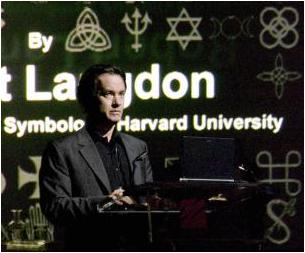
    The image “http://www.log24.com/log/pix06A/061001-Langdon2.jpg” cannot be displayed, because it contains errors.

    Recommended holiday reading list
    from Robert Langdon, Harvard author
    of "the renowned collegiate texbook
    Religious Iconology" --

    Elegance

    Gerard Manley Hopkins on parallelism

    Figures of Speech

    Hamlet's Transformation and the four
    Log24 entries that preceded it

    Finite Geometry of the Hexahedron
    (Alternate title for the Christmas, 2005, entry)

    Happy Six

  • Harvard Psychologist's Recipe for Disaster

    Tales of Philosophy:

    Recipe for Disaster
     
    according to Jerome Kagan,
    Harvard psychologist emeritus
     

    From Log24 --
     

    The Line

    The image “http://www.log24.com/theory/images/GridCube165C3.jpg” cannot be displayed, because it contains errors.

    The Cube

    From Harvard's
    Jerome Kagan --
    "'Humans
    demand that there be a clear right and wrong,' he said. 'You've got to
    believe that the track you've taken is the right track. You get
    depressed if you're not certain as to what it is you're supposed to be
    doing or what's right and wrong in the world.'"

    "People
    need to divide the world into good and evil, us and them, Kagan
    continued. To do otherwise-- to entertain the possibility that life is
    not black and white, but variously shaded in gray-- is perhaps more
    honest, rational and decent. But it's also, psychically, a recipe for
    disaster."
    The image “http://www.log24.com/log/pix06A/061001-epi3-w156.jpg” cannot be displayed, because it contains errors.

    Black and White:

    Log24 in
    May 2005

    The image “http://www.log24.com/log/pix06A/061001-Grays.jpg” cannot be displayed, because it contains errors.

    Shades of Gray:

    An affine space
    and 
    Harvard's
    Jerome Kagan

    The above Kagan quotes are taken
    from a New York Times essay by
    Judith Warner as transcribed by
    Mark Finkelstein on Sept. 29.

    See also Log24 on
    Sept. 29 and 30.

    Related material:

    Kagan's book

    The image “http://www.log24.com/log/pix06A/SurpriseUncertainty.jpg” cannot be displayed, because it contains errors.

    Surprise, Uncertainty,
    and Mental Structures

    (Harvard U. Press, April 2002)

    and Werner Heisenberg--
    discoverer of the
    uncertainty principle--
    as Anakin Skywalker
    being tempted by
    the Dark Side:

    The image “http://www.log24.com/log/pix05/050519-Anakin.jpg” cannot be displayed, because it contains errors.

     
    George Lucas, who has profited
    enormously from public depictions
    of the clash between
    good and evil, light and dark,
    may in private life be inclined
    to agree with Hercule Poirot:
     
    "It is the brain, the little gray cells
    on which one must rely.
    One must seek the truth
    within-- not without."
     
    (This is another version of the
    "Descartes before dehors" principle--