Month: September 2006

  • Tequila!

    for Kylie


    "Time disappears
    with tequila.
    It goes elastic,
    then vanishes."

    -- Kylie Minogue

    From today's AP
    "Obituaries in the News"--

    Danny Flores

    HUNTINGTON BEACH, Calif. (AP) -- Danny Flores,
    who played the saxophone and shouted the word ''tequila!'' in the 1950s
    hit song ''Tequila!'', died Tuesday [Sept. 19, 2006]. He was 77.

    Flores, who lived
    in Westminster, died at Huntington Beach Hospital, said hospital
    spokeswoman Kathleen Curran. He died of complications from pneumonia,
    the Long Beach Press-Telegram reported.

    The man sometimes called
    the ''godfather of Latin rock'' was born in Santa Paula but grew up in
    Long Beach. By age 5, he was playing guitar in church and at 14 he was
    a member of a trio that performed Mexican music.

    In 1957, Flores
    was in a group that recorded some work with rockabilly singer Dave
    Burgess. One of the songs was based on a nameless riff Flores had
    written. He played the ''dirty'' saxophone part and repeatedly growled
    the single-word lyric: ''Tequila!''

    ''Tequila!'' went to No. 1 on
    the Billboard chart and won a Grammy in 1959 for best rhythm and blues
    performance. Flores continued to play it for the next 40 years.

    Related material:

    Today's previous entry,

    "Echoes (Aug. 11)" --

    The image “http://www.log24.com/log/pix06A/060811-Bottle.jpg” cannot be displayed, because it contains errors.

    -- and
    Two-Bar Hook

    (Log24, Aug. 9)


  • "A corpse will be
    transported by express!"

    -- Under the Volcano,
    by Malcolm Lowry (1947)


    Dietrich


    Minogue

    "It has a ghastly familiarity,

    like a half-forgotten dream."

     -- Poppy (Gene Tierney) in

    "The Shanghai Gesture."


    Temptation


    Locomotive

    The Star
    of Venus


    Locomotion


    Joan Didion, The White Album:

    "We tell ourselves stories in order to live....

    We interpret what we see, select the most workable of multiple
    choices. We live entirely, especially if we are writers, by the
    imposition of a narrative line upon disparate images, by the 'ideas'
    with which we have learned to freeze the shifting phantasmagoria which
    is our actual experience.

    Or at least we do for a while. I am talking here about a time when
    I began to doubt the premises of all the stories I had ever
    told myself, a common condition but one I found troubling."

    From Patrick Vert,
    The Narrative of Acceleration:

    "There are plenty of anecdotes to highlight
    the personal, phenomenological experience of railway passage...

    ... a unique study on phantasmagoria and the history of imagination.
    The word originates [in] light-projection, the so-called ghost-shows of the early 19th century....

    ... thought becomes a phantasmagorical process, a spectral,
    representative location for the personal imagination that had been
    marginalized by scientific rationalism....

    This phantasmagoria became more mediated over
    time.... Perception became increasingly visually oriented.... As this
    occurred, a narrative formed to encapsulate the phenomenology of it
    all...."

    For such a narrative, see
    the Log24.net entries of


    From a Christian fairy tale:


    Aslan's last words come at the end of The Last Battle: 'There was
    a real railway accident [...] Your father and mother and all of you
    are--as you used to call it in the Shadow-Lands--dead. The term is
    over: the holidays have begun. The dream is ended: this is the
    morning.'....

    Aslan is given the last word in these quiet but
    emphatic lines. He is the ultimate arbiter of reality: "'There was a
    real railway accident.'" Plato, in addition to the Christian tradition,
    lies behind the closing chapters of The Last Battle. The references
    here to the Shadowlands and to the dream refer back to an earlier
    explanation by Digory, now the Lord Digory:

    "[...] that was not the real Narnia. That had a beginning and an
    end. It was only a shadow or a copy of the real Narnia, which has
    always been here and always will be here: just as our world, England
    and all, is only a shadow or copy of something in Aslan's real world.
    [....] Of course it is different; as different as a real thing is from
    a shadow or as waking life is from a dream. [...] It's all in Plato,
    all in Plato: bless me, what do they teach them at these schools!"

    -- Joy Alexander, Aslan's Speech

    "I was reading Durant's section
    on Plato, struggling to understand his theory of the ideal Forms that lay in
    inviolable perfection out beyond the phantasmagoria. (That was the first, and
    I think the last, time that I encountered that word.)"

    Whether any of the above will be of use in comforting the families of
    those killed in yesterday morning's train wreck in Germany
    is not
    clear.  Pope Benedict XVI, like C. S. Lewis, seems to think Greek
    philosophy may be of some use to those dealing with train wrecks:

    "Modifying the first
    verse of the Book of Genesis, the first verse of the whole Bible, John began
    the prologue of his Gospel with the words: 'In the beginning was the logos.' This is the very word used by the emperor: God acts, syn logo, with logos.
    Logos means both reason and word-- a reason which is creative and
    capable of self-communication, precisely as reason. John thus spoke the final
    word on the biblical concept of God, and in this word all the often toilsome
    and tortuous threads of biblical faith find their culmination and synthesis.
    In the beginning was the logos, and the logos is God, says the
    Evangelist."


    -- Remarks of the Pope at the University of Regensburg on Sept. 12, 2006

  • Shining Forth continued:

    The Grace of Accuracy

    In this morning's New York Times:


    The image “http://www.log24.com/log/pix06A/060922-Obits.jpg” cannot be displayed, because it contains errors.


    The Times describes yesterday's
    memorial to Cy Feuer,
    producer, notably, of the 1972
    film version of "Cabaret"--

    "Joel Grey sang 'Willkommen....'"

    Related material:

    a Log24 entry
    from October 29, 2002--

    Our Judeo-Christian Heritage:

    Two Sides of the Same Coin

    On this date in 1897,
    Joseph
    Goebbels was born.
    Related reading:

    The Calvin College
    Propaganda Archive
    and

    Prince Ombra.

    Cabaret

    Joseph Goebbels

     
    -- and Echoes
    (August 11, 2006).


    The New York Times on Sven Nykvist,

    a cinematographer who died on Wednesday:

    "In his films, especially those with Mr. Bergman, light assumed a metaphysical
    dimension that went beyond mood. It distilled and deepened the feelings of
    torment and spiritual separation that afflicted Bergman characters." --Stephen Holden

    "Pray for the grace of accuracy

    Vermeer gave to the sun's illumination...."

    -- "Epilogue," by Robert Lowell,

    in Day by Day, 1977

    For further remarks on light,

    see Shining Forth as well as
    Tombstone (from May 17,
    the date of Feuer's death).

  • Religious
    Symbolism

    continued from
    Oct. 14, 2004

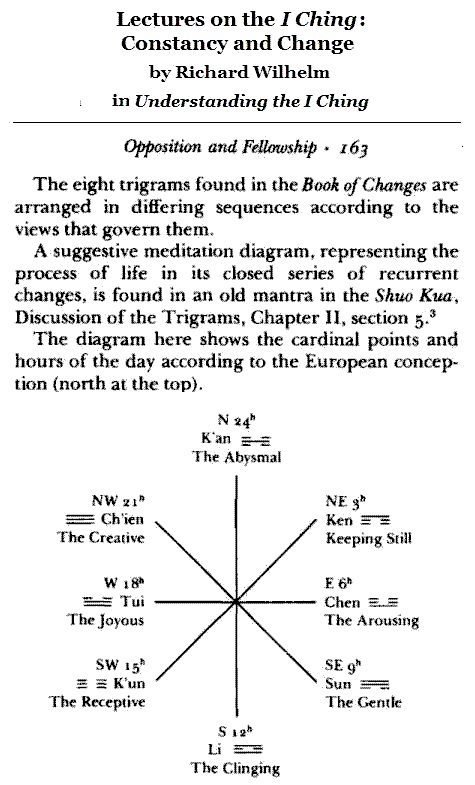
    The image “http://www.log24.com/philo/Wilhelm163.gif” cannot be displayed, because it contains errors.

    See also the previous entry.

    A related symbol, in memory of
    two-time Academy Award winning
    cinematographer Sven Nykvist,
    who died yesterday:

    (See Why Me?, Show Business,
    and the cover of the DVD of
    an Ingmar Bergman trilogy
    photographed by Nykvist.)

  • Public Space

    "...
    the Danish cartoons crisis last March showed 'two world views colliding
    in public space with no common point of reference.'"

    -- George Carey, Archbishop of Canterbury from 1991 to 2002, quoted in today's London Times.

    Related material:

    Geometry and Christianity
       (Google search yielding
        "about 1,540,000" results)

    Geometry and Islam
       (Google search yielding
        "about 1,580,000" results)

    MySpace.com/affine

    The image “http://www.log24.com/log/pix06A/060828-Cube.jpg” cannot be displayed, because it contains errors.

    A Public Space

    The image “http://www.log24.com/log/pix06A/060920-Motto.jpg” cannot be displayed, because it contains errors.

    -- Motto of 
    Plato's Academy

    Background from
    Log24 on Feb. 15, 2006:

      
    Hellmut Wilhelm on the Tao

    If
    we replace the Chinese word "I" (change, transformation) with the word
    "permutation," the relevance of Western mathematics (which some might
    call "the Logos") to the I Ching ("Changes Classic") beomes apparent.

    For the relevance of Plato to
    Islam, see David Wade's
    Pattern in Islamic Art
    and a Google search on
    Plato and Islam
    ("about 1,680,000" results).

    "We should let ourselves be guided by what is common to all. Yet
    although the Logos is common to all, most men live as if each
    had a private intelligence of his own."

    -- Heraclitus of Ephesus, about 500 B.C.

  • For a Dark Lady,

    Soledad O'Brien
    ,
    Who Turns 40 Today:

    Jerezana, by Paco de Lucia
    (Requires RealPlayer and broadband)

    From a 1967 album.


    For a more recent look at de Lucia,
    see his Cositas Buenas video
    (wmv format) at flamenco-world.com.

  • Movie Date
    continued...

    Taking Christ to the Movies,

    by Anna Megill, Princeton '06

    Related material:

    "Prepare for the Weirdness."
    -- Hunter S. Thompson
    (see entry of Sept. 17,
    At Midnight),

    The Presbyterian Exorcist,

    and
    NBC's "Crazy Christians" Show
    (or, "Taking Christ to Studio 60")
    10 PM ET tonight on NBC.


  • Apology


    Excerpts from
    Log 24, January 18, 2004:


    A Living Church


    "Plato has told you a truth; but Plato is dead. Shakespeare has
    startled you with an image; but Shakespeare will not startle you with
    any more. But imagine what it would be to live with such men still
    living. To know that Plato might break out with an original lecture
    to-morrow, or that at any moment Shakespeare might shatter everything
    with a single song. The man who lives in contact with what he believes
    to be a living Church is a man always expecting to meet Plato and
    Shakespeare to-morrow at breakfast. He is always expecting to see some
    truth that he has never seen before."

    -- G. K. Chesterton, Orthodoxy

    C. P. Snow on G. H. Hardy in the foreword to A Mathematician's Apology:

    "... he had another favourite entertainment...."

    ... If, as Chesterton might surmise, he... met
    Plato and Shakespeare in Heaven, the former might discuss with him the
    eternal Platonic form of the number 17*, while the latter might offer....

    * Footnote of 9/18/06: For the Platonic form of 17, see Feast of the Triumph of the Cross (9/14/06) and Medal (9/15/06).

    A Living Church,
    continued...

    Apology:

    An Exercise in Rhetoric

    Related material:


    MOVIE RELEASED
    ON 6-6-6 --

    "Seamus Davey-Fitzpatrick
    stars in a scene from the R-rated movie 'The Omen.' An official of
    the Australian bishops conference took on the superstition
    surrounding the movie's release date of June 6, 2006, noting that 'I
    take evil far too seriously to think "The Omen" is telling me
    anything realistic or important.'" (CNS/20th Century Fox)

    and


    The image �http://www.log24.com/log/pix06A/060915-Roots.gif� cannot be displayed, because it contains errors.

  • At Midnight

    "At midnight
       on the Emperor's pavement
    flit

    Flames that no faggot feeds,
       nor
    steel has lit,

    Nor storm disturbs, flames
       begotten
    of flame,

    Where blood-begotten spirits come

    And all complexities of fury leave,

    Dying into a dance,

    An agony of trance,

    An agony of flame that cannot
       singe
    a sleeve."

    -- From Byzantium, by
        William Butler Yeats

    "The only hope, or else despair
        Lies in the choice of pyre or pyre--
        To be redeemed from fire by fire."

    -- From Four Quartets, by
        Thomas Stearns Eliot

    "Look around you. There is an eerie sense of Panic in the air, a silent
    Fear and Uncertainty that comes with once reliable faiths and truths
    and solid Institutions that are no longer safe to believe in..."

    -- Prepare for the Weirdness, by Hunter S. Thompson, quoted in a sermon for Pentecost Sunday, 2005

    "If you passed, you got to live, and if you failed you were burned alive on a pyre that's now the Transgender Studies Building."

    -- Baccalaureate address at the interfaith worship service, Princeton University, on Pentecost Sunday, June 4, 2006

    Review:

    "At midnight on the Emperor's pavement...."

  • The Pope in
    Plato's Cave

    Those who find the Pope's recent remarks (see the previous entry) on a Byzantine emperor lacking in literary depth may consult the writings of William Butler Yeats on Byzantium quoted in Log24 entries of February 14-16, 2003.  Those entries also refer to a modern version of Plato's cave-- the movie theater-- and the film "The Recruit." See also a more recent Log24 discussion of that film:

    The image “http://www.log24.com/log/pix06A/060806-Einsatz.jpg” cannot be displayed, because it contains errors.

    This supplies a different illustration
    of the previous entry's conclusion:

    "Nine is a very powerful
    Nordic number."