Month: November 2005

  • 720 in the Book

    (continued)

    From today's
    New York Times:

            The image “http://www.log24.com/log/pix05B/EnlargeThis.jpg” cannot be displayed, because it contains errors.

    The image “http://www.log24.com/log/pix05B/051111-BeeSeason.jpg” cannot be displayed, because it contains errors.

    Phil Bray

    Transcendence through spelling:
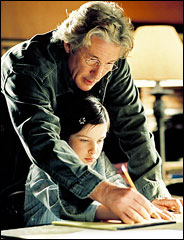
    Richard Gere and Flora Cross
    as father and daughter
    in "Bee Season."

    Words Made Flesh: Code, Culture, Imagination--

    The earliest known foundation of the Kabbalah is the
    Sefer Yetzirah
    (Book of Creation) whose origin and history is unknown....

    ... letters create things by the virtue
    of an algorithm...

        "From two letters or forms He composed two dwellings; from
    three, six; from four, twenty-four; from five, one hundred and twenty; from
    six, seven hundred and twenty...."

    -- Sefer Yetzirah    

    Foucault's Pendulum--

    Mystic
    logic, letters whirling in infinite change, is the world of bliss, it is the
    music of thought, but see that you proceed slowly, and with caution, because
    your machine may bring you delirium instead of ecstasy. Many of Abulafia's
    disciples were unable to walk the fine line between contemplation of the names
    of God and the practice of magic.


    Bee Season--

    "The exercises we've been
    doing are Abulafia's. His methods are primarily a kind of Jewish
    yoga, a way to relax. For most, what Abulafia describes as shefa,
    the influx of the Divine, is a historical curiosity to be discussed
    and interpreted. Because, while anyone can follow Abulafia's
    instructions for permutation and chanting, very few can use them
    to achieve transcendence....

    Spelling is
    a sign, Elly. When you win the national bee, we'll know that
    you are ready to follow in Abulafia's footsteps. Once you're
    able to let the letters guide you through any word you are given,
    you will be ready to receive shefa."

    In the quiet of the room, the sound of Eliza and her father breathing
    is everything.

    "Do you mean," Eliza whispers, "that I'll be
    able to talk to God?"


    Related material:

    Log24, Sept. 3, 2002,

    Diamond Theory notes

    of Feb. 4, 1986,

    of April 26, 1986, and

     of May 26, 1986,

     
    Sacerdotal Jargon

    (Log24, Dec. 5, 2002),

    and 720 in the Book

    (Log24, Epiphany 2004).
  • "... the Board of Education went as far as to
    redefine what science is: it's no longer just a search for natural
    explanations for natural phenomena. Now it's a search for... well,
    that's a bit hard to say. Any sort of explanation, apparently. Pixies,
    ghosts, telekinesis, auras, ancient astronauts, excesses of choleric
    humor, they all seem to be fair game in the interest of 'academic
    freedom.'"


    -- John Rennie, editor in chief of


      Scientific American, Nov. 8, 2005


    The shocking redefinition

    (with changes highlighted):
    Kansas Definition of Science
    Adopted Feb. 14, 2001

    "Science is the human activity of seeking natural
    explanations for what we observe in the world around us. 
    Science does so through the use of observation, experimentation, and
    logical argument while maintaining strict empirical standards and
    healthy skepticism.
    Scientific explanations are built on observations,
    hypotheses, and theories. A hypothesis is a testable statement about
    the natural world that can be used to build more complex inferences and
    explanations. A theory is a well-substantiated explanation of some
    aspect of the natural world that can incorporate observations,
    inferences, and tested hypotheses

    Kansas Definition of Science

    Approved Nov. 8, 2005

    "Science is a systematic method of continuing

    investigation that uses observations, hypothesis testing, measurement,

    experimentation, logical argument and theory building to lead to more

    adequate explanations of natural phenomena. Science does so while

    maintaining strict empirical standards and healthy skepticism.

    Scientific explanations are built on observations, hypotheses, and

    theories. A hypothesis is a testable statement about the natural world

    that can be used to build more complex inferences and explanations. A

    theory is a well-substantiated explanation of some aspect of the

    natural world that can incorporate observations, inferences, and tested

    hypotheses.

    Scientific explanations must meet certain criteria.
    Scientific explanations are consistent with experimental and/or
    observational data and testable by scientists through additional
    experimentation and/or observation. Scientific explanation must meet
    criteria that govern the repeatability of observations and experiments.
    The effect of these criteria is to insure that scientific explanations
    about the world are open to criticism and that they will be modified or
    abandoned in favor of new explanations if empirical evidence so
    warrants. Because all scientific explanations depend on observational
    and experimental confirmation, all scientific knowledge is, in
    principle, subject to change as new evidence becomes available. The
    core theories of science have been subjected to a wide variety of
    confirmations and have a high degree of reliability within the limits
    to which they have been tested. In areas where data or understanding
    are incomplete, new data may lead to changes in current theories or
    resolve current conflicts. In situations where information is still
    fragmentary, it is normal for scientific ideas to be incomplete, but
    this is also where the opportunity for making advances may be greatest.
    Science has flourished in different regions during different time
    periods, and in history, diverse cultures have contributed scientific
    knowledge and technological inventions. Changes in scientific knowledge
    usually occur as gradual modifications, but the scientific enterprise
    also experiences periods of rapid advancement. The daily work of
    science and technology results in incremental advances in our
    understanding of the world about us
    ."
    Scientific explanations must meet certain criteria.
    Scientific explanations are consistent with experimental and/or
    observational data and testable by scientists through additional
    experimentation and/or observation. Scientific explanation must meet
    criteria that govern the repeatability of observations and experiments.
    The effect of these criteria is to insure that scientific explanations
    about the world are open to criticism and that they will be modified or
    abandoned in favor of new explanations if empirical evidence so
    warrants. Because all scientific explanations depend on observational
    and experimental confirmation, all scientific knowledge is, in
    principle, subject to change as new evidence becomes available. The core theories
    of science have been subjected to a wide variety of confirmations and
    have a high degree of reliability within the limits to which they have
    been tested. In areas where data or understanding is incomplete, new
    data may lead to changes in current theories or resolve current
    conflicts. In situations where information is still fragmentary, it is
    normal for scientific ideas to be incomplete, but this is also where
    the opportunity for making advances may be greatest. Science has
    flourished in different regions during different time periods, and in
    history, diverse cultures have contributed scientific knowledge and
    technological inventions. Changes in scientific knowledge usually occur
    as gradual modifications, but the scientific enterprise also
    experiences periods of rapid advancement. The daily work of science and
    technology results in incremental advances in understanding the world."

    From both old (2001) and
    new (2005) Kansas standards:


    Teaching With Tolerance and Respect


    "A teacher is an important role model for  demonstrating respect,
    sensitivity, and civility. Teachers should not ridicule, belittle or
    embarrass a student for expressing an alternative view or belief."

    It's a very ancient saying,


    But a true and honest thought,


    That if you become a teacher,


    By your pupils you'll be taught.

    -- Oscar Hammerstein,
    "Getting to Know You"

    Scientism and Civility:

    A Google blog search for
    fucking kansas evolution standards -fuck
    yields "about 47" entries.

    A search for
    fuck kansas evolution standards -fucking
    yields  "about 34" entries.

    A search for
    fuck fucking kansas evolution standards
    yields "about 42" entries.

  • Butterfly Effect

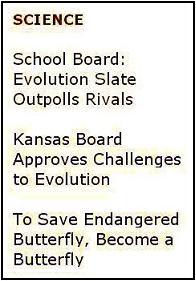
    From today's

    online New York Times:

    The image “http://www.log24.com/log/pix05B/051109-EvolNYT1.jpg” cannot be displayed, because it contains errors.

    John Fowles on two of his novels:

    "I wanted to show the seeds of an intense future evolution in a particular period."

    Ray Bradbury, "A Sound of Thunder" (1952), on the death of a butterfly:

    "It fell to the floor, an exquisite thing, a small thing that could
    upset balances and knock down a line of small dominoes and then big
    dominoes and then gigantic dominoes, all down the years across Time."

    Zhuangzi:

    "Once Zhuang Zhou dreamt he was a butterfly, a butterfly flitting and
    fluttering around, happy with himself and doing as he pleased.  He
    didn't know he was Zhuang Zhou.  Suddenly he woke up and there he
    was, solid and unmistakable Zhuang Zhou.  But he didn't know if he
    was Zhuang Zhou who had dreamt he was a butterfly, or a butterfly
    dreaming he was Zhuang Zhou.  Between Zhuang Zhou and a butterfly
    there must be some distinction!  This is called the Transformation of Things."

    Related material:

  • In honor of the 120th anniversary

    of the birth of Hermann Weyl:

  • Butterfly and Wheel

    The illustration for the previous entry,

    The image “http://www.log24.com/log/pix05B/051107-Aristos2.jpg” cannot be displayed, because it contains errors.

    taken from fowlesbooks.com,
    suggests more links:

    1. To Butterflies and Wheels* (banner below),

    The image “http://www.log24.com/log/pix05B/051107-Butt.jpg” cannot be displayed, because it contains errors.

    a site that attacks Mary Midgley, and

    2. To an AAAS site offering Midgley's

    Evolution as a Religion:
    A Comparison of Prophecies

    I personally prefer Midgley,
    an Oxford-trained philosopher
    also known as
    Mary, Mary, Quite Contrary.

    Related material:
    a meditation on the phrase
    "crucified on the wheel of time."

    * "Who breaks a Butterfly upon a Wheel?"
    -- Alexander Pope

  • Tick Tick Hash

    On Saturday, November 5, 2005,
    author John Fowles died.
     

    The image “http://www.log24.com/log/pix05B/051107-Aristos.jpg” cannot be displayed, because it contains errors.
    From Log24
    on the date of
    Fowles' death: 
    Coincidence
    and Design

    Related material:
    The Collector and
    Speak, Memory

    From Log24
    on the date of
    Fowles' death:
    Contrapuntal
    Themes
    in a Shadowland

    Related material:
    The Aristos

    "Two years after The Collector had brought him
    international recognition and a year before he published The Magus,
    John Fowles set out his ideas on life in The Aristos.  The chief
    inspiration behind them was the fifth century BC philosopher
    Heraclitus.  In the world he posited of constant and chaotic flux the
    supreme good was the Aristos, 'of a person or thing, the best or most
    excellent of its kind.'"

    -- Random House Australia

  • But seriously...

    The image “http://www.log24.com/log/pix05B/051107-Keen.jpg” cannot be displayed, because it contains errors. "Sir Frederick Gray, Minister of
    Defence, is a dignified, upper-class gentleman who is well respected in
    intelligence circles. However for most of his appearances, Gray is a
    strict by-the-book person who plays it seriously at all times.
    Consequently he despises Bond's playful attitude towards life and his
    disregard to take his missions seriously."

    -- jamesbondmm.co.uk

    Geoffrey Keen, who played Sir Frederick Gray in six James Bond films, died on November 3, 2005.

    Related material:

    The Log24 entry of 11:07 AM on the date of Keen's death, and the five Log24 entries ending on January 20, 2005.

  • For Mike Nichols,

    whose birthday is today:

    Angels in Arabia

    Yesterday's entries discussed an angel and a fugue; this suggests Clive Barker's classic tale Weaveworld, which in turn suggests the following links:

    1.  the Log24 archive,
        
    Aug. 1-6, 2005, and

    2.  C. S. Lewis, George Orwell, and
         the Corruption of Language,

    an essay at the website of
    St. Christopher's Cathedral
    in Bahrain, Arabia.

    Nichols, who is Jewish, may of course prefer the following remark of comedian Sarah Silverman:

    "I wear this St. Christopher medal sometimes because-- I’m Jewish, but my
    boyfriend is Catholic-- it was cute the way he gave it to me. He said if
    it doesn’t burn through my skin it will protect me."

  • Contrapuntal Themes

    in a Shadowland
     
    (See previous entry.)

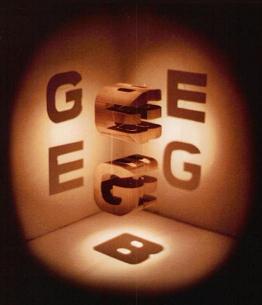
    Douglas Hofstadter on his magnum opus:

    "... I realized that to me, Gödel and Escher and Bach were only shadows
    cast in different directions by some central solid essence. I tried to
    reconstruct the central object, and came up with this book."

    The image “http://www.log24.com/theory/images/GEBcover.jpg” cannot be displayed, because it contains errors.
    Hofstadter's cover

    Here are three patterns,
    "shadows" of a sort,
    derived from a different
    "central object":

    The image “http://www.log24.com/theory/images/GEB.jpg” cannot be displayed, because it contains errors.

    For details, see
    Solomon's Cube.

    Related material:
    The reference to a
    "permutation fugue"
    (pdf) in an article on
    Gödel, Escher, Bach.