Month: August 2004

  • Dyer, Part II:


    From Here to Eternity


    "Dying, at its best, might be something like this.  Everything was a memory, and everything was still happening in some extended present, and everything was still to come."


    -- Geoff Dyer, quoted (in part of an entry, Dyer, for yesterday-- the day mathematician Shizuo Kakutani died) by Ruth Franklin in


    Journey Without Maps


    A Koan for Kakutani--
    on a random walk, a bird, death, time, and eternity--


    In a comment on the previous entry, a Xangan asks,


    "How many drunk men could migrate to Argentina without a map?"


    My answer:  At least one.

  • Drunk Bird


    T. Charles Erickson
    Shizuo Kakutani
    in the 1980's


    Kakutani died yesterday.


    "A drunk man will find his way home, but a drunk bird may get lost forever."


    -- Shizuo Kakutani, quoted by J. Chang in Stochastic Processes (ps), p. 1-19.  Chang says the quote is from an R. Durrett book on probability.


    Meaning:


    A random walk in d dimensions is recurrent if d = 1 or d = 2, but transient if d is greater than or equal to 3.


    From a web page on Kylie Minogue:


    Turns out she's a party girl
    who loves Tequila:
    "Time disappears with Tequila.  
      It goes elastic, then vanishes."


    Kylie sings
    "Locomotion"


    From a web page on Malcolm Lowry's classic novel Under the Volcano


    The day begins with Yvonne’s arrival at the Bella Vista bar in Quauhnahuac. From outside she hears Geoffrey’s familiar voice shouting a drunken lecture this time on the topic of the rule of the Mexican railway that requires that  "A corpse will be transported by express!" (Lowry, Volcano, p. 43).

    For further literary details in memory of Shizuo Kakutani, Yale mathematician and father of book reviewer Michiko Kakutani, see


    Santa Versus the Volcano.


    Of course, Kakutani himself would probably prefer the anti-Santa, Michael Shermer.  For a refutation of Santa by this high priest of Scientism, see


    Miracle on Probability Street


    (Scientific American, July 26, 2004). 

  • Train of Thought


    Kylie sings
    "Locomotion"


    "Oh, my Lolita. I have only words
    to play with!" (Nabokov, Lolita)


    "This is the best toy train set
    a boy ever had!"
    (Orson Welles, after first touring
    RKO Studios, quoted in Halliwell)


    "As the quotes above by Nabokov and Welles suggest, we need to be able to account for the specific functions available to narrative in each medium, for the specific elements that empirical creators will 'play with' in crafting their narratives."


    -- Donald F. Larsson

  • Tribute


    "Un train peut encacher un autre."


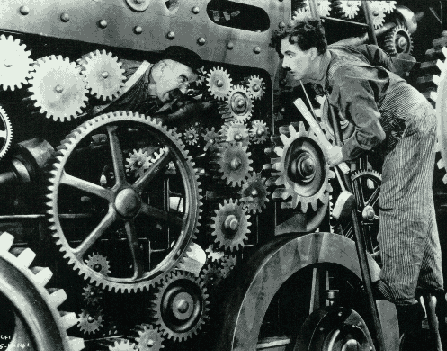
    Modern Times:


    ART WARS September 27, 2002 --


    From the Bulletin of the American Mathematical Society, October 2002, p. 563:


    "To produce decorations for their weaving, pottery, and other objects, early artists experimented with symmetries and repeating patterns.  Later the study of symmetries of patterns led to tilings, group theory, crystallography, finite geometries, and in modern times to security codes and digital picture compactifications.  Early artists also explored various methods of representing existing objects and living things.  These explorations led to.... [among other things] computer-generated movies (for example, Toy Story)."


    -- David W. Henderson, Cornell University


    From an earlier Log24.net note: 


    John Frankenheimer's "The Train" --


    Und was für ein Bild des Christentums
    ist dabei herausgekommen?


  • Dyer


    On an essay by Geoff Dyer:


    "Dyer's writing is searching and melancholic and sometimes profound. In the beautiful title essay, he has a fling with a girl named Kate on a beach in Thailand: for her it is a one-night stand, for him something more. 'There is something about leaving a place on a small boat--something about the movement of the waves, the noise of the engine: it is like you are leaving your life behind and yet, since you are part of the life you have left behind, part of you is still there,' he writes after they have said good-bye. 'Dying, at its best, might be something like this. Everything was a memory, and everything was still happening in some extended present, and everything was still to come.'"


    -- Journey Without Maps, by Ruth Franklin, The New Republic Online, posted Friday the 13th of August, 2004


     "The lord whose oracle is in Delphi neither indicates clearly nor conceals, but gives a sign."
    -- Adolf H., The Left Hand of God, p. 50


    Note the time in the Log24 illustration for Monday, August 16, 2004, and consult the entry for 12/05, 2003.

  • The Zen of Abraham

    Today's Zen Chautauqua, prompted by the fact that this is Abrahamic week at the real Chautauqua, consists of links to

    The Matrix of Abraham,

    Matrix of the Death God, and

    Happy Birthday, Kate and Kevin.

    The real Chautauqua's program this week is, of course, Christian rather than Zen.  Its theme is "Building a Global Neighborhood: The Abrahamic Vision 2004."  One of the featured performers is Loretta Lynn; in her honor (and, of course, that of Sissy Spacek), I will try to overcome the fear and loathing that the Semitic (i. e., "Abrahamic") religions usually inspire in me.

    To a mathematician, the phrase "global neighborhood" sounds like meaningless politico-religious bullshit --  a phrase I am sure accurately characterizes most of the discourse at Chautauqua this week.  But a Google search reveals an area of research -- "particle swarm optimization" in which the phrase "global neighborhood" actually means something.  See

    A Hybrid Particle Swarm
    and Neural Network Approach
    for Reactive Power Control,
    by Paulo F. Ribeiro and
    W. Kyle Schlansker
    (pdf).

    This article includes the following:

    Given the sophistication of his writing, I am surprised at Schlansker's Christian background:

    A good omen for the future is the fact that Schlansker balances the looney Semitic (or "Abrahamic") teachings of Christianity with good sound Aryan religion, in the form of the goddess Themis.

     Themis, often depicted as "Justice"

    For those who must have an Abraham, Schlansker's paper includes the following:

    A Themis figure I prefer to the above:

    For more on religious justice
    at midnight in the garden of
    good and evil, see the Log24
    entries of Oct. 1-15, 2002.

    For material on Aryan religion that is far superior to the damned nonsense at Chautauqua, New York, this week, see

    Jane Ellen Harrison's Themis: a Study of the Social Origins of Greek Religion, with an excursus on the ritual forms preserved in Greek tragedy by Gilbert Murray and a chapter on the origin of the Olympic games by F. M. Cornford.  Rev. 2nd ed., Cambridge, Cambridge U.P., 1927.

    Those who prefer the modern religion of Scientism will of course believe that Themis is purely imaginary, and that truth is to be found in modern myths like that of Carl Sagan's novel Contact, illustrated below.

    Jodie Foster (an admirer of
    Leni Riefenstahl) and the
    opening of the 1936 Olympics

    "Heraclitus.... says: 'The ruler whose prophecy occurs at Delphi oute legei oute kryptei, neither gathers nor hides, alla semainei, but gives hints.'"
    -- An Introduction to Metaphysics, by Martin Heidegger, Yale University Press paperback, 1959, p. 170

    "The lord whose oracle is in Delphi neither indicates clearly nor conceals, but gives a sign."
    -- Adolf Holl, The Left Hand of God, Doubleday, 1998, p. 50

  • Classic to Romantic


    "Ben Webster is probably best known for his eloquent ballad playing. On JAZZ 'ROUND MIDNIGHT, we are treated to no less than 15 ballads, all of which are performed superbly. Webster is one of the great jazz romantics...."


  • The Line


    Robert M. Pirsig, Zen and the Art of Motorcycle Maintenance, Ch. 6 (italics are mine):


    "A classical understanding sees the world primarily as underlying form itself. A romantic understanding sees it primarily in terms of immediate appearance."


    The Sophist, by Plato:


    STRANGER - We are far from having exhausted the more exact thinkers who treat of being and not-being. But let us be content to leave them, and proceed to view those who speak less precisely; and we shall find as the result of all, that the nature of being is quite as difficult to comprehend as that of not-being.


    THEAETETUS - Then now we will go to the others.


    STRANGER - There appears to be a sort of war of Giants and Gods going on amongst them; they are fighting with one another about the nature of essence.


    THEAETETUS - How is that?


    STRANGER - Some of them are dragging down all things from heaven and from the unseen to earth, and they literally grasp in their hands rocks and oaks; of these they lay hold, and obstinately maintain, that the things only which can be touched or handled have being or essence, because they define being and body as one, and if any one else says that what is not a body exists they altogether despise him, and will hear of nothing but body.


    THEAETETUS - I have often met with such men, and terrible fellows they are.


    STRANGER - And that is the reason why their opponents cautiously defend themselves from above, out of an unseen world, mightily contending that true essence consists of certain intelligible and incorporeal ideas; the bodies of the materialists, which by them are maintained to be the very truth, they break up into little bits by their arguments, and affirm them to be, not essence, but generation and motion. Between the two armies, Theaetetus, there is always an endless conflict raging concerning these matters.


    THEAETETUS - True.


    -- Translated by Benjamin Jowett


    Robert M. Pirsig, Zen and the Art of Motorcycle Maintenance, Ch. 18:


    "The wave of crystallization rolled ahead. He was seeing two worlds, simultaneously. On the intellectual side, the square side, he saw now that Quality was a cleavage term. What every intellectual analyst looks for. You take your analytic knife, put the point directly on the term Quality and just tap, not hard, gently, and the whole world splits, cleaves, right in two...


    The Line,
    by S. H. Cullinane


    hip and square, classic and romantic, technological and humanistic...and the split is clean. There's no mess. No slop. No little items that could be one way or the other. Not just a skilled break but a very lucky break. Sometimes the best analysts, working with the most obvious lines of cleavage, can tap and get nothing but a pile of trash. And yet here was Quality; a tiny, almost unnoticeable fault line; a line of illogic in our concept of the universe; and you tapped it, and the whole universe came apart, so neatly it was almost unbelievable. He wished Kant were alive. Kant would have appreciated it. That master diamond cutter. He would see. Hold Quality undefined. That was the secret."


    What Pirsig means by "quality" is close to what Yagoda means, in the previous entry, by "style."

  • In memory of Julia Child,
    born on this date:


    Elements of Style


    "Born Julia McWilliams in 1912, she was the product of the best American genetic engineering, bouncing out of an old-money, privileged Pasadena childhood like a kind of WASP merry prankster...."


    -- Dorothy Kalins in Newsweek, issue dated Aug. 23, 2004


    When I read this, admiring the style of both Julia Child and Dorothy Kalins, I thought of a  blurb I'd seen yesterday in aldaily.com:


    "If only academics had the wit and nerve to honor style... more»"


    I didn't click on the blurb then, but the spirit of Julia prompted me to click just now.  This is what I found, in an essay written while Child was still alive, as examples of style:


    "Think of Michael Jordan and Jerry West each making a 20-foot jump shot, of Charlie Parker and Ben Webster playing a chorus of 'All the Things You Are,' of Julia Child and Paul Prudhomme fixing a duck à l'orange, or of Pieter Brueghel and Vincent van Gogh painting the same farmhouse."


    -- Ben Yagoda in Chronicle of Higher Education, issue dated Aug. 13, 2004

  • Battle of Gods and Giants,
    Part III:


    The Invisible Made Visible


    From today's New York Times:


    "Leon Golub, an American painter of expressionistic, heroic-scale figures that reflect dire modern political conditions, died on Sunday in Manhattan. He was 82....


    In the 1960's he produced a series, called 'Gigantomachies,' of battling, wrestling figures. They were based on classical models, including the Hellenistic Altar of Pergamon. But there was nothing idealized about them."


    The Hellenistic Altar of Pergamon,
    from  Battle of Gods and Giants:


    Golub's New York Times obituary concludes with a quote from a 1991 interview:


    "Asked about his continuing and future goal he said, 'To head into real!'"


    From Tuesday's Battle of Gods and Giants:


    This sort of mathematics illustrates the invisible "form" or "idea" behind the visible two-color pattern.  Hence it exemplifies, in a way, the conflict described by Plato between those who say that "real existence belongs only to that which can be handled" and those who say that "true reality consists in certain intelligible and bodiless forms."


    Perhaps, if Golub is fortunate enough to escape from the afterlife version of Plato's Cave, he will also be fortunate enough to enter Purgatory, where there awaits a course in reality, in the form of...


    Geometry for Jews.