Month: May 2004

  • Language Games:

    Now You’re Playing
    with Power

    My latest preoccupation…

    Using
    search-and-replace programs to reformat earlier Xanga entries. 
    This involves the use of “regular expressions,” which lead to the
    following thoughts….

    It
    seems that pure mathematics (i.e., the theory of finite automata) is
    not without relevance even in very practical data formatting
    problems.  One of the first math books I ever bought – perhaps the very first –was  Automata Studies (Princeton’s Annals of Mathematics Studies, No. 34, 1956).  This book, which I still have, begins with an essay by Stephen Cole Kleene.

    Kleene’s legacy includes regular expressions and Kleene’s theorem.  For further details, see

    Notes on
    Formal Language Theory
    and Parsing

    James Power

    Department of Computer Science
    NATIONAL UNIVERSITY OF IRELAND, MAYNOOTH
    Maynooth, Co. Kildare, Ireland.

    The image “http://www.log24.com/log/images/021221-power2.jpg†cannot be displayed, because it contains errors.
    Click on picture
    for details.

    Here’s more on
    language games and robot wisdom
    from an authority on James Joyce,

  • Ineluctable

    On the poetry of Geoffrey Hill:

    “… why read him? Because of the things he writes about—war and peace and
    sacrifice, and the search for meaning and the truths of the heart, and
    for that haunting sense that, in spite of war and terror and the
    indifferences that make up our daily hells, there really is some
    grander reality, some ineluctable presence we keep touching. There
    remains in Hill the daunting possibility that it may actually all
    cohere in the end, or at least enough of it to keep us searching for
    more.

    There is a hard edge to Hill, a strong Calvinist streak in him, and an intelligence that reminds one of Milton…..”

    – Paul Mariani, review in America of Geoffrey Hill’s The Orchards of Syon

    “Hello! Kinch here. Put me on to Edenville. Aleph, alpha: nought, nought, one.” 

    “A
    very short space of time through very short times of space…. Am I walking into
    eternity along Sandymount strand?”

    James Joyce, Ulysses, Proteus chapter

    “Time has
    been unfolded into space.”

    James O. Coplien, Bell Labs

    “Pattern and symmetry are closely related.”

    James O. Coplien on Symmetry Breaking

    “… as the critic S. L. Goldberg puts
    it, ‘the chapter explores the Protean transformations of matter in time .
    . . apprehensible only in the condition of flux . . . as object . . . and Stephen
    himself, as subject. In the one aspect Stephen is seeking the principles of change
    and the underlying substance of sensory experience; in the other, he is seeking
    his self among its temporal manifestations’….

    – Goldberg, S.L. ‘Homer and the Nightmare of History.’ Modern Critical
    Views: James Joyce
    . Ed. Harold Bloom. New York: Chelsea House, 1986. 21-38.”

    from the Choate site of David M. Loeb

    In summary:

    James Joyce

    Joyce

    Aleph,
    alpha:
    nought,
    nought,
    one
    :


    See also Time Fold.

    (By the way, Jorn Barger seems
    to have emerged from seclusion.)

  • A Form


    John Leonard in the June 10, 2004, New York Review of Books, on E. L. Doctorow:


    “… he’s got urgent things to say and seeks some form to say them in, or a form that will tease and torture secret meanings out of what he thinks he already knows, or a form, like a wishing well, down which to dream, scream, or drown.”


    48. The Well


    The Judgment


    The Well. The town may be changed,
    But the well cannot be changed.
    It neither decreases nor increases.
    They come and go and draw from the well.
    If one gets down almost to the water
    And the rope does not go all the way,
    Or the jug breaks, it brings misfortune.


    From the Book of Ecclesiastes 12:6


    or ever the silver cord be loosed, or the golden bowl be broken, or the pitcher be broken at the fountain, or the wheel broken at the cistern


    From Chuck Polisher’s I Ching Lexicon:


    See also the following form, discussed in


    Balanchine’s Birthday
    (1/9/03) and in


    Art Theory
    for Yom Kippur

    (10/5/03)

  • Star Wars


    In memory of Melvin J. Lasky, editor, 1958-1990, of the CIA-funded journal Encounter:


    “Once called as lively, and as bitchy, as a literary cocktail party, Encounter published articles of unrivalled authority on politics, history and literature.”


    — Obituary in the Telegraph 


    Lasky died on Wednesday, May 19, 2004.  From a journal entry of my own on that date:


    This newly-digitized diagram is from a
    paper journal note of October 21, 1999.


    Note that the diagram’s overall form is that of an eight-point star.  Here is an excerpt from a Fritz Leiber story dealing with such a star, the symbol of a fictional organization:


    Time traveling, which is not quite the good clean boyish fun it’s cracked up to be, started for me when this woman with the sigil on her forehead looked in on me from the open doorway of the hotel bedroom where I’d hidden myself and the bottles and asked me, “Look, Buster, do you want to live?”
    ….


    Her right arm was raised and bent, the elbow touching the door frame, the hand brushing back the very dark bangs from her forehead to show me the sigil, as if that had a bearing on her question.


    The sigil was an eight-limbed asterisk made of fine dark lines and about as big as a silver dollar.  An X superimposed on a plus sign.  It looked permanent.
    ….


    … “Here is how it stacks up:  You’ve bought your way with something other than money into an organization of which I am an agent….”
    ….


    “It’s a very big organization,” she went on, as if warning me.  “Call it an empire or a power if you like.  So far as you are concerned, it has always existed and always will exist.  It has agents everywhere, literally.  Space and time are no barriers to it.  Its purpose, so far as you will ever be able to know it, is to change, for its own aggrandizement, not only the present and the future, but also the past.  It is a ruthlessly competitive organization and is merciless to its employees.”


    “I. G. Farben?” I asked grabbing nervously and clumsily at humor.


    She didn’t rebuke my flippancy, but said, “And it isn’t the Communist Party or the Ku Klux Klan, or the Avenging Angels or the Black Hand, either, though its enemies give it a nastier name.”


    “Which is?” I asked.


    “The Spiders,” she said.


    That word gave me the shudders, coming so suddenly.  I expected the sigil to step off her forehead and scuttle down her face and leap at me—something like that.


    She watched me.  “You might call it the Double Cross,” she suggested, “if that seems better.”


    — Fritz Leiber,
       “Damnation Morning,” 1959


    From last year’s entry,
    Indiana Jones and the Hidden Coffer,
    of 6/14:


    From Borges’s “The Aleph“:


    “The Faithful who gather at the mosque of Amr, in Cairo, are acquainted with the fact that the entire universe lies inside one of the stone pillars that ring its central court…. The mosque dates from the seventh century; the pillars come from other temples of pre-Islamic religions…. Does this Aleph exist in the heart of a stone?”

    (“Los fieles que concurren a la mezquita de Amr, en el Cairo, saben muy bien que el universo está en el interior de una de las columnas de piedra que rodean el patio central…. la mezquita data del siglo VII; las columnas proceden de otros templos de religiones anteislámicas…. ¿Existe ese Aleph en lo íntimo de una piedra?”)

    From The Hunchback of Notre Dame:


    Un cofre de gran riqueza
    Hallaron dentro un pilar,
    Dentro del, nuevas banderas
    Con figuras de espantar.

    A coffer of great richness
    In a pillar’s heart they found,
    Within it lay new banners,
    With figures to astound.


    See also the figures obtained by coloring and permuting parts of the above religious symbol.


    Lena Olin and Harrison Ford
    in “Hollywood Homicide


    Finally, from an excellent site
    on the Knights Templar,
    a quotation from Umberto Eco:


    When all the archetypes burst out shamelessly, we plumb the depths of Homeric profundity. Two cliches make us laugh but a hundred cliches move us because we sense dimly that the cliches are talking among themselves, celebrating a reunion . . . Just as the extreme of pain meets sensual pleasure, and the extreme of perversion borders on mystical energy, so too the extreme of banality allows us to catch a glimpse of the Sublime.


    — ”Casablanca: Cult Movies and Intertextual Collage” (1984) from Travels in Hyperreality


  • Theme and Variations 


    “Por ejemplo, con las posibles secuencias de sólo cuatro letras diferentes: A, R, O y M obtenemos cinco palabras con significados completamente distintos: MORA, ROMA, AMOR, RAMO y OMAR.”


    El Genoma Humano,
    by Ricardo Tapia


    For a deeper meditation on the genetic implications of four-letter words, see
    the link to Richard Powers’s work at
    Theme and Variations.


    I personally prefer the following
    selection of four-letter words:


    The significance of these
    words may be found
    via these links:


    ROMA
    ORAM
    MARO
     AMOR


    Click on pictures
    for further details.


    For the essence and the end
    Of his labor is beauty… 
    one beauty, the rhythm of that Wheel


    Robinson Jeffers,
    “Point Pinos and Point Lobos”

  • Parable, Part II


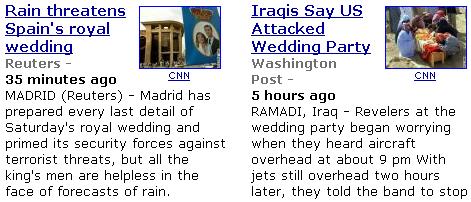
    The juxtaposition in this morning’s Google news of the two wedding stories below calls for some commentary.  The best I can do is the illustrations above the wedding stories, along with a link to some of the best Romani music I have ever heard, from


    La Perla de Cadiz.


    See also this morning’s comments
    on a May 24, 2003, entry
    regarding the Dark Lady,
    as well as the following
    classic remarks by Jack Kerouac:


    “So what do we all do in this life which comes on so much like an empty voidness yet warns us that we will die in pain, decay, old age, horror—?  Hemingway called it a dirty trick.  It might even be an ancient Ordeal laid down on us by an evil Inquisitor in Space, like the ordeal of the sieve and scissors, or even the water ordeal where they dump you in the water with toes tied to thumbs, O God— Only Lucifer could be so mean and I am Lucifer and I’m not that mean, in fact Lucifer goes to Heaven— The warm lips against warm necks in beds all over the world trying to get out of the dirty Ordeal by Death—


    When Ben and I sober up I say ‘How goes it with all that horror everywhere?’


    ‘It’s Mother Kali dancing around to eat up everything she gave birth to, eats it right back—  She wears dazzling dancing jewels and covered all over with silks and decorations and feathers, her dance maddens men, the only part of her aint covered is her vagina which is surrounded with a Mandala Crown of jade, lapis lazuli, cornelean, red pearls and mother of pearl.’


    ‘No diamonds.’


    ‘No, that’s beyond…’ “


    Desolation Angels,
    1960-65, Book Two, Chapter 79

  • Parable


    “A comparison or analogy. The word is simply a transliteration of the Greek word: parabolé (literally: ‘what is thrown beside’ or ‘juxtaposed’), a term used to designate the geometric application we call a ‘parabola.’….  The basic parables are extended similes or metaphors.”


    http://religion.rutgers.edu/nt/
        primer/parable.html


    “If one style of thought stands out as the most potent explanation of genius, it is the ability to make juxtapositions that elude mere mortals.  Call it a facility with metaphor, the ability to connect the unconnected, to see relationships to which others are blind.”


    Sharon Begley, “The Puzzle of Genius,” Newsweek magazine, June 28, 1993, p. 50


    “The poet sets one metaphor against another and hopes that the sparks set off by the juxtaposition will ignite something in the mind as well. Hopkins’ poem ‘Pied Beauty’ has to do with ‘creation.’ “


    Speaking in Parables, Ch. 2, by Sallie McFague


    “The Act of Creation is, I believe, a more truly creative work than any of Koestler’s novels….  According to him, the creative faculty in whatever form is owing to a circumstance which he calls ‘bisociation.’ And we recognize this intuitively whenever we laugh at a joke, are dazzled by a fine metaphor, are astonished and excited by a unification of styles, or ‘see,’ for the first time, the possibility of a significant theoretical breakthrough in a scientific inquiry. In short, one touch of genius—or bisociation—makes the whole world kin. Or so Koestler believes.”


    – Henry David Aiken, The Metaphysics of Arthur Koestler, New York Review of Books, Dec. 17, 1964


    For further details, see


    Speaking in Parables:
    A Study in Metaphor and Theology


    by Sallie McFague


    Fortress Press, Philadelphia, 1975


    Introduction
    Chapter 1
    Chapter 2
    Chapter 3
    Chapter 4
    Chapter 5
    Chapter 6
    Chapter 7


    “Perhaps every science must start with metaphor and end with algebra; and perhaps without metaphor there would never have been any algebra.”


    – attributed, in varying forms (1, 2, 3), to Max Black, Models and Metaphors, 1962


    For metaphor and algebra combined, see


    “Symmetry invariance in a diamond ring,” A.M.S. abstract 79T-A37, Notices of the Amer. Math. Soc., February 1979, pages A-193, 194 — the original version of the 4×4 case of the diamond theorem.

  • Style


    In memory of Lynn H. Loomis:


    The above diagram is from a
    (paper) journal note of October 21, 1999.


    It pictures the relationship of my own discovery, diamond theory (at center), to the field, harmonic analysis, of Professor Loomis, a writer whose style I have long admired.


    A quotation from the 1999 note:


    “…it is not impossible to draw a fairly sharp dividing line between our mental disposition in the case of esthetic response and that of the responses of ordinary life.  A far more difficult question arises if we try to distinguish it from the responses made by us to certain abstract mental constructions such as those of pure mathematics…. Perhaps the distinction lies in this, that in the case of works of art the whole end and purpose is found in the exact quality of the emotional state, whereas in the case of mathematics the purpose is the constatation of the universal validity of the relations without regard to the quality of the emotion accompanying apprehension.  Still, it would be impossible to deny the close similarity of the orientation of faculties and attention in the two cases.”
    — Roger Fry, Transformations (1926), Doubleday Anchor paperback, 1956, p. 8


    In other words, appreciating mathematics is much like appreciating art.


    (Digitized diagram courtesy of Violet.)

  • Language Game


    In memory of
    Samuel Iwry, Hebrew scholar,
    who died on May 8, 2004:


    From a log24 entry of May 8, 2004,
    on Wittgenstein’s “language games” —


        “Let us imagine a language …”


    — Ludwig Wittgenstein,
        Philosophical Investigations


    Okay…


    Moral of the story:
    If you must have a
    religious language,
    Elvish may,
    in some situations,
    do as well as Hebrew.


    See also


    The Unity of Mathematics,
    or Shema, Israel
    .