Month: April 2003
-
"June dawns, July noons, August evenings over, finished, done, and gone forever with only the sense of it all left here in his head. Now, a whole autumn, a white winter, a cool and greening spring to figure sums and totals of summer past. And if he should forget, the dandelion wine stood in the cellar, numbered huge for each and every day. He would go there often, stare straight into the sun until he could stare no more, then close his eyes and consider the burned spots, the fleeting scars left dancing on his warm eyelids; arranging, rearranging each fire and reflection until the pattern was clear."
-- Ray Bradbury, Dandelion Wine
"Socialism or Death"
-- Banner in the film "Guantanamera" (Cuba, 1994)
"I'm thinking, I'm thinking!"
-- Jack Benny, replying to bandits who demanded his money or his life. Benny was born on St. Valentine's day and died on St. Stephen's day.
For what it's worth, both Bradbury and Benny are from Waukegan, Illinois.
"Through the unknown, remembered gate...."
-- T. S. Eliot, epigraph to
Parallelisms of Complete Designs, by
-
Harrowing
In memory of the many who have died on April 19, most notably Octavio Paz.
"There is a suggestion of Christ descending into the abyss for the harrowing of Hell. But it is the Consul whom we think of here, rather than of Christ."
-- Introduction to Malcolm Lowry's classic novel Under the Volcano, by Stephen Spender


"Hey, big Spender, spend a little time
with me." -- Song lyric
For a somewhat deeper meditation on time, see Architecture of Eternity.
See also Literature of the Descent into Hell.
"Mexico is a solar country -- but it is also a black country, a dark country. This duality of Mexico has preoccupied me since I was a child."
-- Octavio Paz, quoted by Homero Aridjis

Amen.
Concluding Unscientific Postscripts:
"Once upon a time..." -- Anonymous
"It's quarter to three..." -- Sinatra
-
A Red Mass
For G. H. Hardy, who, although he kept a portrait of Lenin in his rooms, knew more of truth than most Christians ever know.
"317 is a prime, not because we think so, or because our minds are shaped in one way rather than another, but because it is so, because mathematical reality is built that way."
-- G. H. Hardy, A Mathematician's Apology, 1940 -
To the Society of Jesus
(also known as the Jesuits):
Have a Good Friday,
Traitors

†
Prompted by Pilate's question "What is truth?" and by my March 24 attack on Noam Chomsky, I decided this afternoon to further investigate what various people have written about Chomsky's posing of what he calls "Plato's problem" and "Orwell's problem." The former concerns linguistics, the latter, politics. As my March 24 entry indicates, I have nothing but contempt for both Chomsky's linguistics and Chomsky's politics. What I discovered this afternoon is that Georgetown University, a Jesuit institution, in 2001 appointed a Chomskyite, David W. Lightfoot, as Dean of the Graduate School of Arts and Sciences.
"Why do we know so much more than we have evidence for in certain areas, and so much less in others? In tackling these questions -- Plato's and Orwell's problem -- Chomsky again demonstrates his unequalled capacity to integrate vast amounts of material."
-- David W. Lightfoot, review of Chomsky's Knowledge of Language
What, indeed, is truth? I doubt that the best answer can be learned from either the Communist sympathizers of MIT or the "Red Mass" leftists of Georgetown. For a better starting point than either of these institutions, see my note of April 6, 2001, Wag the Dogma.
See, too, In Principio Erat Verbum, which notes that "numbers go to heaven who know no more of God on earth than, as it were, of sun in forest gloom."
Since today is the anniversary of the death of MIT mathematics professor Gian-Carlo Rota, an example of "sun in forest gloom" seems the best answer to Pilate's question on this holy day. See
"Examples are the stained glass windows
of knowledge." -- Vladimir Nabokov
Motto of
Plato's Academy
† The Exorcist, 1973
-
Holiday Affair
From a site recommended by oOMisfitOo:
In The Star of Bethlehem: The Legacy of the Magi (Rutgers University Press, 1999), Michael R. Molnar explains how the purchase of a $50 Roman coin led him to discover the real date of Jesus's birth.
The coin that provided the clue portrayed Aries the Ram looking back at a star.
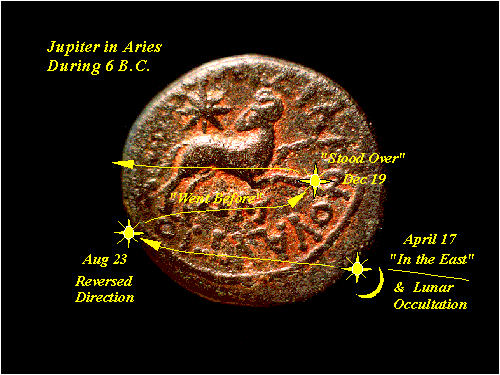
From Molnar's own site, Star of Bethlehem:
"On April 17, 6 BC, two years before King Herod died, Jupiter emerged in the east as a morning star in the sign of the Jews, Aries the Ram."
Therefore, according to Molnar, today is Christmas. Accordingly, let us sing a (slightly improved) carol in memory of the late Murray L. Bob (see April 15 entries):
God rest ye, merry gentleman.
Let us also voice a rousing chorus of one of my personal all-time favorites, in memory of a film director (see previous entry), who gave us a vision of Robert Mitchum (Ram) and Sarah Miles ("Lady Caroline Lamb") united in marriage (Ding-Dong):
Who put the Ram in the
Ram-a-Lamb-a Ding-Dong?
Why, David Lean, of course.
Update of April 21, 2003:
When You Care Enough
to Send the Very Best"Jan Scott, 88, a television art director and production designer who had won 11 Emmy Awards, died April 17 at her home in Hollywood Hills, Calif. The cause of death was not reported.
She started working in television in the 1950s and earned her first Emmy nomination in 1956 for a "Hallmark Hall of Fame" production. Her first Emmy Award came in 1968 for her work as an art director for "Kismet," which appeared on ABC. Her last Emmy was awarded in 1989 for "I'll Be Home for Christmas," on NBC."
-
Keeping Time
The title of this entry comes from T. S. Eliot (see below). The subject, and the relevance of the Kipling passage, are from Eleanor Cameron's Green and Burning Tree, itself the subject of an April 15 entry.
Part I
From Puck of Pook's Hill, by Rudyard Kipling
The Theatre lay in a meadow.... a large old Fairy Ring of darkened grass, which was the stage.... Shakespeare himself could not have imagined a more suitable setting for his play....
Their play went beautifully.... They were both so pleased that they acted it three times over from beginning to end before they sat down in the unthistly centre of the Ring to eat..., This was when they heard a whistle among the alders on the bank, and they jumped.
The bushes parted. In the very spot where Dan had stood as Puck they saw a small, brown, broad-shouldered, pointy-eared person....
He stopped, hollowed one hand round his ear, and, with a wicked twinkle in his eye, went on:
'What, a play toward? I'll be an auditor;
An actor, too, perhaps, if I see cause.'
The children looked and gasped. The small thing - he was no taller than Dan's shoulder - stepped quietly into the Ring.
"I'm rather out of practice," said he; "but that's the way my part ought to be played."
Still the children stared at him -- from his dark blue cap, like a big columbine flower, to his bare, hairy feet. At last he laughed.
"Please don't look at me like that. It isn't my fault. What else could you expect?" he said.
"We didn't expect anyone," Dan answered slowly. "This is our field."
"Is it?" said their visitor, sitting down. "Then what on Human Earth made you act Midsummer Night's Dream three times over, on Midsummer Eve, in the middle of a Ring, and under -- right under one of my oldest hills in Old England? Pook's Hill -- Puck's Hill -- Puck's Hill -- Pook's Hill! It's as plain as the nose on my face."
".... You've done something that Kings and Knights and Scholars in old days would have given their crowns and spurs and books to find out. If Merlin himself had helped you, you couldn't have managed better!"
Part II
From "East Coker," by T. S. Eliot
In that open field
If you do not come too close,
if you do not come too close,
On a summer midnight,
you can hear the music
Of the weak pipe and the little drum....
... Round and round the fire
Leaping through the flames,
or joined in circles....
... Keeping time,
Keeping the rhythm in their dancing....
Part III
From The Real World, by Anonymous:
Tonight is the night of the Paschal full moon, which is used to calculate the date of Easter.
On this date in 1871, playwright John Millington Synge was born. He wrote of "the wonderfully tender and searching light that is seen only in Kerry."
On this date in 1991, director David Lean died. He showed us the tender and searching light of Kerry in "Ryan's Daughter."
The summer harvest festival of County Kerry is known as "Puck Fair."
The song "The Kerry Dance" includes the following lyrics:
O the days of the Kerry dancing....
When the boys began to gather,
in the glen of a summer's night.
And the Kerry piper's tuning
made us long with wild delight.
Tonight's site music is "The Kerry Dance" arranged in a form appropriate to the spirit of "East Coker" and the spirit of Puck Fair.
Eliot and Eleanor Cameron were both concerned with "keeping time" in a very deep sense. For more on this subject, see my previous entries for April 2003, Poetry Month.
See, too, Midsummer Eve's Dream.
-
Green and Burning
After posting the 2:42 PM entry at a public library this afternoon, I picked up the following at a "Friends of the Library" used-book sale:
The Green and Burning Tree:
On the Writing and Enjoyment
of Children's Books,
by Eleanor Cameron (Little, Brown and Company, Boston and Toronto, 1969).
Cameron, on page 73, gives the source of her title; it is from the Mabinogion:
"And they saw a tall tree by the side of the river, one half of which was in flames from the root to the top, and the other half was green and in full leaf."
Cameron finds the meaning of this symbol in Dylan Thomas: His Life and Work, by John Ackerman (Oxford University Press, 1964), p. 6:
"Another important feature of the old Welsh poetry is an awareness of the dual nature of reality, of unity in disunity, of the simultaneity of life and death, of time as an eternal moment rather than as something with a past and future."
For part of a Nobel Prize lecture on this topic — time as an eternal moment — see Architecture of Eternity, a journal note from December 8, 2002.
That lecture is from an author, Octavio Paz, who wrote in Spanish. Here are some other words in that language:
Mi verso es de un verde claro,
Y de un carmín encendido.
My verse is a clear green,
And a burning crimson.
These lyrics to the song "Guantanamera" (see Palm Sunday) were on my mind this afternoon when Cameron's book caught my eye.
Green and crimson are, of course, also the colors of Christmas, or "Christ Mass." In view of the fact that Cameron's book is about children's literature, this leads, like it or not, to the following meditation.
From a religious site:
Matthew 18:3 - And said, Truly I say to you, Unless you are converted, and become like little children, you shall not enter into the kingdom of heaven.
Mark 10:15 - Truly I say to you, Whoever shall not receive the kingdom of God as a little child shall not enter it at all.
Luke 18:17 - Truly I say to you, Whoever does not receive the kingdom of God as a little child shall by no means enter it.
A meditation from a less religious site:
"What I tell you three times is true."
Finally, from what I now consider
- in view of the song lyrics quoted above,
- in view of the fact that it deals with a Cuban movie also titled "Guantanamera,"
- in view of Cameron's remarks on Bergman's "The Seventh Seal" (p. 129), and
- in view of my April 7 entry on mathematics and art,
to be an extremely religious site, a picture:

- in view of the song lyrics quoted above,
-
Once Upon a Time
On Tuesday, April 15, 2003, at 5:01 PM EST, this place was reserved for later use.
It now seems an appropriate spot to put Maurice Rapf, a screenwriter, a blacklisted Communist fellow-traveler, and later a professor of film studies at Dartmouth, his alma mater.
Rapf died on April 15, 2003, at the age of 88.
He contributed to the screenplay for Disney's "Cinderella" (1950). According to his Washington Post obituary, "he said he gave the character of Cinderella a spirit of class struggle."
Rapf described his Hollywood childhood in Back Lot: Growing Up With the Movies, 1999.
"A dream is a wish your heart makes."
Entered Friday, April 18, 2002, 3:24 AM EST.
-
Certain Things
by Murray L. Bob
DEATH:
- The great equalizer.
- The only vacation for which you need no reservation.
- Death was more acceptable when people didn't live as long. More proof, if any was needed, that the more you have, the more you want.
- There is something comforting about its finality. There is nothing unexpected about death except the time, place, and manner of its occurrence.
- The solution is dissolution.
- Has an undeservedly bad reputation: think of all the sons-of-bitches it's ridden us of.
TAXPAYER COMPLAINT:
The people who benefit the most from research are never the people who pay for it.
Both items above are from
A Contrarian's Dictionary Strikes Again! —
2001 Impudent Definitions For the 21st Century,
by Murray L. Bob.
Murray, a library director, checked out during National Library Week, April 6-12, 2003. From the work quoted above, two of his classic parting shots:
LIBRARY:
When you look at everything else in this town you know there shouldn't be a great library here. Fortunately, the librarians don't know this.
LIBRARIANS:
Old librarians never die, they just close the books.

- The great equalizer.

Recent Comments