April 28, 2003
-
ART WARS:
Toward Eternity
April is Poetry Month, according to the Academy of American Poets. It is also Mathematics Awareness Month, funded by the National Security Agency; this year’s theme is “Mathematics and Art.”
Some previous journal entries for this month seem to be summarized by Emily Dickinson’s remarks:
“Because I could not stop for Death–
He kindly stopped for me–
The Carriage held but just Ourselves–
And Immortality.
………………………
Since then–’tis Centuries–and yet
Feels shorter than the Day
I first surmised the Horses’ Heads
Were toward Eternity– ”
Consider the following journal entries from April 7, 2003:
Math Awareness Month
April is Math Awareness Month.
This year’s theme is “mathematics and art.”

An Offer He Couldn’t Refuse
Today’s birthday: Francis Ford Coppola is 64.
“There is a pleasantly discursive treatment
of Pontius Pilate’s unanswered question
‘What is truth?’.“
— H. S. M. Coxeter, 1987, introduction to Richard J. Trudeau’s remarks on the “Story Theory” of truth as opposed to the “Diamond Theory” of truth in The Non-Euclidean Revolution
From a website titled simply Sinatra:
“Then came From Here to Eternity. Sinatra lobbied hard for the role, practically getting on his knees to secure the role of the street smart punk G.I. Maggio. He sensed this was a role that could revive his career, and his instincts were right. There are lots of stories about how Columbia Studio head Harry Cohn was convinced to give the role to Sinatra, the most famous of which is expanded upon in the horse’s head sequence in The Godfather. Maybe no one will know the truth about that. The one truth we do know is that the feisty New Jersey actor won the Academy Award as Best Supporting Actor for his work in From Here to Eternity. It was no looking back from then on.”
From a note on geometry of April 28, 1985:
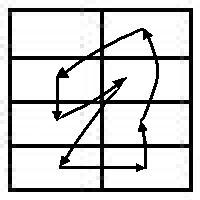
The “horse’s head” figure above is from a note I wrote on this date 18 years ago. The following journal entry from April 4, 2003, gives some details:
The Eight
Today, the fourth day of the fourth month, plays an important part in Katherine Neville’s The Eight. Let us honor this work, perhaps the greatest bad novel of the twentieth century, by reflecting on some properties of the number eight. Consider eight rectangular cells arranged in an array of four rows and two columns. Let us label these cells with coordinates, then apply a permutation.

Decimal
labeling

Binary
labeling
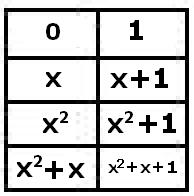
Algebraic
labeling
Permutation
labeling
The resulting set of arrows that indicate the movement of cells in a permutation (known as a Singer 7-cycle) outlines rather neatly, in view of the chess theme of The Eight, a knight. This makes as much sense as anything in Neville’s fiction, and has the merit of being based on fact. It also, albeit rather crudely, illustrates the “Mathematics and Art” theme of this year’s Mathematics Awareness Month.
The visual appearance of the ”knight” permutation is less important than the fact that it leads to a construction (due to R. T. Curtis) of the Mathieu group M24 (via the Curtis Miracle Octad Generator), which in turn leads logically to the Monster group and to related ”moonshine” investigations in the theory of modular functions. See also “Pieces of Eight,” by Robert L. Griess.
