Month: December 2002

  • To Sir Anthony Hopkins
    on His Birthday


    From “The Wardrobe Wars,” by Paul Willis:


    “I was back at Wheaton for a conference just a couple of years ago. During a period of announcements, a curator from the Wade Collection invited the conference participants to visit the collection and see the many books and papers that had belonged to Lewis and his associates. At the end of her announcement, she told us, ‘We also have the wardrobe that served as the original for the one in the Narnia Chronicles.’

    There it was, that definite article again. In a remarkable display of maturity I put up my hand and said, ‘Excuse me, but the wardrobe is at Westmont College in Santa Barbara.’

    The woman gave me a long, hard look of the ‘we are not amused’ variety. That was all. I wasn’t able to find her after the session was over to clear things up.

    Not that we could have, really. Of course, if pressed, I suspect we would both admit the wardrobe we are really concerned with exists only within the covers of a book, and that not even this wardrobe is so important as the story of which it is a part, and that the story is not so important as the sense of infinite longing that it stirs within our souls, and that this longing is not so important as the One—more real than Aslan himself—to whom it directs us. But that would be asking too much of either the curator or myself. To worship at our respective wardrobes, whether they be in Jerusalem or Samaria, is indeed to live in the shadowlands. And that is where we like it.

    Lewis himself would doubtless say that the physical wardrobes in our possession are but copies of a faint copy. He might even claim, to our horror, that no single wardrobe inspired the one found in his book. Then he might add under his breath, like the professor in The Last Battle who has passed on to the next life, ‘It’s all in Plato, all in Plato: bless me, what do they teach them at these schools!’”


  • To Aster, from Plato


    Asteras eisathreis, Aster emos.
    Eithe genoimen ouranos,
    ‘os pollois ommasin eis se blepo.


    You gaze at stars, my Star.
    Would that I were born the starry sky,
    that I with many eyes might gaze at you.


    — Plato


    (Sometimes translated as “To Stella.” Hence the current site music, “Stella by Starlight.” See last midnight’s entry, “Three in One.”)

  • Three in One

    This evening’s earlier entry, “Homer,” is meant in part as a tribute
    to three goddess-figures from the world of film.  But there
    is one actress who combines the intelligence of Judy
    Davis with the glamour of Nicole Kidman and the goodness of
    Kate Winslet– Perhaps the only actress who could have made me cry Stella! as if I were Brando…. Piper Laurie.

    From the Robert A. Heinlein novel

    Glory Road

        “I have many names. What would you  like to call me?”

        “Is one of them ‘Helen’?”

       
    She smiled like sunshine and I learned that she had dimples. She looked
    sixteen and in her first party dress. “You are very gracious. No, she’s
    not even a relative. That was many, many years ago.” Her face turned
    thoughtful. “Would you like to call me ‘Ettarre’?”

        “Is that one of your names?”

       
    “It is much like one of them, allowing for different spelling and
    accent. Or it could be ‘Esther’ just as closely. Or ‘Aster.’ Or even 
    ‘Estrellita.’ “

        ” ‘Aster,’ ” I repeated. “Star. Lucky Star!”

        “I hope that I will be your lucky star,” she said earnestly. “As you will. But what shall I call you?”

        I thought about it….

       The name I had picked up in the hospital ward would do. I shrugged. “Oh, Scar is a good enough name.”

       
    ” ‘Oscar,’ ” she repeated, broadening the “O” into “Aw,”and stressing
    both syllables. “A noble name. A hero’s name.  Oscar.” She caressed it
    with her voice.

        “No, no! Not ‘Oscar’– ‘Scar.’ ‘Scarface.’  For this.”

        “Oscar is your name,” she said firmly. “Oscar and Aster.  Scar and Star.”

    The Hustler

  • Homer

    “No matter how it’s done, you won’t like it.”
    – Robert Redford to Robert M. Pirsig in Lila

    The evening before Harriet injures Roy,
    she asks him, in a restaurant car,
    whether he has read Homer.”
    Oxford website on the film of The Natural

    “Brush Up Your Shakespeare”
    – Cole Porter lyric for a show that opened
    on December 30, 1948

    Judy Davis as Harriet Bird


    Thine eyes I love…
    Shakespeare, Sonnet 132

    “Roy’s Guenevere-like lover is named Memo Paris,
    presumably the face that launched a thousand strikes.”
    Oxford website on the film of The Natural 

    Nicole Kidman
    as Memo Paris

    “Iris is someone to watch over Roy.”
    Oxford website on the film of The Natural 

    Kate Winslet as young Iris Murdoch

    From the second-draft screenplay
    for The Sting,
    with Robert Redford as Hooker:

    HOOKER
    (shuffling a little)
    I, ah…thought you might wanna come out for a while.  Maybe have a drink or somethin’.

    LORETTA
    You move right along, don’t ya.

    HOOKER
    (with more innocence than confidence)
    I don’t mean nothin’ by it.  I just don’t know many regular girls, that’s all.

    LORETTA
    And you expect me to come over, just like that.

    HOOKER
    If I expected somethin’, I wouldn’t be still standin’ out here in the hall.

    Loretta looks at him carefully.  She knows it’s not a line.

    LORETTA
    (with less resistance now)
    I don’t even know you.

    HOOKER
    (slowly)
    You know me.  I’m just like you…
    It’s two in the morning and I don’t know nobody.

    The two just stand there in silence a second.  There’s nothing more to say.  She stands back and lets him in.

    Iris Murdoch on Plato’s Form of the Good,
    by Joseph Malikail:

    For Murdoch as for Plato, the Good
    belongs to Plato’s Realm of Being not the Realm of Becoming….
    However, Murdoch does not read Plato as declaring his faith in a divine
    being when he says that the Good is

    the universal author of all things beautiful and
    right, parent of light and the lord of light in the visible world, and
    the immediate source of reason and truth in the intellectual; and that
    this is the power upon which [one who] would act rationally either in
    public or private life must have his eyes fixed (Republic…).

    Though she acknowledges the influence of Simone Weil
    in her reading of Plato, her understanding of Plato on Good and God is
    not Weil’s (1952, ch.7)*. For Murdoch,

    Plato never identified his Form of the Good with God (the use of theos in the Republic… is a façon de parler),
    and this separation is for him an essential one. Religion is above the
    level of the ‘gods.’ There are no gods and no God either. Neo-Platonic
    thinkers made the identification (of God with good) possible; and the
    Judaeo-Christian tradition has made it easy and natural for us to
    gather together the aesthetic and consoling impression of Good as a
    person (1992, 38)**.

    As she understands Plato:

    The Form of the Good as creative power is not a Book
    of Genesis creator ex nihilo … Plato does not set up the Form of the
    Good as God, this would be absolutely un-Platonic, nor does he anywhere
    give the sign of missing or needing a real God to assist his
    explanations. On the contrary, Good is above the level of the gods or
    God (ibid., 475)**.

    Mary Warnock, her friend and fellow-philosopher, sums up Murdoch’s metaphysical view of the Vision of the Good:

    She [Murdoch] holds that goodness has a real though
    abstract existence in the world. The actual existence of goodness is,
    in her view, the way it is now possible to understand the idea of God.

    Or as Murdoch herself puts it, ‘Good represents the reality of which God is the dream.’ (1992, 496)**”

    *Weil, Simone. 1952. Intimations of Christianity Among The Ancient Greeks. Ark Paperbacks, 1987/1952.

    **Murdoch, Iris. 1992. Metaphysics As A Guide To Morals. London: Chatto and Windus. 

    From the conclusion of Lila,
    by Robert M. Pirsig:

    “Good is a noun. That was it. That was what Phaedrus had been
    looking for. That was the homer over the fence that ended the
    ballgame.”

  • Solace from Hell’s Kitchen


    State of Grace


    The Sting


    This midnight’s site music is “Solace: A Mexican Serenade,” part of which was used in the film “The Sting.” George Roy Hill, the film’s director, died Friday, Dec. 27. He turned 81 on Friday, Dec. 20. See my note of that date,


    Last-Minute Shopping.”

  • On This Date


        Kylie

    In 1937, composer
    Maurice Ravel died.


    Our site music for today
    is Ravel’s classic, “
    Bolero.”


    For “Bolero” purposes, some may prefer Kylie Minogue’s rendition of “Locomotion.”


    Zen meditation: ”Kylie Eleison!”


    (For evidence that this is a valid Japanese religious exclamation, click here.)

  • Another Opening of Another Show


    “To die will be an awfully big adventure.”
    — Peter Pan


    in “An Awfully
    Big Adventure”


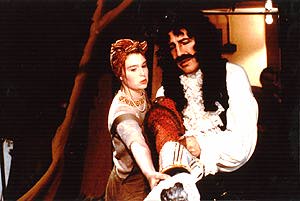
    On this date in 1904, “Peter Pan” opened to great applause at the Duke of York’s theatre in London. A cinematic sequel, “An Awfully Big Adventure,” is illustrated at left and below.  I have always felt this film’s soundtrack should include the classic Mac Davis song “Girl, you’re a hot-blooded woman-child….”


  • Least Popular Christmas Present


    Derrida


    From the University of Chicago Press, Religion and Postmodernism Series:


    The Gift of Death,
    by Jacques Derrida


    Russell Berrie, toy maker, dies on Christmas Day. (AP photo)


    See also my note “Last-Minute Shopping
    of December 20, 2002, and my note
    An Anti-Christmas Present” of June 25, 2002.


    On the bright side: Berrie joins comedians
    W. C. Fields and Charlie Chaplin,
    who also died on Christmas Day. 
    “Dying is easy; comedy is hard.”
    — Unknown source.
    See my note on Santa’s last words.

  • Saint Hoagy’s Day


    Today is the feast day of St. Hoagy Carmichael, who was born on the feast day of Cecelia, patron saint of music. This midnight’s site music is “Stardust,” by Carmichael (lyrics by Mitchell Parish). See also “Dead Poets Society” — my entry of Friday, December 13, on the Carmichael song “Skylark” — and the entry “Rhyme Scheme” of later that same day.

  • Holly for Miss Quinn


    Tonight’s site music is for Stephen Dedalus and Miss Quinn, courtesy of Eithne Ní Bhraonáin.


    Miss Quinn


    Holly


    Eithne