The Message from Vega
|
|


“Mercilessly tasteful”
– Andrew Mueller,
review of Suzanne Vega’s
“Songs in Red and Gray“
The Message from Vega
|
|
“Mercilessly tasteful”
– Andrew Mueller,
review of Suzanne Vega’s
“Songs in Red and Gray“
Zen holy day:
Bodhidharma Day
Epigraph to Chapter 23 of Contact, by Carl Sagan:
We have not followed cunningly devised fables….
– II Peter 1:16
Song lyric:
It’s still the same old story….
– Herman Hupfeld, 1931
From Chapter 23 of Contact, by Carl Sagan:
“You mean you could decode a picture hiding in pi and it would be a mess of Hebrew letters?”
“Sure. Big black letters, carved in stone.”
He looked at her quizzically.
“Forgive me, Eleanor, but don’t you think you’re being a mite too… indirect? You don’t belong to a silent order of Buddhist nuns. Why don’t you just tell your story?”

Moonlight and love songs,
never out of date….
See also my journal note
for Michaelmas, 2002,
“Pi in the Sky.”
ART WARS:
The Agony and the Ya-Ya
Today’s birthdays:
To honor the birth of these three noted spiritual leaders, I make the following suggestion: Use the mandorla as the New Orleans Mardi Gras symbol. Rice lives in New Orleans and LaBelle’s classic “Lady Marmalade” deals with life in that colorful city.
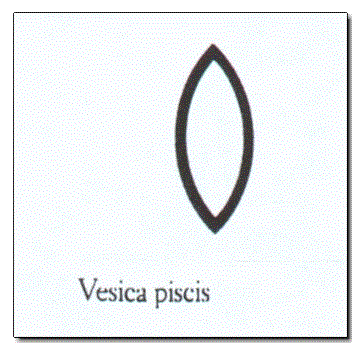
What, you may well ask, is the mandorla? This striking visual symbol was most recently displayed prominently at a meeting of U.S. cardinals in the Pope’s private library on Shakespeare’s birthday. The symbol appears in the upper half of a painting above the Pope.

From Church Anatomy:
The illustration below shows how Barbara G. Walker in her excellent book “The Woman’s Encyclopedia of Myths and Secrets” describes the mandorla.
The Agony Based on a novel by Irving Stone, this 1965 movie focuses on the relationship between Michelangelo (Charlton Heston) and Pope Julius II (Rex Harrison), who commissioned the artist to paint the Sistine Chapel ceiling.
|
Vesica piscis Mandorla, “almond,” the pointed-oval sign of the yoni, is used in oriental art to signify the divine female genital; also called vesica piscis, the Vessel of the Fish. Almonds were holy symbols because of their female, yonic connotations. Christian art similarly used the mandorla as a frame for figures of God, Jesus, and saints, because the artists forgot what it formerly meant. I. Frazer, G.B., 403 |

Literary Landmarks
From Dr. Mac’s Cultural Calendar for Oct. 3:
“On this day in 1610, Ben Jonson’s funniest comedy The Alchemist was entered into the Stationer’s Register. It involves a servant who when the masters are away sets up a necromantic shop, tricking all and everyone.”
From Literary Calendar for tomorrow, Oct. 4:
“1892 — Robert Lawson, the only author/illustrator to win both the Caldecott Award and the Newbery Award—both coveted awards in the United States for children’s literature, is born.”
As a child I was greatly influenced by Robert Lawson’s illustrations for the Godolphin abridgement of Pilgrim’s Progress. Later I was to grow up partly in Cuernavaca, Mexico, an appropriate setting for The Valley of the Shadow of Death and other Bunyan/Lawson themes. Still later, I encountered Malcolm Lowry’s great novel Under the Volcano, set in Cuernavaca. Lowry’s novel begins with an epigraph from Bunyan. For the connection with Ben Jonson, see Pete Hamill’s article “The Alchemist of Cuernavaca” in Art News magazine, April 2001, pages 134-137. See also my journal note of April 4, 2001, The Black Queen.
A Crackpot with Power
The following is an greatly abbreviated version of a sci.math group thread on an attempted proof of the four-color theorem.
There is a nicely presented approach to proving the Four Color Theorem… at the following… site:
http://www.geocities.com/dharwadker/index.html
Where in the proof is the hypothesis of “requiring N colors” (not colorable with N-1 colors) used?
(Following some banter) Go play elsewhere if you buy into 4CT crackpot proofs.
The proposed 4CT proof is hardly crackpot, and may contain some new ideas (or reformulations of old ones).
That’s what all crackpots say. Join the club.
My first-glance reaction is that it’s an amazing collection of undigested chunks of heavy equipment. It seems more designed to confuse any expert (by making sure it contains something the expert doesn’t understand) than to convince anyone of the truth of the 4CT.
Skimming the proof I did not see any place where the minimality of the chromatic number N was used, nor any explanation of why a 12-fold covering is introduced (other than it fits the numerology needed to rule out a Steiner system). This makes me skeptical about the proof, but it’s hardly crackpot.
The author of this attempted proof, Ashay Dharwadker, is now an editor of the following Open Directory Project categories:
Science: Math: Combinatorics and
Science: Math: Combinatorics: Graph Theory.
I agree with ”Default,” Eppstein, and Varney.
As “Default” notes, the proof is invalid, since it does not even use the hypotheses of the theorem. I pointed this out in November 2000 in a sub-page of a website in the Open Directory combinatorics category,
I also agree with Eppstein that Dharwadker’s writing seems “designed to confuse.”
Finally, I strongly agree with Varney that Dharwadker is a crackpot. I reluctantly arrived at this conclusion only last night, after learning that
Who’s on First?
To Lucero on October First, 2002:
A Poem by Homero Aridjis
ES TU NOMBRE Y ES TAMBIÉN OCTUBRE…
Es tu nombre y es también octubre